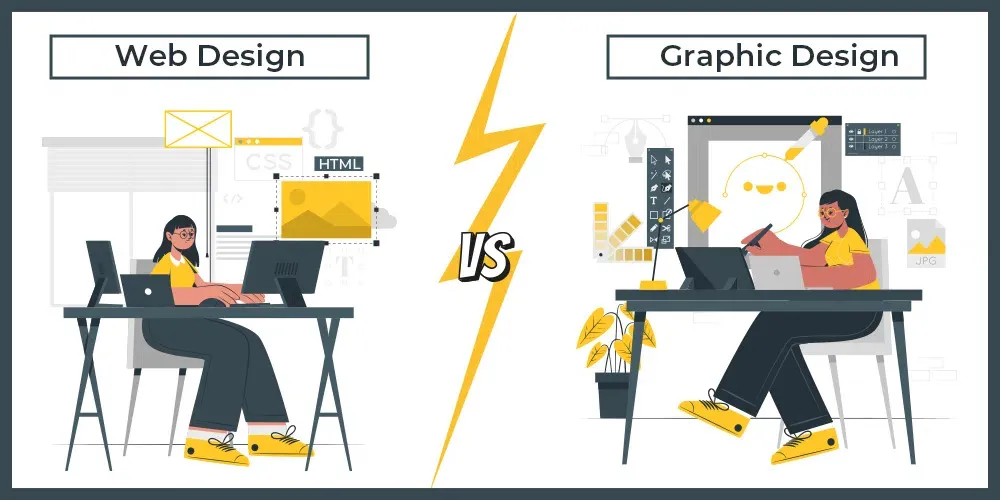

Entering the creative industry through graphic and digital design opens avenues across marketing, software development, multimedia production, and branding. While both disciplines share foundational visual concepts, they serve distinct purposes and require complementary skill sets. Graphic design focuses primarily on visual communication, identity, and print or digital static assets, whereas web design emphasizes interactive user experience, interface logic, and responsive digital frameworks.
Understanding the relationship between visual hierarchy and functional design allows aspiring creators to build portfolios that satisfy real-world commercial standards. Structured training through modern graphic designing courses in Udaipur provides students with hands-on practice in industry workflows, helping them turn basic aesthetic instincts into professional creative production.
Core Pillars of Graphic Design
Graphic design solves communication challenges by arranging typography, imagery, form, and color. Beginners must master core concepts before exploring complex digital software.
- Visual hierarchy establishes the order in which a viewer processes information. Contrast, scale, and positioning guide the viewer's eye from the primary focal point down to secondary details.
- Typography determines how written messages are perceived visually. Designers study font classifications, kerning, leading, tracking, and pairing conventions to ensure both legibility and emotional resonance.
- Color theory explores the emotional and practical impact of palettes. Designers must differentiate between additive RGB models used for digital screens and subtractive CMYK models required for commercial printing.
- Composition and layout rely heavily on systems like the rule of thirds, the golden ratio, and symmetrical or asymmetrical balance to create harmony and structure within a frame.
Fundamentals of Modern Web Design
Web design extends visual design principles into an interactive, dynamic environment. Unlike static canvases, web layouts must function across diverse screen sizes, browsers, and device configurations.
- User Interface (UI) design focuses on the visual components a visitor interacts with, including buttons, forms, typography, menus, and layout grids.
- User Experience (UX) design addresses the overall usability, accessibility, and navigation journey of a site, ensuring users reach their objectives without unnecessary friction.
- Responsive layouts dynamically adapt content to desktop monitors, tablets, and smartphones using flexible grids and fluid image scaling.
- Accessibility standards ensure websites remain usable for individuals with visual, auditory, motor, or cognitive impairments, following international guidelines such as contrast ratio minimums and screen reader compatibility.
Essential Tools for Beginners
Professional designers utilize specialized software suites to produce work that meets technical output specifications. Becoming familiar with these industry standards is an essential step during early career development.
For vector illustration and branding assets, vector-based editors allow scalable artwork creation without loss of clarity. For raster image editing, digital painting, and photo manipulation, raster-based tools remain standard across publishing and advertising pipelines. In the web design and product prototyping space, cloud-based collaborative interface design software enables practitioners to design clickable wireframes, component libraries, and interactive design systems seamlessly.
Gaining structured guidance at a dedicated animation academy in Udaipur gives learners direct exposure to these creative suites under the mentorship of seasoned instructors. Working on guided projects bridges the gap between software literacy and real-world commercial execution.
The Design Process: From Concept to Execution
Professional design projects follow a structured workflow designed to align creative decisions with business objectives. Beginners should cultivate a repeatable methodology rather than jumping directly to final digital rendering.
- Research and discovery: Understand the audience, analyze competitors, outline core project constraints, and define measurable project goals.
- Conceptual sketching and ideation: Brainstorm multiple creative solutions using low-fidelity sketches and mood boards to establish a direction quickly.
- Wireframing and layout drafting: Create grayscale structures to validate visual hierarchy, page flow, and spacing before applying typography or color palettes.
- Digital production and prototyping: Translate approved wireframes into high-fidelity mockups, vector artwork, or clickable prototypes within designated design software.
- Testing, review, and iteration: Gather constructive feedback, conduct usability checks, evaluate readability across devices, and refine assets accordingly.
- Technical handoff and asset export: Prepare production-ready files with correct color spaces, resolution settings, compression formats, and development documentation.
Common Mistakes Beginners Should Avoid
- Overcomplicating compositions by introducing too many contrasting typefaces, saturated colors, or competing graphic elements that distract from the main message.
- Neglecting negative space, which gives visual components room to breathe and prevents layouts from feeling cluttered.
- Designing exclusively for desktop displays while neglecting mobile optimization, leading to broken navigation and poor user engagement.
- Ignoring technical export guidelines, such as delivering RGB files for print production or exporting uncompressed, heavy media files for website deployment.
Building a Professional Creative Career
Success in graphic and web design relies heavily on demonstrable practical ability. While theoretical knowledge forms the bedrock of good taste, employers and prospective clients evaluate candidates based on their portfolio of case studies. Beginner designers should focus on documenting their process, explaining why specific design decisions were made, and illustrating how their visual solutions address specific user problems. Structured training at Arena Animation Udaipur helps students build industry-grade portfolios through practical studio assignments, live project briefs, and technical guidance across multiple creative disciplines.























Sign in to leave a comment.