
With increasing concerns being raised over the escalating air pollution levels and soaring greenhouse gas (GHG) emissions, the deployment of electric vehicles (EVs) is rising sharply across the world. According to the International Energy Agency (IEA), the global electric car industry registered a growth of more than 40% in 2020, with the registration of 3 million electric cars during the year. The increasing deployment of these new energy vehicles is driving the demand for electric vehicle charging stations. In order to encourage the adoption of EVs, the governments of several countries are actively focusing on developing EV charging stations.
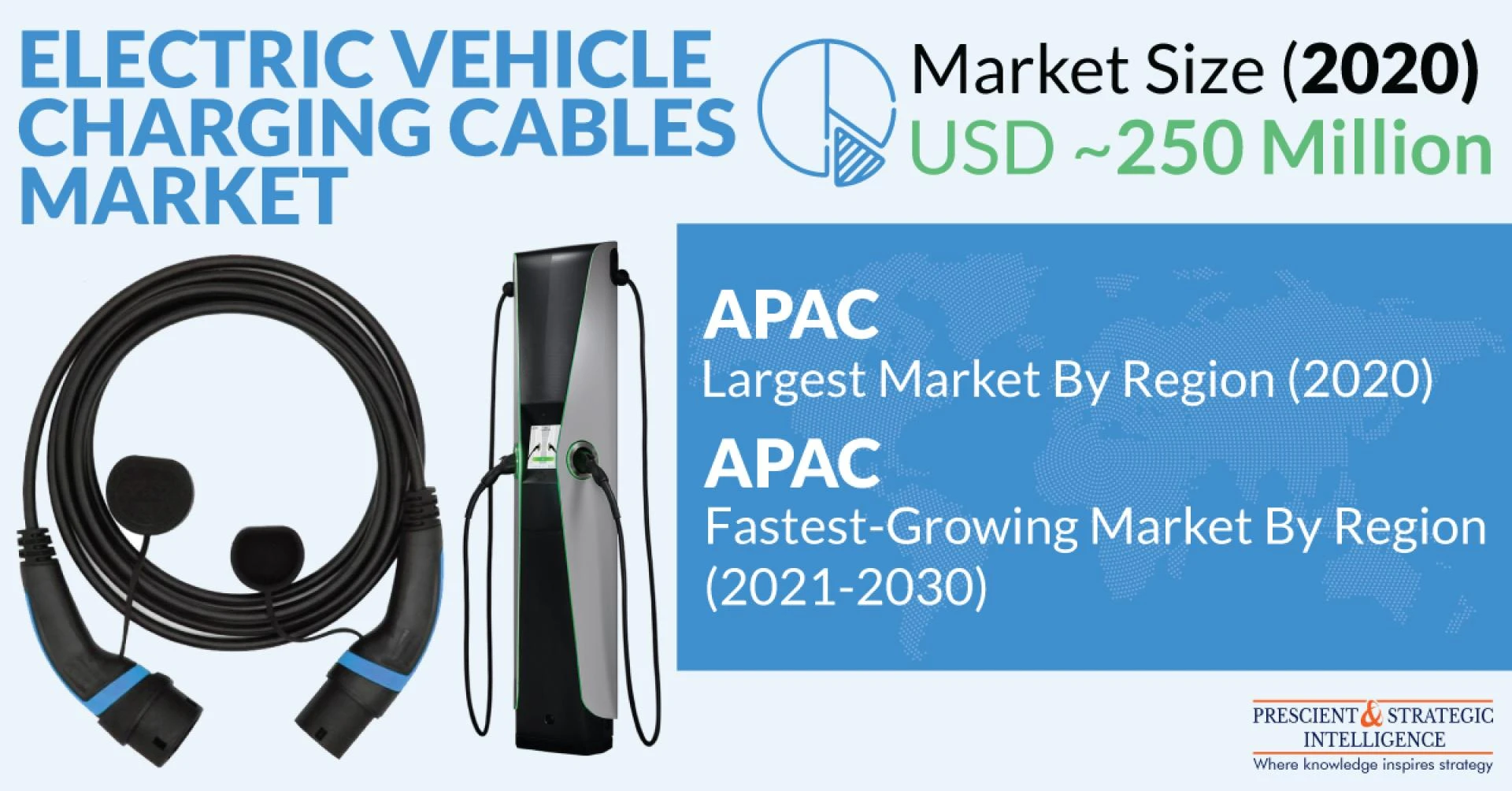
Moreover, the huge investments being made by several governments are propelling the deployment of EV charging stations in public places. As per the IEA, the total number of EV charging points all over the world rose by nearly 44% from 2017 to 2018. The development of EV charging infrastructure is predicted to fuel the expansion of the global electric vehicle (EV) charging cables market in the coming years. Owing to these factors, the market reached a value of $250 million in 2020, and it is predicted to rise significantly between 2021 and 2030 (forecast period).
Depending on power supply, the EV charging cables market is divided into direct current (DC) and alternating current (AC) categories. Between these, the AC category is predicted to contribute higher revenue to the market in the forthcoming years. This is credited to the rapid development of charging infrastructure in various private settings, such as homes and offices. Between coiled and straight charging cables, the demand for the latter was observed to be higher during the last few years, and this trend is expected to continue in the coming years as well.
This will be because of the low maintenance, greater ease of installation, and lower cost of these cables than the coiled variants. Across the globe, the sales of EV charging cables were found to be the highest in the Asia-Pacific (APAC) region in the past. This was because of the expansion of the EV industry in regional countries, such as South Korea, China, and Japan. Furthermore, with South Korea and Japan becoming the epicenters of the EV industry, the region will be the fastest-growing region in the EV charging cables market in the upcoming years, as per the estimates of the market research company, P&S Intelligence.
Moreover, the governments of these countries are providing financial and regulatory support to the buyers and manufacturers of EVs, which is, in turn, supporting the development of EV charging stations and fueling the demand for EV charging cables. In addition, the governments of several countries are launching multiple projects for augmenting the number of public charging stations, which is also predicted to facilitate the expansion of the EV charging cables market in the region in the years to come.
Thus, the sales of EV charging cables will surge all over the world in the forthcoming years, mainly because of the development of EV charging stations, owing to the mushrooming deployment of EVs in several countries.
0























Sign in to leave a comment.