B2B e-commerce has changed significantly in recent years. Buyers now expect the same convenience, speed, and ease of use from business purchasing experiences that they receive from consumer websites. At the same time, B2B companies have to manage complex requirements such as customer-specific pricing, large product catalogs, multiple users, approval processes, recurring orders, and integrations with business systems.
Because of this complexity, choosing the right e-commerce architecture is an important decision. Two approaches that frequently come into consideration are traditional and headless e-commerce platforms.
Both can support successful B2B commerce, but they take very different approaches to building and managing the digital experience. Understanding those differences can help businesses make a more informed decision during e commerce platform development.
What Is a Traditional E-commerce Platform?
A traditional e-commerce platform typically combines the storefront and core commerce functionality within a relatively connected system. Product management, shopping carts, checkout, customer accounts, order management, and other commerce capabilities are generally managed through the same platform.
This approach has been widely used because it provides businesses with a more unified environment. Many capabilities are available out of the box, reducing the amount of custom development required to get a commerce site running.
For B2B companies, this can be particularly useful when their purchasing processes are relatively straightforward or already align with the capabilities offered by the selected platform.
Modern traditional platforms should not be confused with outdated technology. Many now offer APIs, cloud infrastructure, integrations, personalization, analytics, and flexible customization options.
The main difference is that the storefront and commerce backend remain more closely connected than they would in a headless architecture.
What Is a Headless E-commerce Platform?
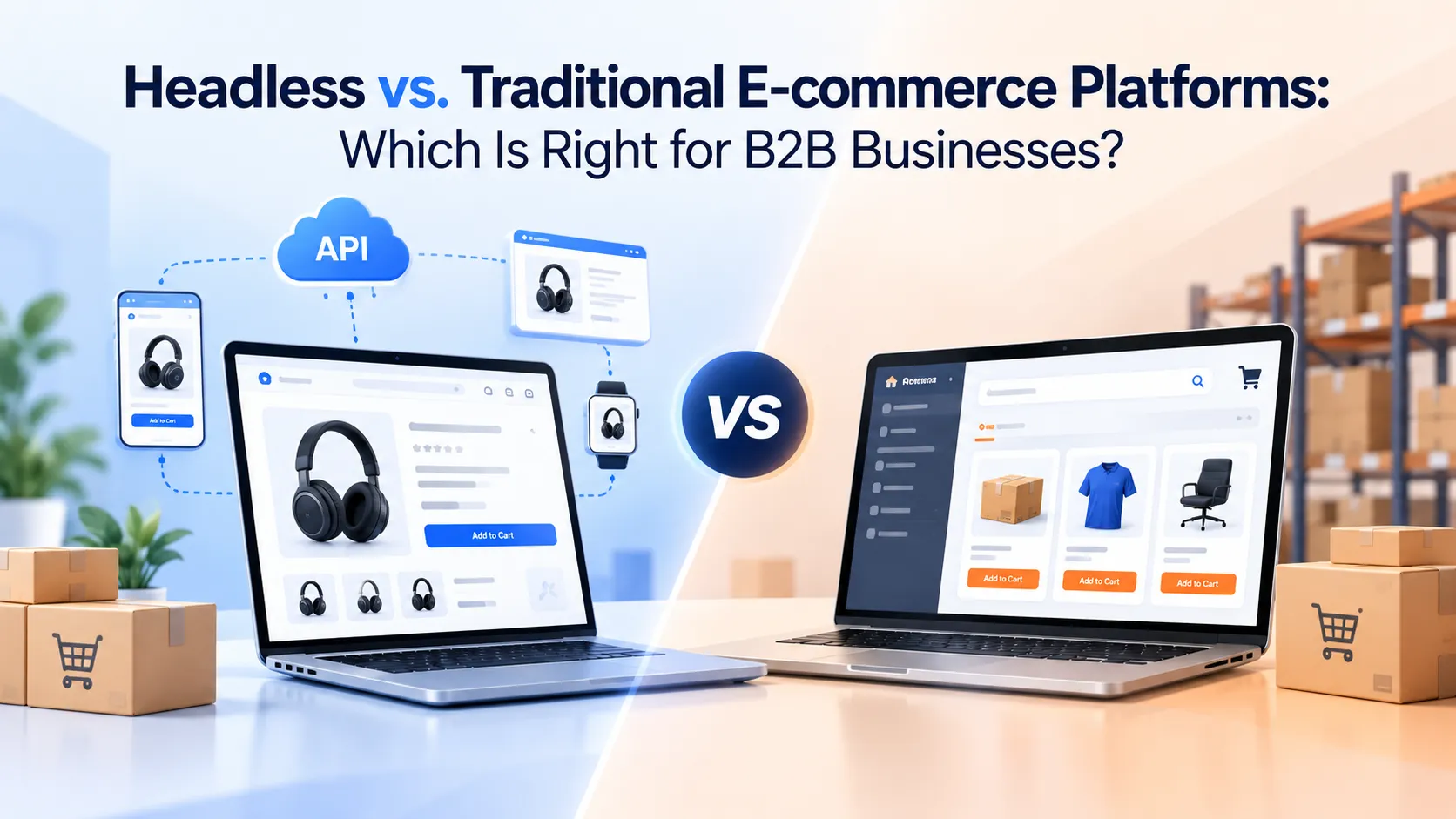
A headless e-commerce platform separates the customer-facing front end from the commerce backend.
The commerce backend continues to manage functions such as products, pricing, customers, carts, orders, and payments. However, the front end is developed independently and communicates with the backend through APIs.
This separation gives businesses much greater freedom when designing the customer experience.
For example, a company could use its commerce backend to support a website, mobile application, customer portal, sales application, or other digital touchpoint without requiring all of these experiences to use the same front-end technology.
Headless architecture can therefore be attractive to businesses that view their digital experience as a key competitive advantage.
However, this flexibility also introduces additional development and maintenance requirements.
Headless vs. Traditional E-commerce: What Is the Difference?
The fundamental difference comes down to how the front end and commerce functionality are connected.
In a traditional platform, the storefront is closely connected to the commerce engine. The platform usually provides a defined framework for managing the customer-facing experience.
With headless architecture, the front end and commerce backend are separated. Developers can build the presentation layer independently while accessing commerce functionality through APIs.
This difference affects how businesses approach design, development, integrations, performance, maintenance, and future digital experiences.
Neither architecture is automatically better. The right option depends on what the business needs from its commerce platform.
Flexibility and Customer Experience
B2B businesses often have unique customer journeys that do not fit neatly into a standard online shopping experience.
A manufacturer may need to display technical specifications and documentation. A distributor may need customer-specific catalogs and pricing. A wholesaler may need bulk ordering, account hierarchies, and customized purchasing workflows.
Traditional platforms can support many of these requirements through built-in functionality, extensions, and customization.
However, businesses may still need to work within the platform's front-end framework.
Headless architecture provides greater freedom because the customer experience can be designed independently of the commerce engine. Businesses can use different front-end technologies and create highly customized interfaces around their specific customer journeys.
This flexibility can be especially valuable when the digital experience itself is a major differentiator.
At the same time, businesses should consider whether they actually need this level of flexibility. A highly customized front end can require more development resources and ongoing maintenance.
Performance and User Experience
Performance is another important consideration for B2B commerce.
Customers may search large catalogs, compare products, review specifications, manage recurring orders, and complete complex purchasing processes. If the experience is slow or difficult to navigate, customers may become frustrated and rely more heavily on traditional sales channels.
Headless architecture can give development teams greater control over front-end performance. Since the presentation layer is separated from the commerce backend, developers can optimize how pages, content, and commerce data are delivered.
However, choosing headless does not automatically make a website faster.
Performance depends on implementation quality, hosting, APIs, caching, front-end development, integrations, and infrastructure. A well-optimized traditional platform can perform better than a poorly implemented headless solution.
The architecture provides opportunities, but execution ultimately determines the customer experience.
Integrations and B2B Commerce
Integrations are particularly important for B2B organizations.
An e-commerce platform may need to exchange information with an ERP, CRM, PIM, warehouse management system, payment provider, logistics platform, customer service software, and other business applications.
Traditional platforms can support these integrations through APIs, extensions, and pre-built connectors. This can make them a practical choice for businesses that have established systems and relatively predictable integration requirements.
Headless architecture is naturally suited to API-driven environments. The separation between front end and backend makes it easier to connect different services without tightly coupling every component to the customer-facing interface.
This can be valuable for organizations moving toward a composable commerce approach or businesses that expect their technology ecosystem to evolve over time.
Supporting Complex B2B Purchasing Processes
B2B buying is rarely as simple as selecting a product and completing a standard checkout.
Customers may need negotiated pricing, purchase orders, credit terms, multiple users, approval workflows, quote requests, bulk ordering, or recurring purchases.
Both traditional and headless platforms can support these requirements.
The key question is how the platform handles the specific processes of the business.
If most requirements are already supported by a traditional platform, choosing a more complex architecture may not provide enough additional value.
On the other hand, businesses with highly customized purchasing journeys may benefit from the flexibility of headless architecture.
The decision should therefore be based on actual customer and operational requirements rather than the popularity of a particular technology approach.
Understanding the Benefits of an E-commerce Platform
Regardless of architecture, the broader e commerce platform benefits come from creating a more connected and efficient digital buying environment.
A well-designed platform can make product discovery easier, reduce manual purchasing tasks, provide customers with self-service capabilities, improve order visibility, and connect online commerce with internal business processes.
For B2B organizations, these benefits can extend beyond the online storefront.
A commerce platform can support sales teams, customer service, marketing, product management, finance, and operations by providing a shared digital environment for managing customer interactions and transactions.
This is why architecture should be evaluated in the context of the overall business strategy rather than treated as a purely technical decision.
How an E-commerce Education Platform Can Use Different Architectures
An e commerce education platform provides an interesting example of how commerce and digital experiences can work together.
Businesses selling online courses, training programs, certifications, memberships, or educational resources may need commerce functionality alongside a learning experience.
A traditional architecture can work well when the commerce and educational experience can be managed within a relatively integrated environment.
A headless approach may be useful when the business wants to separate purchasing functionality from the learning experience. For example, the commerce system could handle products, customers, payments, and transactions while a separate learning platform manages course access and educational content.
The best approach depends on how closely the commerce and learning experiences need to work together and how much customization the business requires.
Scalability and Future Growth
The architecture selected today should also support the organization's future plans.
Traditional platforms can scale successfully when the platform and infrastructure are appropriately designed. For many businesses, this provides a straightforward path to growth without introducing unnecessary technical complexity.
Headless architecture can be attractive for businesses that expect to expand across multiple digital channels.
A company may start with a B2B website and later introduce a mobile application, customer portal, marketplace presence, or other digital experiences. A headless commerce backend can provide a common commerce foundation for these different experiences.
However, future flexibility should be balanced against present requirements. Building a highly complex architecture before the business actually needs it can increase costs and make the technology environment harder to manage.
Development and Maintenance Considerations
The technical requirements of each approach should be carefully considered during e commerce platform development.
Traditional platforms generally provide a more unified environment. This can simplify implementation because developers and administrators work within a single commerce ecosystem.
Headless platforms require more architectural planning. The front end, backend, APIs, integrations, infrastructure, analytics, and monitoring need to work together effectively.
This can provide significant flexibility, but it also means businesses need the right technical expertise.
Organizations should consider who will build and maintain the platform, how future changes will be managed, and whether the internal team has the skills required to support the chosen architecture.
The most flexible technology is not necessarily the most suitable if the organization cannot effectively operate it.
Cost and Total Investment
Cost is another factor that businesses should evaluate carefully.
The total investment in an e-commerce platform includes much more than the initial software or licensing cost. Development, integrations, customization, hosting, maintenance, security, optimization, and future enhancements can all contribute to the overall cost.
Traditional platforms may require less initial development when their existing functionality matches the business requirements.
Headless solutions can require more upfront development because the front end and backend are managed separately. However, the additional investment may be justified when the business needs highly customized experiences or multiple digital channels.
Rather than asking which architecture is cheaper, businesses should consider which approach provides the best long-term value for their specific requirements.
When Is a Traditional E-commerce Platform the Better Choice?
A traditional platform can be a strong option for businesses that want to launch or modernize their B2B commerce operation without adding unnecessary technical complexity.
It may be particularly suitable when the business has well-defined requirements, the platform already supports most required B2B capabilities, and there is no immediate need for highly customized experiences across multiple channels.
For these organizations, a traditional architecture can provide a practical balance between functionality, development effort, maintenance, and cost.
It can also be easier for smaller technical teams to manage because many components are available within a single environment.
When Does Headless E-commerce Make More Sense?
Headless architecture becomes more compelling when a business needs extensive control over the digital customer experience.
Organizations with highly customized interfaces, multiple brands, different digital channels, complex integrations, or rapidly changing front-end requirements may benefit from separating the presentation layer from the commerce backend.
Headless can also be a good fit for businesses adopting composable commerce, where specialized technologies are combined to create a broader digital ecosystem.
However, businesses should not select headless simply because it is considered more modern.
If a traditional platform can meet the organization's requirements effectively, introducing additional architectural complexity may not provide a meaningful advantage.
How Should a B2B Business Choose?
The decision should begin with the customer journey.
Businesses should understand how customers discover products, access pricing, request quotes, place orders, obtain approvals, make payments, and manage repeat purchases.
The existing technology environment should then be evaluated. ERP, CRM, PIM, inventory, payment, logistics, and customer service systems can all influence the most appropriate architecture.
Future plans should also be considered. Businesses expecting expansion into new markets, brands, customer segments, or digital channels may require greater architectural flexibility.
Finally, organizations should evaluate their internal technical capabilities. Headless can provide substantial flexibility, but that flexibility comes with additional development and maintenance responsibilities.
Why Architecture Matters in E-commerce Platform Development
Architecture decisions made during e commerce platform development can influence the business for many years.
The platform needs to provide a foundation for customer experience, operational efficiency, integrations, analytics, security, and future growth.
Choosing an architecture simply because it is popular can create unnecessary complexity. Similarly, choosing a platform only because it is easy to implement today can create limitations as the business grows.
A better approach is to understand the business requirements first and then select the architecture that provides the right balance of flexibility, functionality, cost, and maintainability.
Final Thoughts
Headless and traditional e-commerce platforms can both be effective for B2B businesses.
A traditional platform may be the right choice for organizations that value simplicity, faster implementation, and an integrated commerce environment. Headless architecture may be better suited to businesses that need extensive customization, multiple digital experiences, and greater control over their front-end technology.
The right decision ultimately depends on the company's customers, business processes, existing technology ecosystem, development capabilities, budget, and long-term digital commerce strategy.
There is no universal architecture that works for every B2B organization. The goal should be to choose an approach that solves today's challenges while providing enough flexibility to support tomorrow's opportunities.
Frequently Asked Questions
Is headless e-commerce better than traditional e-commerce for B2B?
Not necessarily. Both approaches can support sophisticated B2B commerce. Headless is generally more suitable when businesses need extensive customization and multi-channel flexibility, while traditional platforms can be a better choice when simplicity and faster implementation are more important.
Is headless e-commerce more expensive?
Headless can require a higher initial investment because the front end and backend are developed and maintained separately. The overall cost depends on the level of customization, integrations, infrastructure, development resources, and long-term requirements.
Can traditional e-commerce platforms support complex B2B requirements?
Yes. Modern traditional platforms can support customer-specific pricing, account management, bulk ordering, quotes, approvals, integrations, and other B2B capabilities. The key consideration is whether the platform can meet the organization's requirements without excessive customization.
What role do APIs play in headless e-commerce?
APIs allow the independently developed front end to communicate with the commerce backend. They can provide access to products, pricing, customer information, carts, orders, payments, and other commerce functionality.
How should a business choose between headless and traditional e-commerce?
Businesses should evaluate their customer experience requirements, existing systems, integrations, development capabilities, budget, scalability needs, and long-term strategy. The best architecture is the one that provides the required functionality without creating unnecessary complexity.
Build the Right B2B Commerce Experience With Neortus
Choosing between headless and traditional e-commerce is only one part of building a successful digital commerce operation. The bigger question is how the technology should support your customers, business processes, and long-term growth.
Neortus helps B2B companies, manufacturers, wholesalers, and other organizations plan, build, and optimize digital commerce experiences around their specific business needs. From platform strategy and architecture to implementation and ongoing optimization, Neortus can help businesses create a commerce foundation that is flexible, scalable, and ready for what's next.





















Sign in to leave a comment.