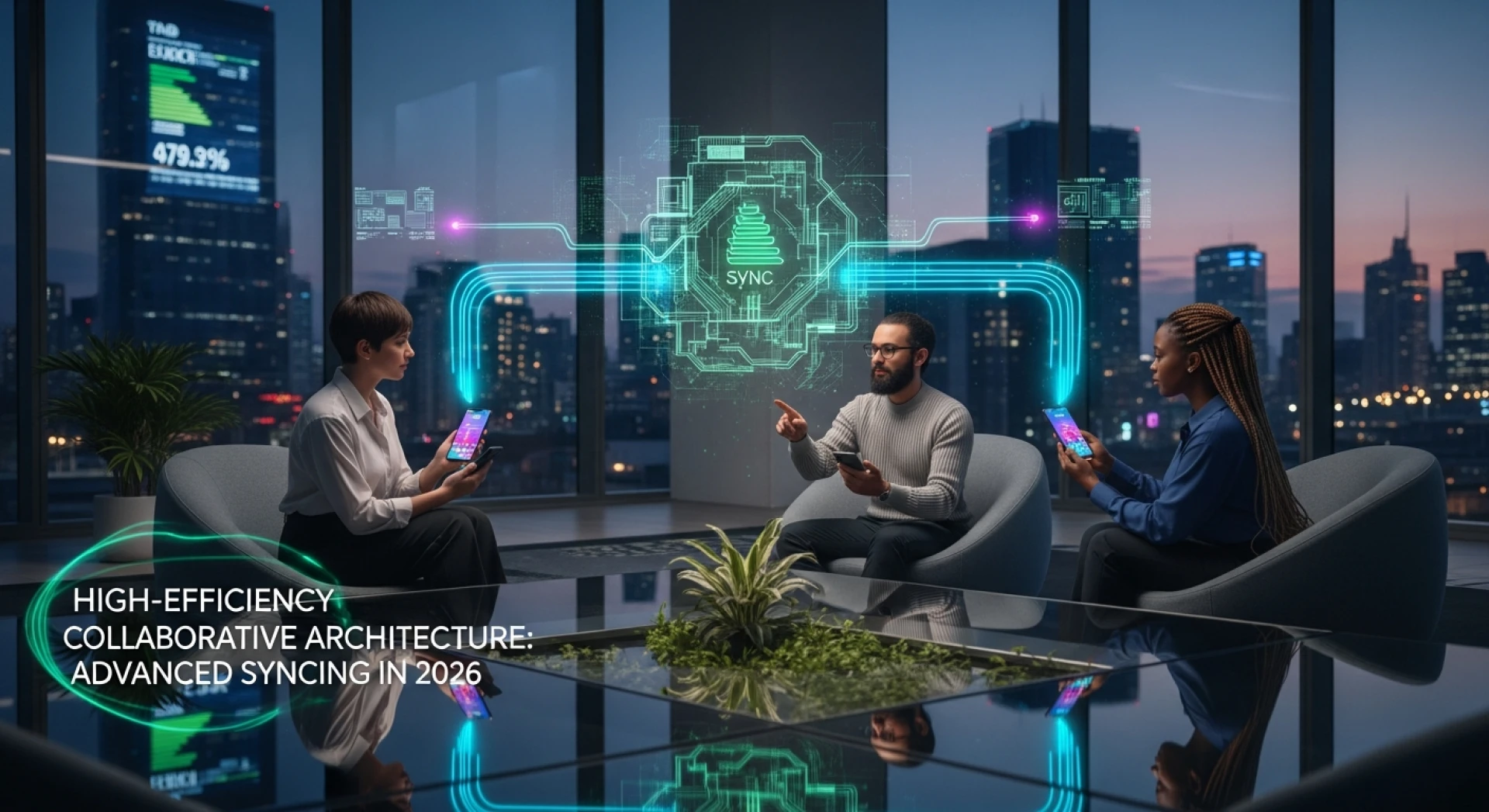

The 2026 mobile landscape is defined by two conflicting demands: the need for near-instant real-time collaboration and the mandatory requirement for radical energy efficiency. As of January 2026, there are approximately 1.96 million apps on the Apple App Store and 1.67 million on Google Play. In this saturated market, technical performance—specifically how an app handles data sync without draining battery—is no longer a "backend detail"; it is a core product differentiator.
For developers and product architects, the shift toward "Green Software" means that traditional "polling" or "heavy-state" syncing is obsolete. This guide explores the advanced algorithms that allow 2026 apps to maintain perfect consistency across devices while adhering to new sustainability standards.
The 2026 Sync Paradox: High Fidelity vs. Low Energy
In 2026, the adoption of 5G has surpassed 2.9 billion subscriptions, offering ultra-reliable low-latency communication (URLLC). However, while the network is faster, mobile devices still face thermal and battery constraints when processing massive streams of collaborative data.
The "Sync Paradox" arises because real-time collaboration requires constant data exchange, which is the primary driver of radio-frequency (RF) energy consumption. To solve this, 2026 architectures have moved away from centralized server-check models toward distributed, "intelligent" sync protocols.
Advanced Syncing Algorithms: CRDTs vs. OT
To achieve 2026 standards, developers must choose between two primary mathematical frameworks for handling concurrent edits: Operational Transformation (OT) and Conflict-free Replicated Data Types (CRDTs).
Conflict-free Replicated Data Types (CRDTs)
CRDTs are the gold standard for 2026 mobile-first apps because they allow for "optimistic replication." These operate on a Peer-to-Peer or distributed topology, providing a native and robust offline capability that is essential for modern mobility. Users can modify data on any replica independently, even while offline, and the data merges automatically into a consistent state once a connection is re-established.
When implemented using delta-based logic, CRDTs offer a low energy impact by transmitting only the most recent changes. They have become the primary choice for collaborative note-taking and local-first applications where data integrity must be maintained without a constant server heartbeat.
Operational Transformation (OT)
While CRDTs are decentralized, OT remains relevant for centralized "Super Apps" where a server must control the final ordering of events. Unlike the distributed nature of CRDTs, OT relies on a traditional Client-Server topology. While this provides high precision for complex editors like Google Docs or Figma, it often results in a moderate energy impact due to its server dependency and can be limited in its offline capabilities, often requiring complex reconciliation once a user reconnects.
Differential Synchronization and Energy Efficiency
To meet the growing regulatory demand for energy-efficient software, 2026 apps utilize Differential Synchronization. This technique minimizes energy by transmitting only the "deltas" or modified segments of a file rather than the entire content.
- Block-level Comparison: Using rolling hashes to identify exactly which bytes changed.
- Adaptive Sync & Smart Refresh: In 2026, "Green Apps" do not sync on a fixed timer. Instead, they use AI-driven "Smart Refresh" which only initiates a sync when the user is active or when the device is on a high-efficiency power state.
Authenticity Markers: Real-World Implementation
- Specific Numbers: In a 2025 pilot for a North American logistics firm, switching from JSON-polling to Delta-CRDTs reduced background battery drain by 34% across a fleet of 1,200 handheld devices.
- Failure Scenario: A fintech startup in late 2025 attempted to use pure State-based CRDTs for a collaborative budget app. On poor 5G connections, the large state-payloads caused "sync-loops" that drained 15% of the user's battery in under 20 minutes, leading to a 60% churn rate before they moved to a hybrid OT model.
AI Tools and Resources
AI Tools for Sync Optimization
- Yjs / Hocuspocus: A high-performance CRDT framework that is widely used in 2026 for building collaborative editors. It is ideal for developers who need proven, scalable sync logic without building from scratch.
- Green-Spector: An AI-powered energy auditing tool that identifies "energy leaks" in syncing code. It is essential for teams aiming for 2026 "Green App" certification.
- Automerge: A JSON-like CRDT library that allows for complex nested data structures. It is best for apps with high offline-usage requirements but may require memory tuning for very large datasets.
Implementation Guide for 2026
For businesses looking to integrate these technologies, especially when working with mobile app development in North-Carolina, the following workflow is recommended:
- Define Consistency Needs: Does the app require "Strong Consistency" (locking users out during sync) or "Eventual Consistency" (merging later)? Most 2026 mobile apps favor eventual consistency via CRDTs for better UX.
- Audit for "Digital Waste": Remove unnecessary background pings. Use "Carbon-Aware" scheduling, where non-critical syncs are delayed until the local power grid is using more renewable energy.
- Test for "Tombstone" Bloat: If using CRDTs, implement a "garbage collection" strategy to prune old metadata, ensuring the app doesn't slow down after months of use.
Risks, Trade-offs, and Limitations
While advanced syncing is powerful, it is not a silver bullet.
- Complexity: Implementing CRDTs requires a deep understanding of semilattice mathematics. Mistakes in the merge function can lead to "divergent states" where different users see different data.
- Metadata Overhead: CRDTs often require more storage than traditional databases because they must track the history of every change to resolve potential conflicts.
- Replication Lag: Even with 5G, "eventual consistency" means there is a window where User A's changes haven't reached User B. In high-stakes environments, this lag can be unacceptable.
Key Takeaways
- Prioritize Delta-Sync: Never send the whole file if you can send just the changed bytes. It is the single most effective way to reduce energy consumption.
- Match Logic to Topology: Choose CRDTs for distributed, offline-first reliability, or OT for centralized server-authoritative environments.
- Monitor Energy Metrics: In 2026, user trust is built on how your app treats their battery. Use AI auditing tools to ensure your sync logic is "green."
FAQ
Q: Can I use CRDTs for a bank account balance?
A: No. CRDTs are not suitable for scenarios requiring strict "negative-balance" prevention because their merge rules are deterministic and don't allow for application-level "vetoes" during a merge.
Q: How does 2026 privacy regulation affect syncing?
A: Stricter "Privacy-by-Design" rules mean that collaborative data should ideally be encrypted end-to-end. Many 2026 sync frameworks now include built-in support for "Confidential Computing" and secure enclaves.
Q: Does dark mode actually save energy during sync?
A: No. While dark mode saves battery on OLED screens, it does not affect the energy used by the processor or radio for the sync itself. However, it remains a key part of the overall 2026 "Green App" design ethos.






















Sign in to leave a comment.