
Choosing the right design partner can affect a hardware product timeline. Whether you're building a medical device, an industrial controller, or a high-speed communications system, the team you hire requires more than general engineering skills.
However, the team needs specific expertise in the technologies your product depends on. The following are questions worth asking before you sign on with anyone.
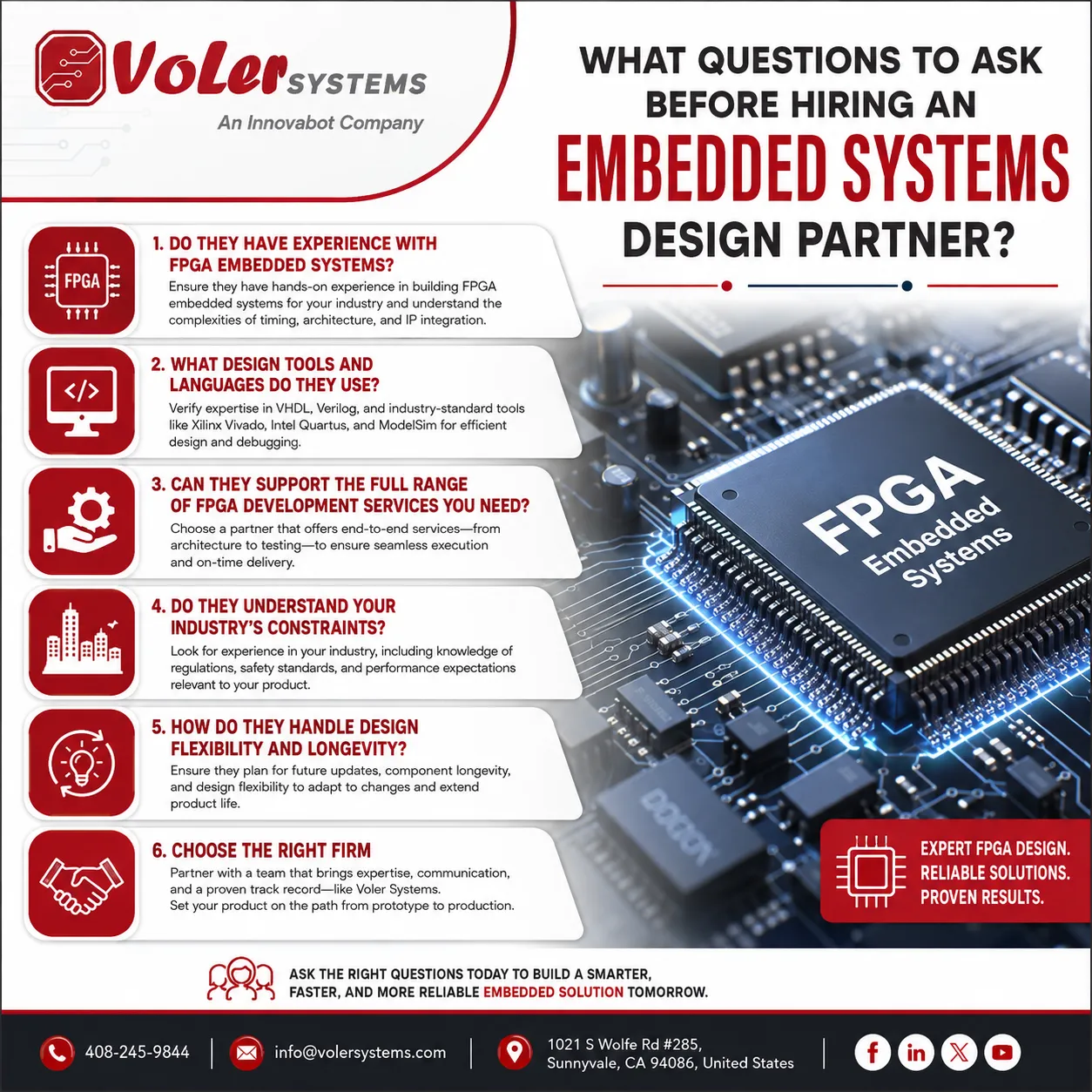
Do They Have Experience with FPGA Embedded Systems?
Not every embedded design firm often works with programmable logic. If your product depends on parallel processing, high-speed data handling, or custom hardware acceleration, you need a partner with genuine, hands-on experience building FPGA embedded systems.
However, it’s not just general microcontroller work. You can ask for specific past projects, target industries, and the FPGA vendors they've worked with (Xilinx, Intel/Altera, and Microchip/Microsemi are common benchmarks). A team that's dabbled in FPGA design will struggle with the nuances of timing constraints, parallel architecture, and IP integration that come with the territory.
What Design Tools and Languages Do They Use?
The right tool chain is as essential as the right people. Ask whether the team is fluent in VHDL and Verilog, and whether they frequently work in industry-standard environments like Xilinx Vivado, Xilinx ISE, Intel Quartus, and ModelSim. A partner familiar with these tools can move faster, debug more efficiently, and avoid costly rework later in the process.
Can They Support the Full Range of FPGA Development Services You Need?
Some firms handle only isolated parts of a project, such as architecture, but not verification, coding, or system integration. Before committing, you can confirm the partner can offer complete FPGA development services. Their offerings cover everything from architecture development and design optimization to hardware/software integration and testing. A partner who can handle a project from concept through production reduces the risk of miscommunication between multiple vendors and keeps your timeline intact.
Do They Understand Your Industry's Constraints?
FPGA-based products span an enormous range, including video imaging, aerospace, automotive computing, medical devices, and high-speed networking, to name a few. Every industry comes with its own regulatory, safety, and performance requirements. A design partner with experience in your specific space will already understand things like documentation standards for medical devices or the reliability expectations in aerospace and defense. You can ask for case studies or references that closely resemble your product type.
How Do They Handle Design Flexibility and Longevity?
One significant advantage of FPGAs over ASICs is the ability to reconfigure designs after deployment. A noteworthy partner should be able to explain how they build in flexibility for future updates, how they plan for component longevity in low- to medium-volume production, and how they balance performance against cost and power constraints. This foresight can help you save significant time and money if your product needs revisions down the road.
Choosing the Right Firm
The right embedded systems partner brings judgment, communication, and a track record that matches your product's demands. Firms like Voler Systems specialize in FPGA embedded systems across medical, industrial, and high-speed applications. They illustrate what to look for, such as broad tool expertise, cross-industry experience, and the ability to support a project end-to-end.
Asking these questions up front can save you from costly missteps later and set your product on a smoother path from prototype to production.




























Sign in to leave a comment.