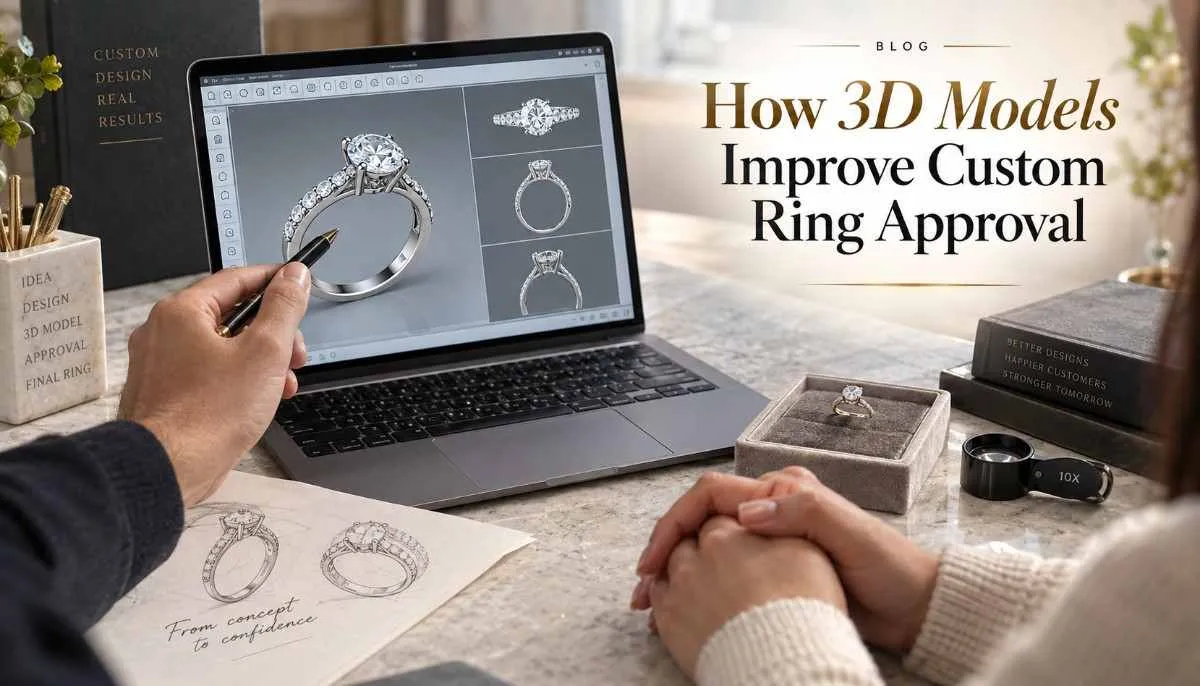

A customer approving a custom ring based on a hand-drawn sketch or a verbal description is, in practical terms, approving their own mental interpretation of what that piece will look like, not the actual finished design. That gap between imagination and final product has historically been one of the biggest sources of costly rework, disappointed customers, and delayed timelines in custom jewelry production. 3D modelling closes that gap almost entirely, and it's changed what a reliable custom approval process looks like.
The Approval Problem 3D Models Actually Solve
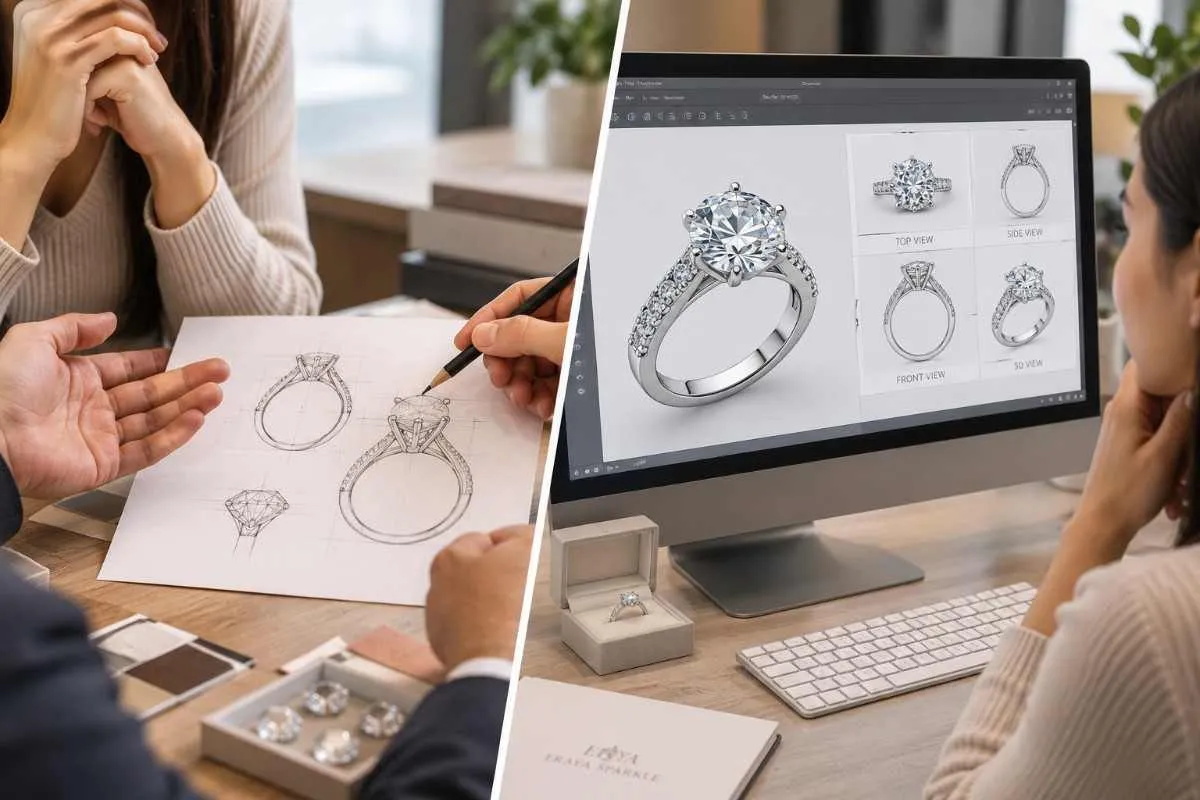
Traditional custom ring approval relied heavily on sketches, verbal descriptions, or at best a rough physical mockup, none of which accurately convey how light will interact with a specific stone shape, how proportions will actually read at true scale, or how a design will look from angles the customer hasn't specifically thought to ask about.
This ambiguity created a specific, recurring business problem: customers approving something based on an incomplete mental picture, then requesting changes once the finished piece revealed details the approval process never actually communicated clearly. Every one of those post-approval changes costs time, materials, and customer trust, exactly the outcomes a stronger approval process is meant to prevent in the first place.
What a 3D Model Actually Shows That a Sketch Cannot
A rendered 3D model displays true proportional scale, accurate light behaviors based on the actual stone shape and cut being proposed, and a fully rotatable view from any angle, details a two-dimensional sketch simply cannot communicate regardless of how skilled the illustrator is.
This matters enormously for custom rings specifically, where small proportional decisions, prong height, band width relative to center stone size, how a halo's accent stones relate visually to the center diamond, significantly affect the finished piece's appearance in ways that are genuinely difficult to judge from a flat illustration or written description alone.
Reducing Post-Approval Revisions Through Accurate Previews

The single biggest business benefit of 3D modelling in custom ring production is the dramatic reduction in post-approval revision requests, since customers are approving an accurate representation of the actual finished piece rather than their own best guess based on incomplete information.
This reduction in revisions compounds across a business's entire custom order volume. Fewer post-approval changes mean fewer instances of reworking already-cut metal or resetting already-mounted stones, both considerably more expensive and time-consuming than adjusting a digital model before physical production ever begins. A discrepancy caught and corrected in a 3D model costs a fraction of the same discrepancy caught after physical fabrication has started.
How This Changes the Customer Conversation
Beyond the technical accuracy, 3D models fundamentally change the nature of the approval of conversation itself. Instead of a jewelers trying to translate a customer's verbal preferences into a design and hoping the interpretation matches what the customer actually pictured, the customer can respond directly to an accurate visual representation, adjust specific details in real time, and arrive at genuine, informed approval rather than approval based on assumption.
This shift particularly benefits customers less familiar with jeweler's design terminology, who may struggle to articulate exactly what they want verbally but can immediately recognize whether a rendered model matches their vision once they see it directly.
Mounting-Specific Benefits of 3D Modelling

Mounting design specifically benefits from 3D modelling in ways worth highlighting separately from stone-setting visualization. A rendered mounting model shows prong placement, band proportions, and structural details with a level of precision that helps both the customer and the production team confirm the design will perform as intended before any metal is cut.
Working with jewel mounts that already include accurate 3D modelling as part of the design and ordering process removes a significant layer of ambiguity from custom orders built around those mounting styles, since both the retailer and end customer can review the exact proportional relationship between mounting and stone before committing to production.
Integrating 3D Models into an Existing Custom Order Workflow
Adopting 3D modelling doesn't require rebuilding an entire custom order process from scratch. A few specific integration points tend to deliver the most value.
- Generate a model immediately after initial design consultation, before any material sourcing or production begins, ensuring the foundational design is fully approved while changes remain essentially free to make.
- Use the model as the explicit approval document, requiring customer to sign-off on the specific rendered version rather than a general verbal agreement, which also protects the business if a dispute arises later about what was approved.
- Revisit the model after any specification change, even minor ones, rather than assuming a small adjustment doesn't warrant re-confirmation, since customer expectations can shift meaningfully even with seemingly small changes.
- Archive approved models with the corresponding order, creating a clear record that protects both the business and the customer if any questions arise during or after production.
Why This Matters More for Complex or Unconventional Designs
The value of 3D modelling scales directly with design complexity. A simple, standard solitaire benefits from accurate preview, but a more unconventional design, an east-west setting, a Toi et Moi two-stone arrangement, or a heavily customized halo, benefits dramatically more, since these designs are precisely where verbal description and simple sketches struggle most to convey the actual finished result accurately.
For businesses regularly fielding requests for more distinctive, non-standard designs, 3D modelling isn't simply a nice-to-have convenience, it's frequently the difference between a smooth, single-round approval process and a frustrating cycle of revisions driven by miscommunication rather than genuine design disagreement.
Evaluating Whether a Supplier Supports This Process Well
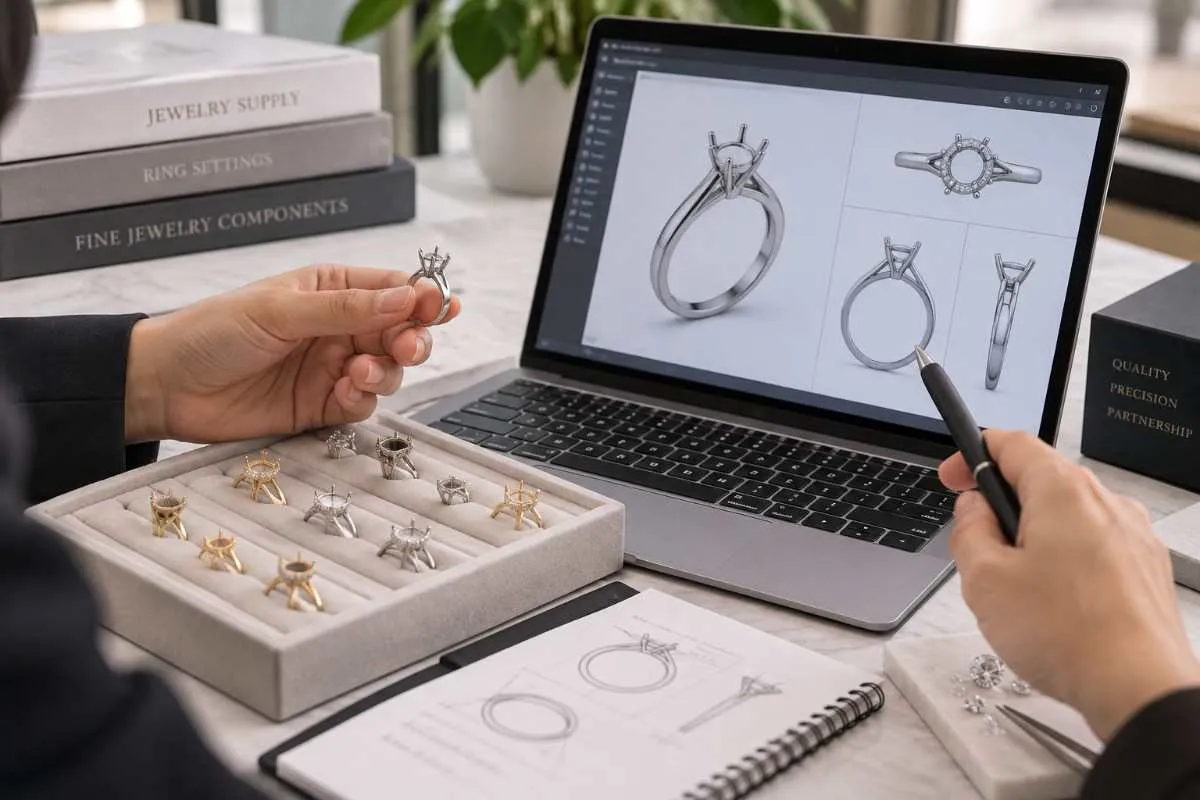
When sourcing mounting components for custom work, it's worth confirming a supplier's catalog and ordering process genuinely supports accurate 3D visualization, rather than treating digital modelling as a separate, disconnected service layered awkwardly on top of standard ordering.
You can explore mounting collections build with this kind of integrated design and visualization process in mind, where mounting specifications translate directly and accurately into the 3D models used for customer approval, rather than requiring separate reconciliation between what's ordered and what's actually modelled for the customer.
Frequently Asked Questions
1.How does 3D modelling actually reduce costs in custom ring production?
Ans. By catching design discrepancies before physical production begins, 3D models prevent the far more expensive rework required when a finished piece doesn't match what a customer expected based on a sketch or verbal description.
2. Is 3D modelling only useful for complex or unusual ring designs?
Ans. No, though the value increases significantly with complexity. Even standard designs benefit from accurate proportional preview, but unconventional settings see the most dramatic reduction in miscommunication and revision requests.
3. Does using 3D models slow down the custom order process?
Ans. Generally, not overall, since the time spent generating and reviewing a model upfront is typically far less than the time lost to post-approval revisions and rework that occur without an accurate preview step.
4. Can 3D models help protect a business from customer disputes?
Ans. Yes. An archived, customer-approved 3D model serves as a clear record of exactly what was agreed to, which can help resolve any disagreement about design expectations that arise during or after production.
5. What should retailers look for in a mounting supplier regarding 3D modelling?
Ans. A supplier whose mounting specifications translate directly and accurately into the 3D models used for customer approval, rather than requiring separate reconciliation between the ordered components and what's shown to the customer.
The Bottom Line
3D modelling has changed custom ring approval from a process built on interpretation and guesswork into one built on accurate, confirmed visual agreement between the business and the customer. The reduction in post-approval revisions alone justifies the investment for most custom-focused jewelry businesses, and the benefit only grows with design complexity. Businesses that integrate accurate 3D visualization directly into their approval workflow, and that source mounting components from suppliers who support this process well, consistently see smoother approvals, fewer costly revisions, and stronger customer trust throughout the custom design process.
Frequently Asked Questions
How does 3D modelling help in reducing costs for custom ring production?
3D modelling reduces costs by identifying design discrepancies before physical production starts. This prevents the expensive rework that occurs when a finished piece does not match customer expectations based on sketches or verbal descriptions.
Is 3D modelling beneficial for all types of ring designs?
Yes, 3D modelling is beneficial for both standard and complex ring designs. While its advantages are more pronounced with unconventional designs, even simple rings benefit from accurate proportional previews that help clarify expectations.
Will using 3D models slow down the custom order approval process?
Typically, no. The time invested in creating and reviewing a 3D model is usually far less than the time lost due to post-approval revisions and rework that occur without an accurate preview step.
How can 3D models assist in avoiding customer disputes?
3D models serve as a documented record of the agreed-upon design, which can be vital in resolving disputes. When a customer approves a model, it clearly outlines expectations and can clarify any disagreements during or after production.
What should retailers consider when choosing a mounting supplier for 3D modelling?
Retailers should look for suppliers whose mounting specifications seamlessly translate into accurate 3D models. This integration ensures that the models used for customer approval reflect the actual components ordered, minimizing potential discrepancies.
Can 3D modelling improve communication between jewelers and customers?
Absolutely. 3D modelling enhances communication by providing customers with a clear visual representation of their design, allowing for real-time adjustments and informed approval, rather than relying on interpretations of sketches or descriptions.
What impact does 3D modelling have on the approval process for complex designs?
For complex designs, 3D modelling significantly reduces misunderstandings and revision requests. It provides a detailed visual that accurately conveys intricate details, which are often difficult to communicate through sketches alone.
























Sign in to leave a comment.