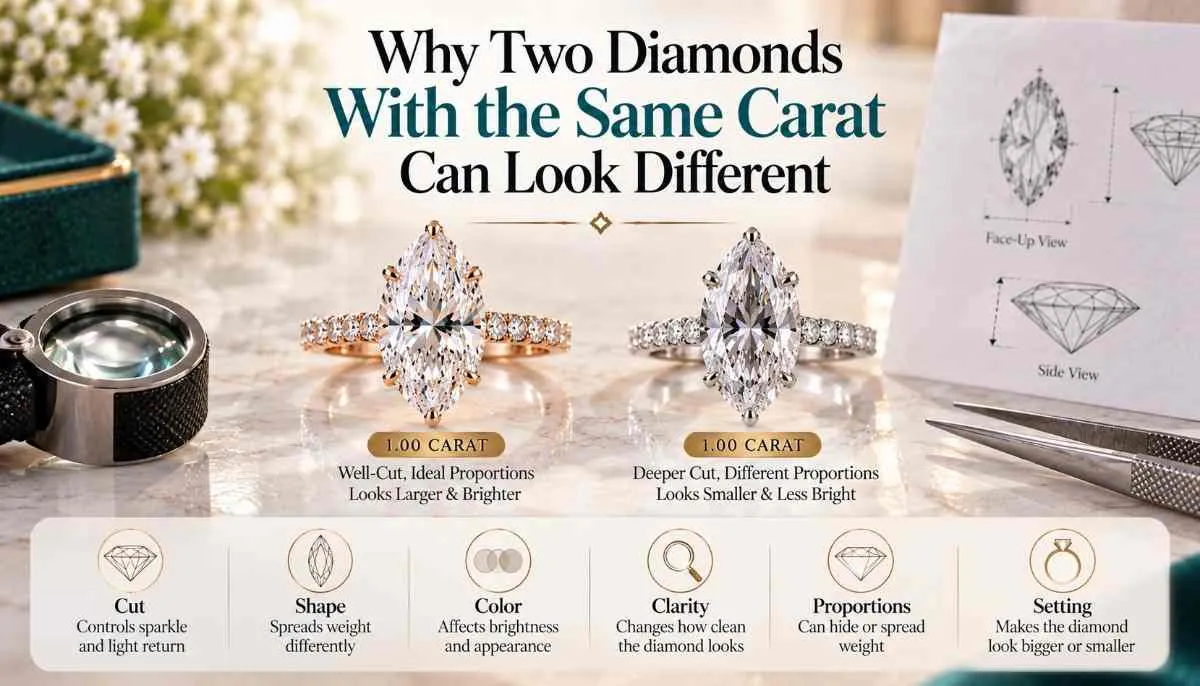

You hold two diamonds that both weigh 1.00 carat. One looks bright and lively. The other looks smaller and a little flat. The price may differ too. This confuses many buyers and even some new jewelers.
The reason is simple: carat measures weight, not appearance. Diamonds with the same carat can differ in cut, shape, color, clarity and proportions, and the setting changes how each stone looks on the hand. This guide explains each factor in plain English so you can judge a diamond by how it looks, not just by one number.
Quick Answer
Why can two diamonds with the same carat look different?
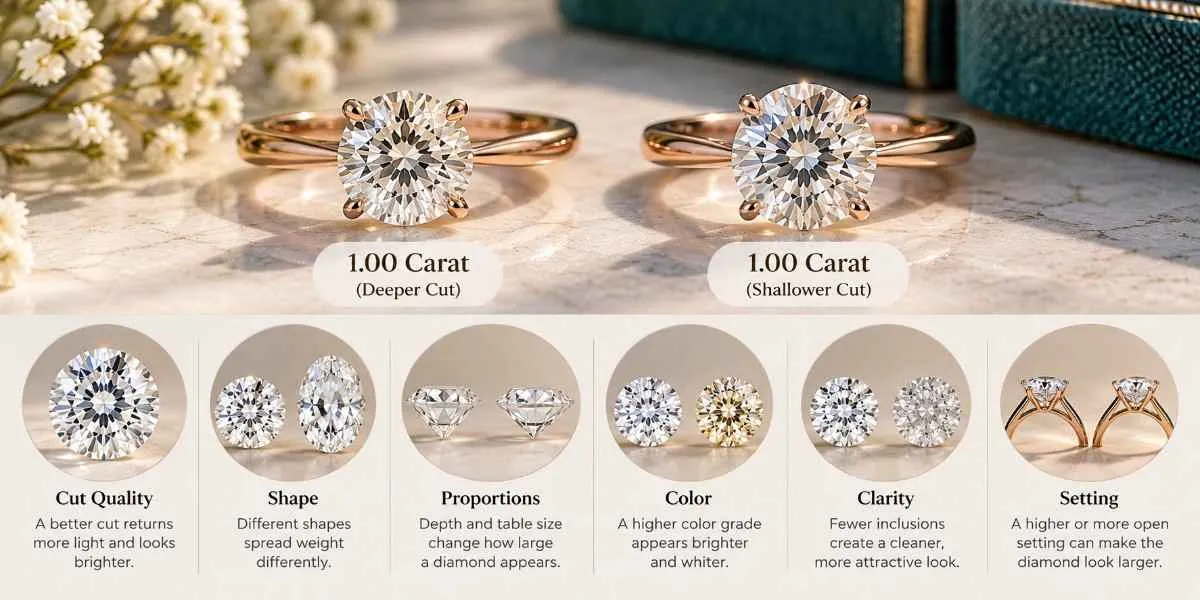
Carat measures only weight. Cut quality, shape, proportions, color, clarity and the setting all change how large and bright a diamond looks. Two stones of equal weight can spread that weight differently, return light differently and show tint or inclusions differently.
What Carat Actually Measures
A carat is a unit of weight. One carat equals 0.2 grams. It says nothing about width, brilliance or color.
Think of two bags of flour that weigh the same. One bag can be tall and narrow, and the other short and wide. The weight matches, but the shape does not.
Diamonds work the same way. Weight can sit in the depth of the stone, where nobody sees it, or across the top, where everybody does.
Cut Changes Sparkle and Visual Size
Cut describes how well a diamond's facets are angled, proportioned and polished. It controls light return, which is the light that bounces back up through the top of the stone. Strong light return creates brilliance and sparkle.
A well-cut diamond acts like a mirror. Light enters, reflects inside and exits through the top. A poorly cut diamond lets light leak out of the sides or bottom. The stone looks dull, even if its color and clarity grades are high.
Cut also affects visual size. A stone cut too deep hides weight below the surface. A stone cut too shallow may look wide but lifeless.
Two cut details matter most:
- Table size: the flat top facet. A very small or very large table can change how light behaves.
- Depth percentage: the stone's height compared to its width. Extreme numbers often signal weight hiding in the wrong place.
Shape Changes How Large a Diamond Looks

Shape is the outline of the diamond seen from above. It is not the same as cut. A round diamond and an oval diamond can both be well cut or badly cut.
Shape matters here because each outline spreads weight differently. A 1.00 carat round diamond measures roughly 6.4 mm across. An oval or marquise of the same weight can show more surface area from the top, so it often looks larger.
| Shape | How it tends to look at the same carat |
| Round | Compact outline, strong sparkle |
| Oval | Often looks larger, elongated |
| Marquise | Long and narrow, high surface area |
| Pear | Larger look, softer outline |
| Cushion | Smaller face-up, soft corners |
| Emerald | Wide, glassy, steps show clarity easily |
Always check the millimeter measurements on the grading report. They tell you more about visual size than carat weight does.
Color Affects How Bright a Diamond Appears
Color grading measures how colorless a white diamond is. Less color usually costs more. A stone with a slight yellow or brown tint can look warmer and less bright next to a more colorless one.
Tint shows more in some places than others. Large stones and certain shapes reveal color more easily. Yellow gold can mask a slight tint, while white metals may highlight it.
When you compare two stones, view them side by side in the same light. A difference that seems small on paper can look obvious in person, and the opposite can happen too.
Clarity Changes Clean Looks and Transparency

Clarity describes small marks inside or on the surface of a diamond. Most grades below the top levels hide these marks from the naked eye.
Still, two stones with different clarity grades can look different in practical ways:
- Inclusion position: a mark near the center is easier to see than one near the edge.
- Inclusion type: a cloudy area can reduce diamond transparency and make the stone look hazy.
- Shape: step cuts like emerald show inclusions more readily than brilliant cuts.
Ask whether a stone is "eye-clean," which means you can't see flaws at a normal viewing distance. An eye-clean diamond at a lower grade can look identical to a higher grade at a lower price.
Polish, Symmetry and Fluorescence
Two smaller details can also shift appearance.
Polish and symmetry describe the finish and the alignment of facets. Weak grades can scatter light and soften sparkle.
Fluorescence is the glow some diamonds show under ultraviolet light. In most everyday lighting you won't notice it. In rare cases, strong fluorescence can make a stone look slightly hazy. Check the report and view the stone in person or on video when possible.
The Setting Can Make a Diamond Look Bigger or Smaller

The same diamond looks different in different settings. The mounting frames the stone, and that frame changes visual size, balance and comfort.
- Solitaire: a plain band keeps all the attention on the diamond.
- Halo: small stones around the center add sparkle and make the center stone look bigger.
- Bezel: a metal rim holds the stone securely. It can slightly reduce how much of the diamond shows.
- Prong height: a high setting shows more of the stone's side. A low setting sits closer to the finger.
- Band thickness: a thin band makes a stone look larger. A thick band can make it look smaller by comparison.
Metal color matters too. White metals can bring out a stone's brightness. Yellow and rose gold add warmth that can soften a slight tint.
For jewelers and designers, mounting choice matters just as much. A mounting must match the stone's actual dimensions, not only its weight. If you source mountings separately, you can explore Ring Mounting designs for center stones, or review Gents Ring Mounting styles when you build a men's piece. Always confirm the stone's millimeter size against the mounting's seat before you commit.
Do Lab-Grown and Natural Diamonds Differ at the Same Carat?
A lab-grown diamond and a natural diamond of equal weight share the same carat measure. Both go through the same grading scale for cut, color and clarity. The same rules apply: weight alone does not tell you how the stone looks.
The difference is origin, and sometimes price. Compare each stone on its own grades and measurements, whichever origin you choose.
How to Compare Diamonds With the Same Carat

Use this short process whenever two stones share a weight:
- Compare cut grades. Choose the stronger cut if you only change one thing.
- Check millimeter measurements. Pick the stone with the size you want to see.
- Compare color and clarity. Look for grades you can't distinguish by eye.
- Look at depth and table numbers. Avoid extremes unless the report explains them.
- View both stones in the same lighting. Photos can mislead.
- Match the mounting to the stone. Check seat size, prong style and band width.
Common Mistakes When Buying by Carat
- Treating carat as size. Weight does not equal width.
- Skipping the grading report. Without it, you rely on description alone.
- Ignoring cut. It has the biggest effect on sparkle.
- Judging from photos only. Lighting and zoom change how stones look.
- Choosing the setting last. The mounting changes visual size and balance.
Questions Buyers Often Ask
Why does one 1-carat diamond look smaller than another?
Ans. Weight can sit in different places. A deep cut hides weight below the surface, while a shallower, well-proportioned cut spreads it across the top. Shape matters too, since ovals and marquise stones often show more surface area than rounds of equal weight.
Does a higher carat weight always mean a better diamond?
Ans. No. Carat measures weight only. A larger stone with a weak cut can look duller than a smaller, well-cut diamond. Compare cut, color, clarity and measurements before you decide.
How can I tell which diamond looks bigger?
Ans. Check the length and width in millimeters on the grading report. A larger face-up measurement usually means a larger look from above. Viewing both stones side by side confirms it.
Does the setting change how big a diamond looks?
Ans. Yes. A halo, a thin band or a high prong setting can make the same stone look larger. A bezel or thick band can make it look smaller.
Do lab-grown diamonds follow the same carat rules?
Ans. Yes. Carat measures weight for lab-grown and natural diamonds alike. Cut, color and clarity decide how each stone looks.
Conclusion
Diamonds with the same carat can look very different because weight is only one part of the picture. Cut, shape, color, clarity and setting all shape what you see. Read the report, check the millimeter measurements and compare stones in the same light.
If you're planning a custom piece or sourcing for a collection, you can Explore Mounting Collections to find settings that suit your stones.
Frequently Asked Questions
Why can two diamonds with the same carat look different?
Two diamonds with the same carat can appear different due to factors like cut, shape, color, and clarity. While carat measures weight, the distribution of that weight and how well a diamond is cut can significantly affect its visual appearance.
What does carat actually measure in diamonds?
Carat is a unit of weight, with one carat equaling 0.2 grams. It does not indicate the size or appearance of the diamond, much like two bags of flour can weigh the same but have different shapes.
How does the cut of a diamond affect its appearance?
The cut of a diamond determines how well its facets reflect light, which influences its brilliance and sparkle. A well-cut diamond will return light effectively, making it appear more vibrant, while a poorly cut diamond may look dull, even if it has high color and clarity grades.
Can the setting of a diamond impact how large it looks?
Yes, the setting can greatly influence how a diamond appears. A halo setting or a thin band can make a diamond look larger, while a bezel setting or a thick band can visually reduce its size.
Do lab-grown diamonds follow the same carat rules as natural diamonds?
Yes, lab-grown diamonds and natural diamonds share the same carat measurement rules. Carat measures weight for both types, and their appearance is determined by factors such as cut, color, and clarity.
How can I determine which diamond looks bigger?
To determine which diamond looks bigger, check the millimeter measurements on the grading report. Comparing the length and width side by side will give you a clearer idea of how they appear from above.
What common mistakes should I avoid when buying diamonds by carat?
Common mistakes include treating carat as a measure of size, skipping the grading report, ignoring the importance of cut, and judging only from photos. Always consider cut, color, clarity, and the setting when making your choice.




















Sign in to leave a comment.