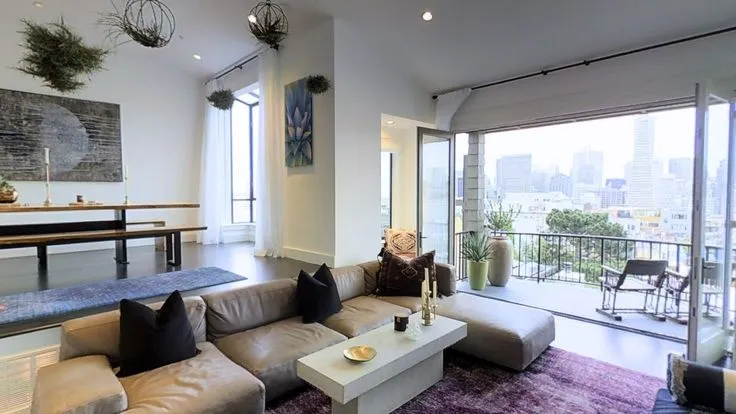

Hey, if you're house hunting in San Francisco right now, first of all, respect. This market is relentless. You've probably already learned that the photos mean almost nothing. Twelve images, all shot on a wide-angle lens, on a Tuesday morning in perfect light, carefully framed to hide the fact that the "open living area" is roughly the size of a generous parking space.
You book the showing anyway. You drive thirty minutes. You walk in and know within the first ten seconds it's not right — the layout, the ceiling, the way the rooms connect — none of it matches what you'd built in your head. And you've already done this four times this month.
That specific exhaustion — the gap between what a listing shows and what a property is — is exactly what a 3D home tour in San Francisco was built to fix. Not as a nice-to-have. As the thing that saves you from showing number five being another dead end.
Why Listing Photos Are Designed to Mislead You
Not maliciously. But deliberately.
A photograph is a choice of angle, light, lens, and timing. The photographer's job is to make t he space look as large and inviting as possible. That cramped hallway betwee n th e b edroom an d bathroom? Never photographed. The living room that technically fits a couch, but nothing else. Shot from the corner with a wide lens so it reads as spacious…
A 3d home tour in San Francisco doesn't make those choices for you. You control the perspective. You check the corner the photographer avoided. You spend three minutes in the kitchen figuring out whether the counter space actually works for how you cook — not how it looks in a hero shot.
That's the shift. Photos curate a version of the home. A 3D tour hands you the unedited one.
How Buyers Actually Move Through a 3D Tour
You know nobody watches a 3D tour start to finish like a video. That's not how it works…
You use it like an elimination round. You walk through the space looking for the thing that knocks it out of contention – the bedroom that's too small, the bathroom that has no natural light, the backyard that's more of a concept than a reality. If you find it, you've just eliminated yourself from showing up. If you don't, you've got a property worth seeing in person.
The checklist that every buyer has in their head – ceiling height, flow of the space, whether the kitchen opens to the living area or closes it off, how the light is in the main bedroom in the afternoon – gets checked off. What survives that process is real interest, not hope.
Showing up in person becomes confirmation. Not discovery. That one shift makes the entire experience less draining.
What a 3D Tour Catches That an In-Person Visit Sometimes Misses
This part surprises people. But it's true.
During a live showing, you're managing a lot at once — the agent, the clock, maybe other buyers walking through behind you. It's easy to miss things. To not quite register that the second bedroom shares a wall with the neighbor's driveway, or that the open floor plan means the dining area has no separation from the front door…
A Matterport 3D tour in San Francisco lets you move at your own pace, backtrack, and study the floor plan overlay while standing virtually in the living room. No pressure. No performance. You can spend eight minutes in the kitchen and thirty seconds in the garage if that's what your questions demand.
Buyers who do this arrive at in-person showings with specific questions instead of general impressions. That clarity speeds up decisions — and in this market, speed built on clarity is the only kind worth having.
Why This Matters Most for Buyers Who Aren't Local
San Francisco pulls buyers from everywhere. People relocating for work. Remote buyers investing from out of state. Families moving from cities where the market moves more slowly, and they still have time to tour casually.
For these buyers, flying in to see properties that don't survive basic layout scrutiny isn't inconvenient — it's expensive and demoralizing. A 3D home tour in San Francisco doesn't replace the in-person visit for a property they're serious about. It replaces the preliminary visits. The ones that only exist to answer questions a digital walkthrough could have answered in ten minutes.
Narrow twelve properties to three. Fly in once. Tour with real intent.
The Part That Actually Changes Your Position as a Buyer
In a market where good properties go under offer in days, the buyers who move with confidence are the ones who already know the space. They're not processing basic layout questions at the showing. They've done that. They're deciding.
A 3D home tour in San Francisco doesn't just save time in a logistical sense. It compresses the emotional distance between seeing a listing and knowing whether it's worth fighting for.
And in San Francisco, that distance is exactly where most buyers lose.




























Sign in to leave a comment.