

Maintaining stable upstream pressure is one of the most overlooked details in fluid and gas handling systems until it fails. When upstream pressure drifts, analytical instruments lose accuracy, reactors lose repeatability, and sensitive processes like gas chromatography or bioreactor venting become unreliable. The component responsible for holding that pressure steady is the back pressure regulator (BPR) and understanding how it works can save engineers significant troubleshooting time.
What Is a Back Pressure Regulator?
A back pressure regulator is a control valve that maintains a set pressure on its inlet (upstream) side, rather than controlling the pressure downstream. It stays normally closed and only opens when the upstream pressure exceeds the setpoint, releasing just enough flow to bring the pressure back into balance.
This is the key distinction between a BPR and a standard pressure-reducing regulator. A pressure-reducing regulator is normally open and controls the pressure delivered to downstream equipment, remaining largely insensitive to what happens upstream. A BPR does the opposite: it protects and stabilizes conditions before the valve, which makes it essential anywhere consistent upstream pressure directly affects process quality vessel headspace control, sample loop pressurization, or venting from bioreactors and fermenters.
BPRs are also easy to confuse with relief valves, since both open in response to rising pressure. The difference is intent. A relief valve is a safety device that opens only during an overpressure event and is not designed for continuous throttling. A back pressure regulator is designed to operate continuously, fine-tuning flow to hold pressure at a precise setpoint under normal operating conditions.
Diaphragm vs. Piston-Sensed Designs
Most BPRs fall into two broad sensing categories, and the choice between them affects both accuracy and application suitability:
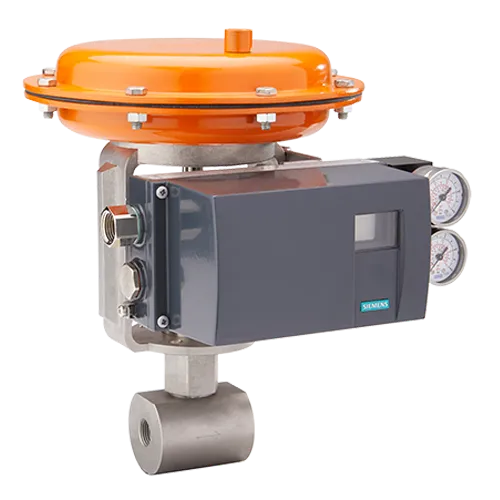
Diaphragm-sensed regulators use a flexible diaphragm as the pressure-sensing element. Because the diaphragm has a large surface area relative to typical flow rates, it can respond to very small pressure changes with high sensitivity making this style well suited to low-flow, high-precision applications such as gas chromatography, flame ionization detection, and other analytical instrumentation where even minor upstream pressure fluctuations can distort results.
Piston-sensed regulators use a piston rather than a diaphragm to sense pressure. Piston designs generally tolerate higher inlet pressures and offer greater mechanical robustness, which makes them a common choice for higher-pressure gas and liquid service where extreme sensitivity is less critical than durability and pressure range.
Selecting between the two isn't just a matter of preference it depends on the process's flow rate, required setpoint accuracy, inlet pressure range, and the media being handled.
Key Specifications That Actually Matter
When evaluating a BPR for a given application, a few specifications determine whether it will perform reliably:
- Cv (flow coefficient): Low-flow BPRs used in analytical and lab-scale applications often have Cv values well under 1 (commonly in the 0.05–0.35 range), while higher-capacity diaphragm units used in process venting can reach a Cv near 2 or more. Matching Cv to the actual flow demand prevents both instability (oversized valves) and pressure lag (undersized valves).
- Maximum inlet pressure: BPR inlet ratings vary widely, from a few hundred psi in gas chromatography service up to several thousand psi in high-pressure liquid or gas applications. Selecting a regulator rated well above the expected operating pressure not just at it builds in a margin of safety.
- Wetted materials: 316L stainless steel is the standard for corrosion resistance and cleanability in pharmaceutical, biotech, and food & beverage systems. For more aggressive chemistries, alloys such as Hastelloy are sometimes specified.
- Soft goods and seat materials: Elastomer and seat material selection affects both chemical compatibility and shutoff quality. For regulated industries, USDA- and FDA-compliant soft goods are often a hard requirement, not just a preference.
- Surface finish: In sanitary and biopharmaceutical service, electropolished internal surfaces (commonly specified to ASME BPE standards) reduce product adhesion and support cleaning validation.
Common Applications
Back pressure regulators show up across a wide range of industries:
- Analytical instrumentation - gas chromatographs and flame ionization detectors rely on stable carrier gas pressure for repeatable retention times and peak resolution.
- Bioreactors and fermenters - BPRs regulate headspace pressure and manage gas venting without disturbing the biological process inside.
- Pharmaceutical and food & beverage processing - sanitary, hygienic-design BPRs maintain process pressure while meeting cleanability and material compliance standards.
- High-pressure gas and liquid systems - compact, high-pressure BPRs protect equipment and maintain consistent supply pressure in industrial and research settings where space is limited.
Sizing and Selection Tips
A regulator that is oversized for its application tends to "hunt," oscillating around the setpoint instead of holding it steady. One that is undersized creates excessive pressure drop and lag. As a rule, engineers should size a BPR based on actual expected flow rather than worst-case system capacity, then verify the selection against the manufacturer's Cv curves at the intended operating pressure.
It's also worth confirming end connections and body style early in the selection process. Inline and angle-body configurations, along with Tri-Clamp, weld-end, NPT, or VCR connections, all affect installation and maintenance access details that are easy to overlook until the unit is already on order.
Final Thoughts
Back pressure regulators are a small component with an outsized effect on process stability. Getting the sensing method, Cv rating, pressure range, and materials right up front prevents the kind of subtle, hard-to-diagnose instability that can undermine analytical accuracy or process consistency for months. Manufacturers such as LowFlowValve offer both diaphragm and piston-sensed lines spanning low-flow analytical service through high-pressure industrial applications, which is a useful starting point for engineers comparing specifications side by side before finalizing a selection.




















Sign in to leave a comment.