

Pregnancy is one fabulous experience filled with wonders and questions and waiting, especially for one of the million-dollar queries: "Is it a boy or a girl?" Back then, parents had to wait till half of the pregnancy was through to get to know the gender of the child through an ultrasound. With the advent of new prenatal test techniques, there is a new possibility to find out about the child's gender as early as 6 weeks into pregnancy by a blood test.
Let's get into how such a state-of-the-art technique operates and is different from other gender tests, such as the HD live sonogram. So, if it is found in the mother's blood samples, then it means a male child is there; otherwise, if its presence is not detected, then usually a girl is determined by this test.
Gender determination of this kind is possible because the fetal DNA fragments find their way into the bloodstream of the mother during pregnancy.
How the Blood Test Works
The blood test for gender takes a quick blood draw from the arm of the mother. The sample is then analyzed in a specialized laboratory by technicians who extract fetal DNA and search for the Y chromosome. The test is simple, safe, and not time-consuming. Results are usually available within a few days to a week.
Accuracy of the Blood Test

One of the most considerable advantages of early gender testing blood test through blood is how accurate it is. The majority of quality laboratories report over 99% accuracy rates once the test is done after 6 weeks of pregnancy.
For accurate dating, most providers suggest getting the pregnancy confirmed with an ultrasound scan beforehand. Some clinics even provide an HD live sonogram to see the baby and confirm gestational age before taking the blood test.
HD Live Sonogram vs. Blood Test
Though a blood test offers early and extremely accurate gender information, many expectant parents also eagerly anticipate viewing their baby on an ultrasound. Come in the HD live sonogram—a 3D/4D imaging method that provides real-time, life-like images of the baby within the womb.
The gender can be determined with an HD live sonogram, but it's generally done at 14 to 20 weeks when the anatomy of the baby is more established and observable. Not only does this determine the gender, but it also allows parents to view facial structures, movement, and bonding moments in astonishing clarity.
So, how do the two compare?
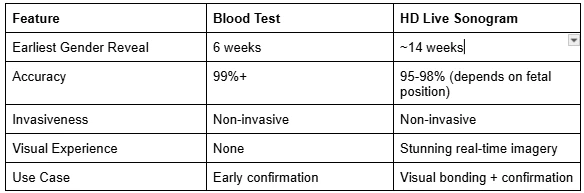
Many parents choose to do both, starting with the blood test for early gender knowledge, followed by an HD live sonogram for visual reassurance and bonding.
Emotional and Practical Benefits
Learning your baby's gender in advance has emotional and practical benefits. Emotionally, it is said to build the attachment between parents and their unborn baby and make older children feel included.
For parents who wish to plan a gender reveal party, early gender testing based on blood is a lifesaver. It provides parents with enough time to plan a memorable event, complete with surprises, themes, and decorations.
Is It Safe?
Yes, gender testing through blood is entirely safe for both the mother and the baby. In contrast to amniocentesis, which does carry some risk of miscarriage, this sort of test does not interfere with pregnancy. You can consider this a very routine blood test.
But it's always a good idea to select a reputable clinic or lab. Make sure the test is done in a certified center that has experience with prenatal DNA testing.
Things to Consider
While this test is highly accurate, a few factors can impact the results:
- Twins or multiples: May make it harder to detect fetal DNA accurately.
- Maternal health: Certain conditions or recent blood transfusions can affect DNA analysis.
- Testing too early: Before 6 weeks, fetal DNA levels might be too low to detect.
Make sure you have spoken to your health care provider or a specialist clinic before performing a test.
Wrapping Up
Finding out the gender of your baby is an exciting milestone. Due to the advances made in prenatal blood screening techniques, this measure is accomplished even earlier than ever before, 6 weeks pregnant, to be precise. Paired with the forever etched pictures of an HD live sonogram, would-be parents today have more options to associate with their baby long before delivery.
Choosing to do an early gender reveal, complete with premature nursery decoration, or to find out your baby's secrets will give early gender testing an aura of clarity, accuracy, and peace of mind.































Sign in to leave a comment.