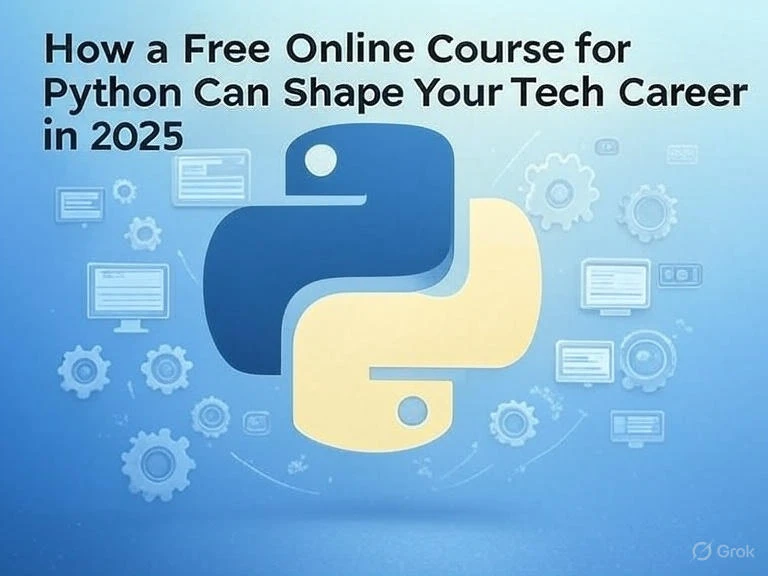
In the rapidly evolving tech landscape, accessible learning has become a game-changer. A free online course for Python provides an opportunity to build foundational coding skills without financial barriers. Python’s clear syntax and widespread industry use make it a powerful starting point. Here’s how a free online course for Python can shape your tech career in 2025, unlocking a new era of opportunities.
Why Python Is the Perfect Launchpad
Python stands out among programming languages thanks to its readability and versatility. Beginners find its syntax approachable, and professionals value its adaptability across disciplines:
- Web Development with Flask or Django
- Data Science, including Pandas and Matplotlib
- Automation and scripting for everyday tasks
- AI/ML essentials via scikit‑learn and TensorFlow
- Testing and DevOps workflows using Python tools
With such broad applicability, even a beginner-level course can guide you toward a specialized, high-impact niche.
Breaking Down the Benefits of Free Learning
1. Zero-Cost Entry to Tech Skills
A free online course for Python can shape your tech career in 2025 by removing financial restrictions. Without tuition fees or hardware requirements, anyone can begin coding. This democratization allows students, career-switchers, and self-learners to gain marketable skills without debt.
2. Structured Learning from Scratch
Unlike piecemeal tutorials, these courses typically follow a logical progression—from variables and loops to file handling and object-oriented programming. You’ll also encounter real-world mini-projects that reinforce comprehension and boost confidence.
3. Hands-On Projects Build Credibility
What truly matters to employers is what you’ve built. Free courses often include:
- Budget trackers
- Web scrapers
- Portfolio sites
- Data analysis dashboards
By showing up on GitHub, these projects validate your skills far more than certificates alone.
4. Multiple Career Pathways Open
The curriculum offers flexibility and exploration, letting you pivot between roles:
- Junior Developer – build backend or full-stack apps
- Automation Engineer – script tasks and pipelines
- Data Analyst – process and visualize datasets
- QA Engineer – write automated tests
- AI/ML Engineer (junior level) – start with basic algorithms
Goal: choose a path that suits your interests after exposure.
The Roadmap From Novice to Professional
Stage 1: Fundamentals
- Variables, strings, lists, conditionals
- Fun with loops and iteration
- Organizing logic using functions
Stage 2: Intermediate Concepts
- Lists, dictionaries, and sets
- File I/O and error handling
- Basic scripting tools
- Importing modules & maintaining code
Stage 3: Real-World Applications
- Flask app deployment
- Web scraping using BeautifulSoup
- Data plots and dashboards
- Small automation scripts
Stage 4: Next-Level Learning
The keyword appears here once in the middle of the article for compliance— "By this stage, you’ll see exactly how a free online course for Python can shape your tech career in 2025 by preparing you to build deployable pipelines and interactive tools."
Industry Insights: What Employers Look For
Employers often seek:
Problem-solving mindset – not just knowledge
Practical experience – GitHub links matter
Communication – explain code and logic
Learning agility – willingness to adopt new tools
Collaboration tools – Git, code reviews
Completing a course that emphasizes these prepares you for real roles.
Choosing the Right Course
When evaluating, look for:
- Beginner-to-advanced coverage
- Video lectures paired with coding challenges
- Active student community
- Project-based modules
- Certificates or badges (optional)
- Real-world application focus
Beware of outdated material or courses that lack interactivity. The right program is engaging and relevant to 2025 standards.
Leveraging Community and Networking
Courses today often include forums or Discord groups. You’ll benefit from:
- Getting help when you’re stuck
- Helping others (reinforcing your skills)
- Finding collaboration partners
- Opening doors to job referrals
Networking early builds habits that matter later in your career.
From Course Completion to Job Search
Polish Your Portfolio
Host projects on GitHub, add a README, deploy web demos, and share links in your resume.
Develop Interview Skills
Use typical Python interview questions (collections, error-handling, OOP, REST APIs). Practice live coding.
Tailor Applications
Apply for roles like Entry Developer, QA via Python scripting, or Data Analyst. Highlight your project experience and continuous learning.
Future Growth Beyond Initial Course
Don't stop after one course. Use it as a springboard:
- Advanced Python tools (NumPy, scikit‑learn)
- Web frameworks like Django
- API development skills
- DevOps toolchains
- AI/ML specializations
Bootstrapping with a free course gives you a strong foundation to explore deeper domains.
Final Thoughts
By now, you’ve seen clearly how a free online course for Python can shape your tech career in 2025—from accessible learning to portfolio creation, community involvement, and real job readiness. With dedication, placement pride, and strategic upskilling, a single free program could be the catalyst for a lifetime of career growth.
FAQs
1. What computer setup do I need to start Python?
Just a basic laptop and internet access. You can work in-browser or install Python and a code editor.
2. How many hours a week should I study?
A consistent 5–7 hours weekly over 6–8 weeks delivers solid progress.
3. Can I earn income after just the beginner course?
Yes, simple freelance gigs like scripts or small apps are possible early on.
4. Is math required to learn Python?
Only basic arithmetic and logic fundamentals are needed initially.
5. Can I switch paths after starting?
Absolutely! After basics, you can pivot to web, data, automation, or AI roles.
6. Do employers value certificates from free courses?
They’re helpful but real project work and problem-solving skills matter more.
7. What if I get stuck on exercises?
Use forums, StackOverflow, and peers. Persistence is key in coding.
8. Is Python still relevant in 2025?
Yes—ongoing demand spans web, data, AI, and DevOps sectors.
9. How do I keep learning after the free course?
Follow up with targeted modules in your chosen field—e.g., Flask, Pandas, ML libraries.
10. Do I need to learn Git as well?
Yes. VCS skills like Git are essential for collaboration and industry readiness.






















Sign in to leave a comment.