
Computer networks rely heavily on trust models to facilitate seamless communication between devices. During the early days of network architecture, this trust was often implicit, prioritizing connectivity over stringent authentication. Administrators assumed that any device connected to a local area network was inherently authorized and safe. This fundamental design choice created a fertile ground for exploitation.
Security professionals and malicious actors alike frequently utilized specialized software to test these boundaries. One such application gained significant notoriety for its ability to dismantle these implicit trust mechanisms. When modern professionals ask what is cain and abel cybersecurity, they are looking at a critical piece of history that forced the industry to rethink local network defenses.
As reported frequently in security news daily segments from the early 2000s, this password recovery tool demonstrated exactly how fragile early protocols were. By reading this analysis, network administrators and security students will gain a comprehensive understanding of how early network trust models failed and why modern zero-trust architectures became an absolute necessity in enterprise environments.
Core Functions: What Is Cain and Abel Cybersecurity?
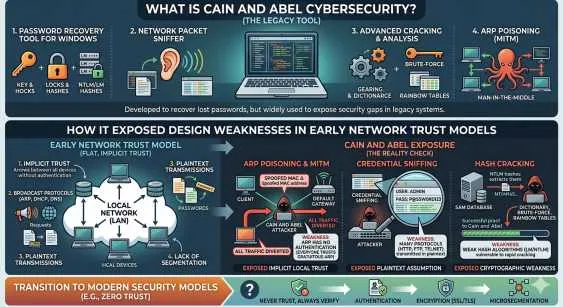
The software was originally developed for Microsoft operating systems as a password recovery and network assessment tool. It allowed system administrators to recover lost credentials through various methods, including network sniffing, cracking encrypted passwords using dictionary attacks, brute-force attacks, and cryptanalysis. If you examine retrospective articles in security news daily publications, it is often categorized as a dual-use tool. It provided immense value for legitimate security audits, yet it posed a severe threat when deployed by unauthorized users.
Password Cracking and Cryptanalysis
The tool excelled at extracting plaintext passwords from hashed values stored on local machines or captured over the network. It supported a wide array of hashing algorithms, such as NTLM, MD5, and SHA-1. By leveraging pre-computed hash chains known as rainbow tables, it drastically reduced the time required to crack complex hashes. This capability highlighted the severe inadequacy of relying solely on weak hashing algorithms without salting, a practice that was unfortunately common in legacy systems.
Network Sniffing Capabilities
Beyond simple password cracking, the software possessed robust network sniffing capabilities. It could monitor local network traffic and extract authentication credentials transmitted in plaintext. Protocols like FTP, Telnet, POP3, and basic HTTP were highly vulnerable to this type of interception. When new professionals research what is cain and abel cybersecurity, they often discover its notorious ability to manipulate routing protocols to intercept traffic seamlessly, effectively turning a standard workstation into a powerful surveillance node.
Exposing Flaws in Early Network Trust Models
Early local area networks (LANs) operated on the premise of absolute internal trust. Devices on the same subnet trusted one another without rigorous verification, prioritizing rapid data transmission over data confidentiality or integrity.
Address Resolution Protocol (ARP) Poisoning
The most significant design weakness exposed by this software was the complete lack of authentication within the Address Resolution Protocol. ARP is responsible for mapping logical IP addresses to physical MAC addresses on a local network. Because early network designs lacked mechanisms to verify the origin of an ARP response, any host could broadcast a forged ARP packet.
The tool automated ARP cache poisoning, effectively routing all traffic between a target machine and the default gateway through the attacker's machine. This Man-in-the-Middle (MitM) attack vector was a frequent topic in security news daily discussions during the era of widespread LAN vulnerabilities. It proved that manipulating Layer 2 traffic could compromise the entire network segment without triggering perimeter alarms.
The Fallacy of Internal Security
Network architects historically focused almost entirely on perimeter defense. Firewalls and intrusion detection systems were positioned at the network edge, assuming the internal network was a completely safe zone. The deployment of tools that could easily hijack internal sessions proved that perimeter defenses were entirely insufficient. The realization that internal threats—whether malicious insiders or compromised hosts—could bypass external defenses shifted the fundamental philosophy of network security engineering.
The Evolution of Mitigation and Defense Mechanisms
The widespread use of automated MitM and sniffing tools forced hardware manufacturers and software developers to implement stricter, localized controls. Understanding what is cain and abel cybersecurity helps clarify why modern networks operate the way they do today.
Network switch manufacturers introduced specialized security features to combat protocol manipulation. Dynamic ARP Inspection (DAI) was developed to validate ARP packets against a trusted database, discarding invalid IP-to-MAC bindings. Additionally, DHCP Snooping and Port Security became standard practices to restrict unauthorized devices from establishing network presence. Furthermore, the industry accelerated the deprecation of plaintext protocols in favor of encrypted alternatives. SSH replaced Telnet, HTTPS superseded HTTP, and secure email protocols became mandatory, rendering basic packet sniffing largely ineffective against authentication mechanisms.
Frequently Asked Questions
Why do analysts still study what is cain and abel cybersecurity?
Studying this tool provides foundational knowledge of network protocols and their inherent vulnerabilities. It illustrates the mechanical failures of early LAN architecture, allowing modern security engineers to understand the rationale behind current security controls and encrypted communications.
Is the software still actively used by professionals today?
While the original application has not been updated in years and struggles to function on modern operating systems, the core concepts it utilized remain highly relevant. Modern frameworks like Ettercap, Responder, and Wireshark have superseded it in functionality. However, the historical context and the paradigm shift it caused remain heavily documented in security news daily archives and academic curricula.
How did early networks attempt to mitigate these attacks before hardware upgrades?
Initially, system administrators relied on hardcoding static ARP entries into individual machines. This approach prevented automated poisoning but was entirely unscalable in growing enterprise environments. Eventually, the widespread adoption of cryptographic network protocols and intelligent Layer 2 switch configurations became the industry standard for mitigation.
Transitioning to Zero-Trust Architecture
The fundamental vulnerabilities exposed by early password recovery and protocol manipulation tools completely reshaped enterprise security strategies. The assumption of internal trust has been universally discarded in favor of zero-trust models, where every request is rigorously authenticated and authorized regardless of its origin or location on the network.
Understanding what is cain and abel cybersecurity serves as a stark, historical reminder of the severe consequences of implicit trust. As network complexity continues to grow with cloud integrations and distributed workforces, maintaining a deep understanding of historical vulnerabilities is crucial. Staying informed through reputable industry resources and security news daily updates ensures that network administrators remain vigilant against both legacy tactics and sophisticated emerging threats.






























Sign in to leave a comment.