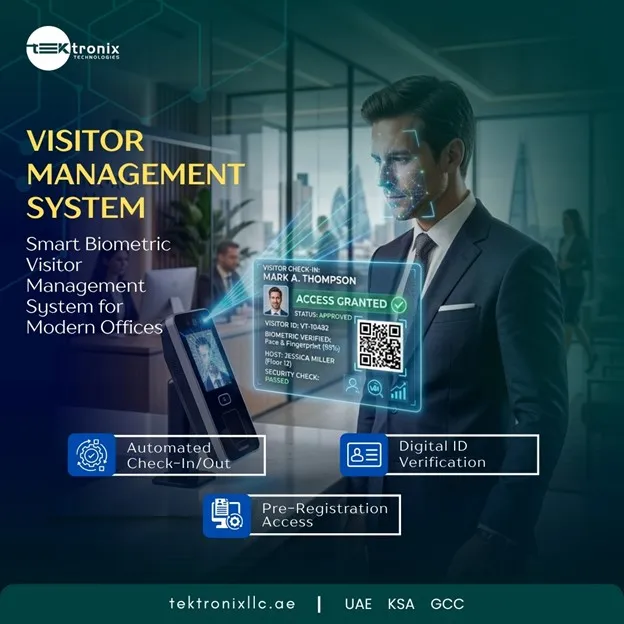

The way organizations manage visitor access has undergone a fundamental transformation. In the UAE, one of the world's most security-conscious and compliance-driven business environments — a paper logbook at reception is no longer an acceptable standard. Modern enterprises, government institutions, schools, and logistics hubs demand instant visibility, verified identities, and auditable records.
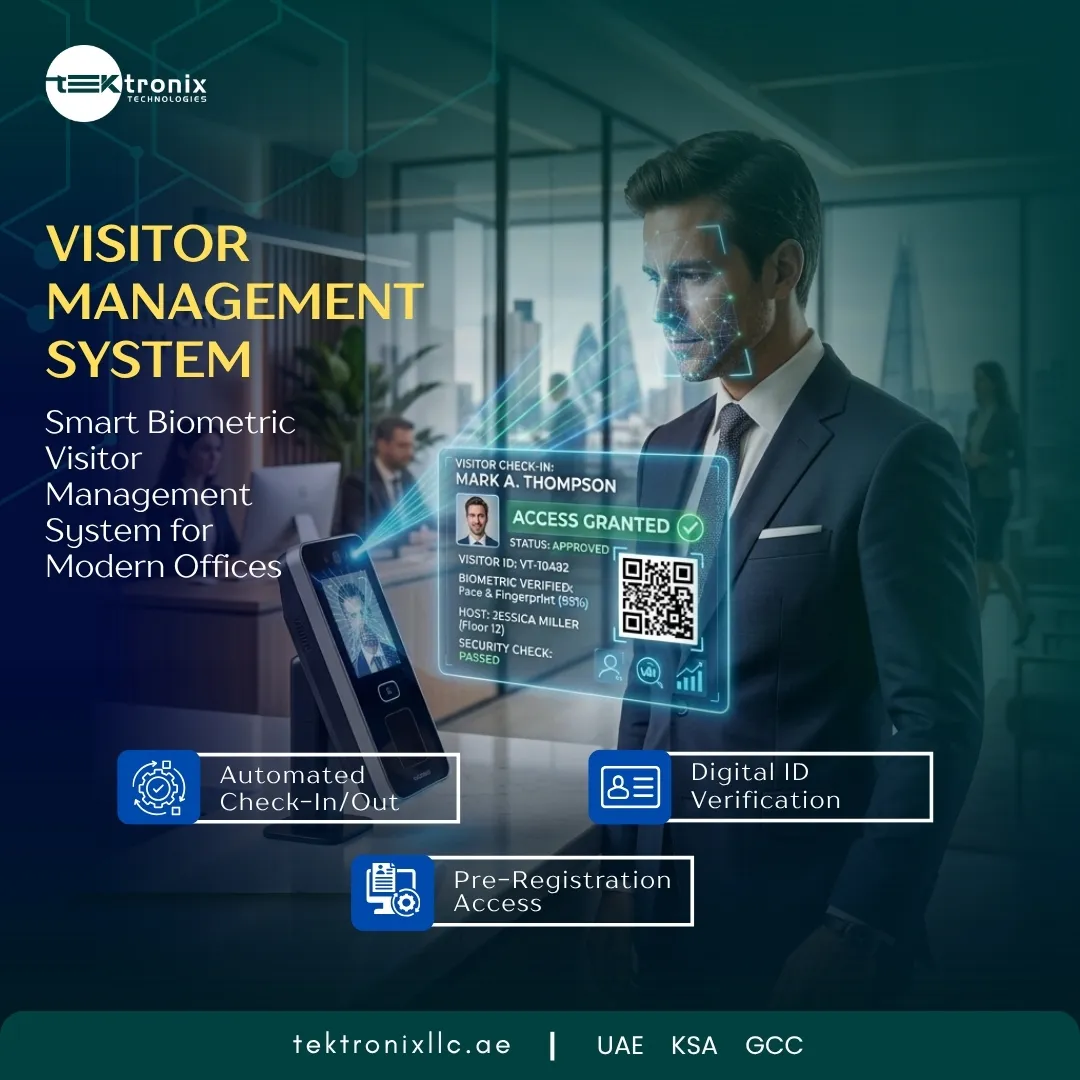
A Visitor Management System (VMS) is the technology that delivers exactly that. By digitizing and automating every stage of the visitor lifecycle — from pre-registration to departure — a VMS gives organizations real-time situational awareness, strengthens physical security, and ensures compliance with UAE regulatory requirements.
In this definitive guide, we explore everything UAE businesses need to know about Visitor Management Systems: how they work, which features matter, how they integrate with broader security infrastructure, and what the future holds for visitor intelligence in the region.
1. What Is a Visitor Management System?
A Visitor Management System is a digital platform that manages, monitors, records, and controls the entry and exit of visitors across a facility or multi-site estate. It replaces manual, error-prone paper logbooks with an intelligent, automated workflow that captures verified visitor data in real time.
At its core, a VMS answers three fundamental security questions at every moment:
- Who is currently on the premises?
- Why are they here, and who invited them?
- Have they been cleared against watch lists, NDAs, or access restrictions?
A modern Visitor Management Solution goes far beyond check-in automation. It serves as the intelligence layer of an organization's physical security architecture, feeding verified visitor data to access control systems, HR platforms, and compliance dashboards in real time.
2. Why Real-Time Situational Awareness Is Critical for UAE Organizations
Real-time situational awareness — the ability to know exactly who is on your premises at any given moment — is no longer a luxury reserved for high-security government buildings. It is a baseline operational requirement across virtually every sector in the UAE.
Key risks that a Visitor Management System in UAE directly mitigates:
- Unauthorized access to restricted zones by unregistered or unchecked visitors
- Compliance violations during fire drills, emergency evacuations, or regulatory audits
- Reputational and legal exposure from undocumented visitor incidents
- Insider threat facilitation via visitor tailgating or fraudulent identity claims
- Data breaches caused by unsupervised visitor access to sensitive areas
The UAE's rapidly evolving regulatory landscape — including ADGM data regulations, DIFC privacy laws, and sector-specific compliance standards — makes a certified Visitor Management System not just a security investment, but a legal necessity for many organizations.
3. How a Visitor Management System Works: The Complete Visitor Lifecycle
A best-in-class VMS manages the visitor experience across six distinct stages, each contributing to a secure, auditable, and frictionless process.
| Stage | Process | Security Output |
| 1. Pre-Registration | Host sends digital invite; visitor submits details in advance | Identity pre-verified; watchlist screening triggered |
| 2. Arrival & Check-In | Self-service kiosk or tablet; QR code scan or ID capture | Real-time entry log created; host notified instantly |
| 3. Identity Verification | Passport/Emirates ID scan; optional biometric capture | Visitor authenticated against approved list |
| 4. Badge Issuance | Printed or digital badge with photo, visit purpose, zones | Visual identification enforced across premises |
| 5. Access & Movement | Badge grants zone-specific entry via access control integration | Movement tracked; alerts triggered on restricted zone breach |
| 6. Departure & Audit | Exit logged; badge deactivated; visit record archived | Full audit trail available for compliance reporting |
4. Key Features of a Modern Visitor Management System
Enterprise-grade Visitor Management Solutions deployed across the UAE incorporate a comprehensive feature set that addresses security, efficiency, and compliance requirements simultaneously.
4.1 Digital Pre-Registration & Invitation Portal
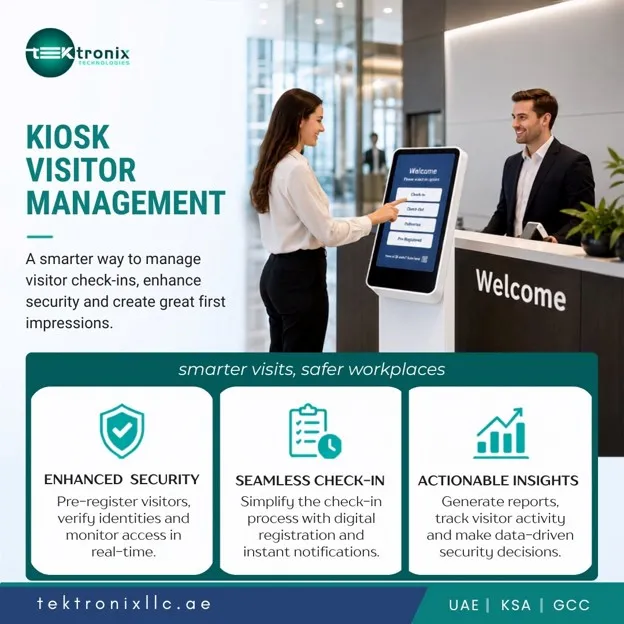
Hosts send branded digital invitations to visitors in advance. Visitors’ complete registration, upload identification documents, sign NDAs or health declarations, and receive a unique QR code — all before arriving. This eliminates reception queues and enables security pre-screening.
4.2 Multi-Modal Identity Verification
A modern Visitor Management Device supports multiple verification methods: Emirates ID scanning, passport OCR, QR code reading, and optional facial biometric capture. Integration with national watchlists or internal block lists provides an additional security layer.
4.3 Instant Host Notifications
Upon visitor check-in, the host receives an automated notification via SMS, email, or mobile app. This ensures no visitor waits unattended and eliminates the security risk of unescorted guests.
4.4 Smart Badge Generation
Visitor badges are generated on-demand and include the visitor's photo, name, company, visit purpose, authorized zones, and time-limited validity. Color-coded badge types (contractor, VIP, vendor) enable instant visual differentiation by security personnel.
4.5 Real-Time Dashboard & Occupancy Monitoring
Security managers access a live dashboard displaying current visitors, zone occupancy, pending check-ins, and flagged entries. This is the operational heart of real-time situational awareness for UAE facilities.
4.6 Watchlist & Compliance Screening
Visitor details are automatically screened against internal block lists, government watchlists (where applicable), and sanction databases at the point of registration. Flagged visitors trigger instant alerts to security personnel.
4.7 Emergency Evacuation Management
In emergency scenarios, the VMS generates a real-time muster report showing every visitor currently on-site, their last known location, and their emergency contact details — critical for duty-of-care compliance and evacuation accountability.
4.8 Comprehensive Audit Trails & Compliance Reporting
Every visitor interaction is timestamped and stored in tamper-proof digital records. One-click compliance reports can be generated for internal audits, regulatory inspections, or insurance purposes.
4.9 Multi-Site & Cloud Management
Cloud-based VMS platforms allow UAE organizations with multiple locations — across Dubai, Abu Dhabi, Sharjah, and beyond — to manage visitor policies, blacklists, and reporting from a unified central dashboard.
4.10 API-First Integration Architecture
Open API frameworks enable seamless integration with access control systems, HR software, parking management, CCTV platforms, and building management systems — creating a unified security ecosystem.
5. Visitor Management System Applications by Sector in the UAE
Different sectors have distinct visitor management requirements. Here is how leading UAE organizations deploy VMS solutions tailored to their specific security and operational environments.
5.1 Visitor Management System for Schools & Educational Institutions
A Visitor Management System for Schools addresses the unique safeguarding obligations of educational facilities. Schools in the UAE must verify that every adult entering the campus is authorized, whether they are a parent, substitute teacher, contractor, or government inspector.
- Authorized parent/guardian pre-registration with photo ID verification
- Sex offender and child protection watchlist screening
- Contractor and vendor access restricted to designated zones and time windows
- Automated alerts to school principals or security officers on flagged entries
- Digital visitor logs instantly available for KHDA or Ministry of Education inspections
Schools using a dedicated VMS report significant improvements in campus security, parent confidence, and regulatory audit readiness.
5.2 Visitor Management System for Warehouses & Logistics Facilities
A Visitor Management System for Warehouses manages the high-frequency, high-diversity visitor flow typical of logistics hubs, free zones, and industrial facilities — including delivery drivers, freight agents, customs officials, maintenance contractors, and client representatives.
- Pre-registered delivery driver workflows with vehicle registration capture
- Time-windowed access credentials for contractors tied to work orders
- Health and safety induction e-signature capture before zone entry
- Forklift and dangerous-zone access restrictions enforced via badge type
- Customs and free-zone compliance reporting for JAFZA, DAFZA, and similar authorities
5.3 Visitor Management System for Corporate Offices & Business Centers
A Visitor Management System for Companies elevates the professional image of corporate headquarters while enforcing rigorous security protocols. From client meetings in boardrooms to vendor access in server rooms, every visit is managed with precision.
- Branded, white-labeled visitor invitation and check-in experience
- NDA and confidentiality agreement digital signature at check-in
- Visitor-specific Wi-Fi credential issuance integrated with IT systems
- Meeting room and parking slot auto-assignment linked to visitor registration
- Executive protection protocols for VIP visitor management
5.4 Visitor Management System for Government & Public Sector Facilities
Government buildings, ministries, and public service centers in the UAE require the highest standards of identity verification and access control. VMS platforms for government deployments include biometric integration, classified zone restrictions, and full compliance with UAE federal security standards.
5.5 Visitor Management System for Healthcare & Hospitals
Hospitals and clinics manage a complex visitor mix of patients, families, medical representatives, and contractors. VMS ensures infection control compliance (visitor health screening), patient privacy protection, and restricted ICU/surgical zone access enforcement.
6. Visitor Management Devices: Hardware Components Explained
The physical Visitor Management Device infrastructure deployed at entry points is as important as the software platform it runs on. UAE deployments typically use a combination of the following hardware components:
| Device | Function | Typical Location |
| Self-Service Kiosk (iPad / Tablet Stand) | Visitor self-check-in, ID scan, badge print trigger | Main lobby, reception |
| ID / Passport Scanner | OCR extraction of visitor ID data; eliminates manual entry | Reception desk, security checkpoint |
| Badge Printer | On-demand visitor badge with photo, QR, zone details | Reception, adjacent to kiosk |
| Facial Recognition Terminal | Biometric verification and touchless check-in | High-security entrances |
| QR Code Reader | Fast scan of pre-registered visitor QR codes | Turnstiles, secondary entrances |
| Security Management Workstation | Live dashboard monitoring, manual override, reporting | Security control room |
The right hardware combination depends on visitor throughput, security classification of the facility, and integration requirements with existing access control infrastructure.
7. Integration with Security Ecosystems
A Visitor Management System achieves its maximum-security value when integrated as part of a unified physical security platform. The following integrations are standard in enterprise UAE deployments:
- Access Control Systems: VMS-issued badges activate turnstiles, door readers, and elevator controls for approved zones only, eliminating the need for separate credential issuance
- CCTV & Video Analytics: Visitor entry events are linked to corresponding camera footage, enabling rapid incident investigation with verified identity context
- Biometric Authentication: Integration with fingerprint or facial recognition terminals provides dual-factor physical verification for high-security zones
- HR & Active Directory: Employee host verification, automatic de-provisioning on employee departure, and visitor blacklist synchronization
- Building Management Systems (BMS): Visitor presence triggers automated HVAC, lighting, and floor access adjustments
- Parking Management Systems: Pre-registered visitors receive validated parking access linked to their visit window
- Emergency Response Platforms: Real-time visitor occupancy data feeds directly into evacuation management and fire safety systems
8. Compliance & Regulatory Alignment in the UAE
Organizations deploying a Visitor Management System in UAE must ensure their solution aligns with a range of applicable regulations:
- UAE Federal Data Protection Law (2021): Visitor personal data — including biometrics — must be collected with informed consent, processed lawfully, and stored securely with defined retention limits
- DIFC Data Protection Law 2020: Applies to organizations in the Dubai International Financial Centre; requires documented data processing records including visitor logs
- ADGM Data Protection Regulations: Governs visitor data handling for Abu Dhabi Global Market entities
- Dubai Civil Defense / Fire Safety Regulations: Mandates real-time occupancy records for evacuation accountability — directly satisfied by VMS audit trails
- KHDA (Knowledge and Human Development Authority): School visitor management standards for Dubai educational institutions
- Free Zone Authority Requirements: JAFZA, DAFZA, KIZAD, and other free zones impose specific access control and visitor logging obligations on tenants
Partnering with a VMS provider experienced in UAE regulatory compliance ensures your deployment satisfies legal obligations without operational friction.
9. Visitor Management System ROI: The Business Case for UAE Organizations
Beyond security, a VMS delivers measurable operational and financial returns that justify the investment across any sector.
| Benefit Area | Tangible Impact | Typical Metric |
| Reception Efficiency | Eliminates manual sign-in and badge writing | 60–80% reduction in check-in time |
| Security Incident Reduction | Pre-screening and real-time alerts prevent unauthorized access | 40–70% fewer unauthorized entry incidents |
| Compliance Cost Avoidance | Automated audit trails eliminate manual record-keeping | Saves 5–15 hrs/week in admin effort |
| Emergency Accountability | Instant muster reports replace manual headcounts | Evacuation time reduced by up to 50% |
| Visitor Experience | Branded, frictionless check-in improves professional image | Measurable improvement in visitor satisfaction scores |
| Insurance Premium Reduction | Certified visitor logs reduce liability exposure | Potential 5–15% reduction in premises insurance |
10. Challenges in VMS Implementation & How to Overcome Them
While the benefits are clear, organizations must anticipate and address common implementation challenges to maximize VMS value.
| Challenge | Root Cause | Recommended Solution |
| Staff adoption resistance | Unfamiliarity with digital workflows | Role-specific training; simple UI; champions program |
| Visitor privacy objections | Biometric data collection concerns | Transparent consent flows; on-device template storage; PDPL-compliant data handling |
| Legacy system integration | Proprietary access control protocols | Choose VMS vendors with broad API libraries and proven UAE integrations |
| High-volume throughput bottlenecks | Single check-in points for large facilities | Multi-kiosk deployment; pre-registration mandate; QR fast-lane setup |
| Data retention & GDPR alignment | Long storage of visitor PII | Automated retention policies; scheduled data purging; consent-based storage |
| Connectivity outages | Cloud VMS dependency on internet | Hybrid edge/cloud architecture; offline-capable devices with sync-on-restore |
11. How to Choose the Right Visitor Management System in UAE
11.1 Define Visitor Volume and Flow Complexity
A corporate HQ receiving 50 visitors daily has very different requirements from a hospital handling 2,000 daily interactions or a free-zone warehouse with continuous shift-based contractor access. Choose a platform scaled and licensed for your actual traffic.
11.2 Prioritize UAE Regulatory Compliance
Confirm that the VMS vendor has explicit UAE data compliance credentials, including PDPL-aligned data processing agreements, UAE-based or EU-standard cloud hosting, and documented biometric data handling policies.
11.3 Evaluate Integration Depth
Request a technical integration matrix from shortlisted vendors. Verify compatibility with your specific access control hardware, CCTV platform, HR system, and any free-zone authority reporting portals relevant to your facility.
11.4 Assess Multi-Site Capabilities
If your organization operates across multiple UAE locations, ensure the platform offers centralized policy management, unified blacklists, consolidated reporting, and consistent visitor experience across all sites from a single dashboard.
11.5 Demand a Pilot Deployment
Before committing to full rollout, commission a 30-day pilot at your highest-traffic entrance. Measure check-in time, system reliability, integration stability, and staff adoption before scaling.
11.6 Review Total Cost of Ownership
Factor in hardware (kiosks, badge printers, scanners), software licensing or SaaS subscription, implementation and integration services, staff training, and annual maintenance when comparing vendors. The lowest upfront cost rarely delivers the lowest TCO.
12. Future Trends in Visitor Management Systems
The UAE's smart-city ambition and its position as an early technology adopter mean that the next generation of VMS capabilities is already being piloted across Dubai and Abu Dhabi.
12.1 AI-Powered Visitor Behavioral Analytics
Machine learning models analyze historical visitor patterns to predict peak times, identify anomalous behavior (loitering, repeated failed access attempts), and recommend proactive security interventions — moving VMS from reactive logging to predictive intelligence.
12.2 Touchless & Frictionless Entry
Combining facial recognition with mobile credentials enables fully touchless visitor journeys from car park to meeting room — no kiosk, no badge, no human intervention — while maintaining complete audit accountability.
12.3 Decentralized Digital Identity
UAE National Digital Identity initiatives (UAE Pass) are enabling visitor pre-verification using government-issued digital credentials, eliminating the need for document scanning at reception and dramatically accelerating high-security check-in processes.
12.4 Blockchain-Based Visitor Audit Trails
Immutable, tamper-proof visitor records stored on private blockchain infrastructure are being explored for high-compliance environments — including government buildings and financial institutions — where audit trail integrity is paramount.
12.5 Integrated Smart Building Convergence
Next-generation VMS platforms will serve as the unified orchestration layer for the entire visitor experience: automated parking allocation, digital wayfinding, personalized floor temperature and lighting, meeting room preparation, and catering requests — all triggered by visitor check-in.
13. Why UAE Organizations Are Accelerating VMS Adoption
The convergence of regulatory tightening, smart-city infrastructure investment, and heightened security consciousness has created powerful momentum for VMS adoption across the UAE. Forward-looking security and facilities leaders recognize that visitor management is no longer a front-desk administrative function — it is a strategic component of organizational resilience.
- UAE Vision 2031 smart-city mandates reward digital-first operations with preferential government contracting and certification
- Rising insurance underwriter requirements for documented visitor access controls in commercial and industrial facilities
- Post-pandemic shift to permanent touchless, contactless operational standards across all visitor-facing processes
- Growing supply-chain security requirements from multinational clients who audit vendor facility security as part of procurement due diligence
- Increasing frequency of regulatory spot audits in UAE schools, healthcare, and financial services requiring instant visitor record production
14. Conclusion: Smarter Visitor Management Starts with the Right System
In the UAE's dynamic, security-conscious, and compliance-driven operating environment, a modern Visitor Management System is no longer optional infrastructure — it is a foundational component of any serious physical security strategy.
From the Visitor Management System for Schools safeguarding children in Dubai's educational campuses, to the Visitor Management System for Warehouses managing high-velocity logistics access in Jebel Ali, to the Visitor Management System for Companies protecting intellectual property in Abu Dhabi's financial district — the right VMS transforms visitor control from a manual liability into a strategic security asset.
Partnering with an experienced, UAE-compliant Visitor Management Solution provider ensures that your deployment is technically robust, legally compliant, scalable across sites, and ready for the next generation of AI-powered visitor intelligence. In a country that sets the global standard for smart security, your visitor management should reflect that ambition.
Frequently Asked Questions (FAQs)
What is a Visitor Management System and why does my UAE business need one?
A Visitor Management System is a digital platform that automates the registration, verification, tracking, and departure of visitors across your facility. UAE businesses need one to meet regulatory compliance requirements (PDPL, DIFC, free-zone standards), achieve real-time situational awareness, and replace insecure paper logbooks with auditable digital records.
What is the difference between a Visitor Management System and a Visitor Registration System?
A Visitor Registration System refers specifically to the check-in and data-capture component of visitor management. A full Visitor Management System is a comprehensive platform that includes registration, identity verification, badge issuance, real-time tracking, access control integration, compliance reporting, and emergency management.
What hardware devices are used in a Visitor Management System?
Key Visitor Management Devices include self-service check-in kiosks (iPad or touchscreen tablet stands), passport and Emirates ID scanners, badge printers, facial recognition terminals, and QR code readers. The right hardware combination depends on your facility's visitor throughput and security classification.
Is a Visitor Management System suitable for schools in the UAE?
Yes. A Visitor Management System for Schools is specifically designed to address the safeguarding requirements of educational institutions, including parent/guardian verification, child protection watchlist screening, contractor access restriction, and KHDA-compliant visitor logging. It is one of the most impactful security investments a UAE school can make.
Can a Visitor Management System integrate with existing access control and CCTV systems?
Modern Visitor Management Solutions are built with open API architectures that integrate with leading access control platforms, CCTV and video management systems, HR software, and building management systems. Always verify specific integration compatibility with your shortlisted VMS vendor.
How does a Visitor Management System support UAE data protection compliance?
A compliant VMS supports UAE PDPL obligations by implementing consent-based data collection, defined retention policies, secure encrypted storage, and documented data processing records. Choose a provider with explicit UAE PDPL and DIFC compliance certifications and UAE-based or EU-standard data hosting.
What is the ROI of implementing a Visitor Management System?
ROI is generated through reduced reception staffing costs, elimination of manual compliance record-keeping, faster emergency evacuation accountability, reduced unauthorized access incidents, and potential insurance premium reductions. Most mid-size UAE organizations achieve full payback within 12–24 months of deployment.
Visitor Management System (VMS)
Visitor Management System for Schools
Visitor Management System for Companies



























Sign in to leave a comment.