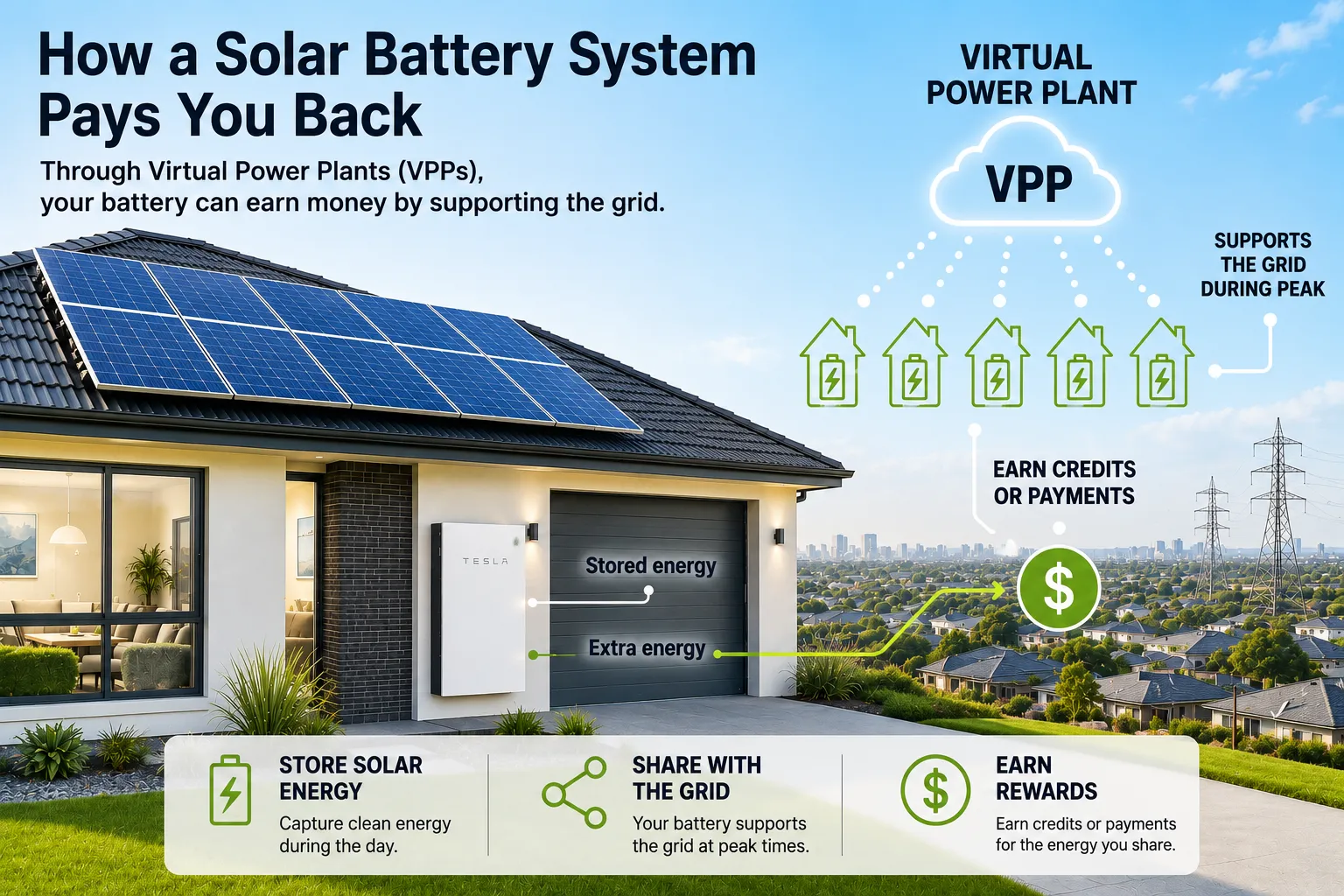

Most homeowners install solar to cut their power bill. Fewer realise that a solar battery system can also become a source of income, not just a cost-saving device. Through Virtual Power Plants (VPPs), households across Australia are now getting paid to let their battery support the wider electricity grid, turning what was once a one-way expense into a two-way asset.
Key Takeaways
- A VPP links thousands of home batteries into one network that can release stored energy to the grid during periods of high demand.
- Homeowners can be compensated through upfront incentives, bonus feed-in tariffs, or ongoing bill credits, depending on the plan.
- Retailers such as Origin now offer multiple battery plans, ranging from no VPP involvement to fully automated earnings.
- Joining a VPP is a requirement for some rebate eligibility, but active participation is generally optional once the system is installed.
- Not every VPP plan suits every household - control, contract terms, and payment structure vary significantly between providers.
What Is a Virtual Power Plant, and How Does a Solar Battery System Fit In?
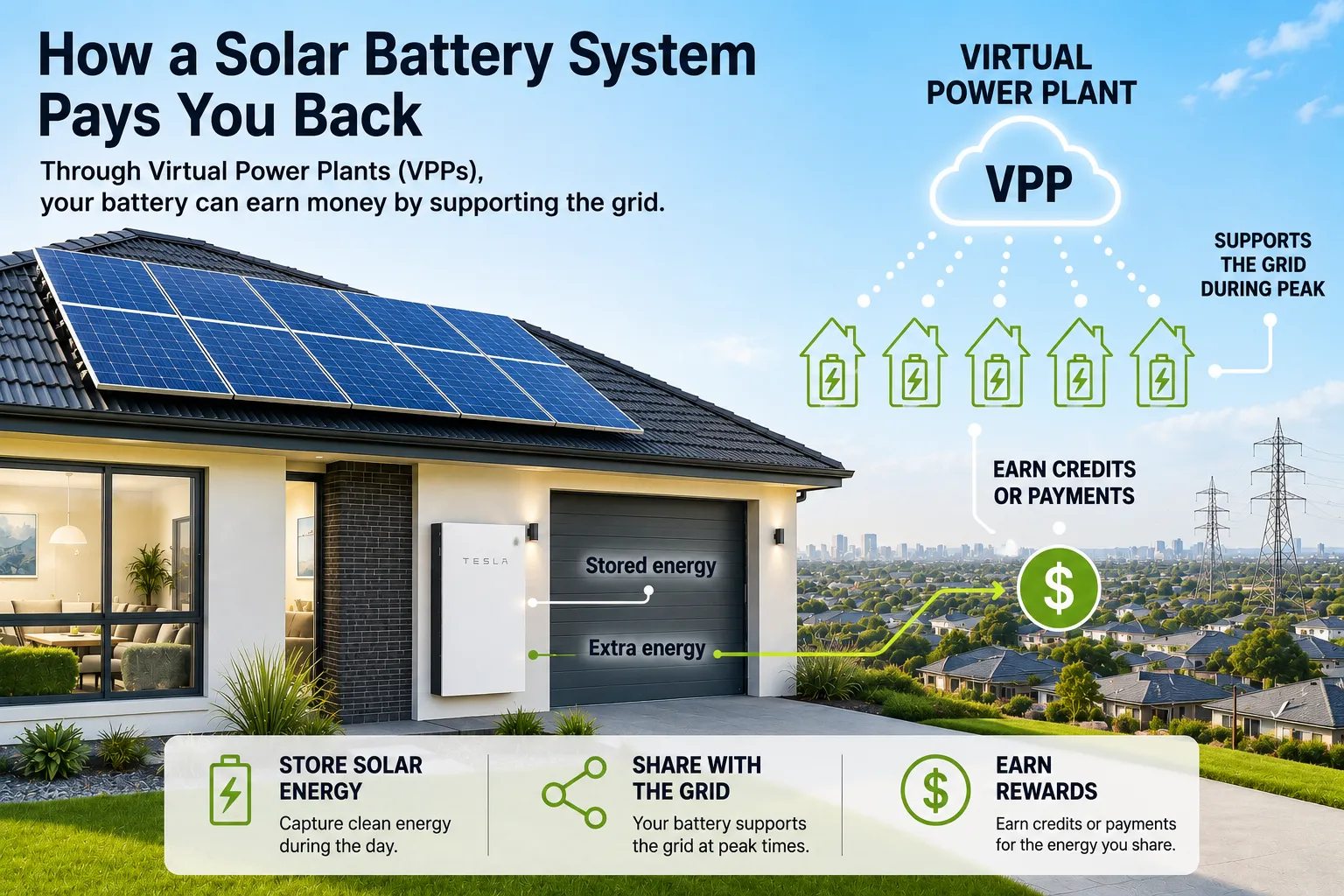
A Virtual Power Plant (VPP) is a network of home batteries and solar systems, connected by software, that acts as one combined power source the grid can draw on during periods of high demand. Instead of a single power station, thousands of individual solar battery systems are linked together, and an operator can draw on their stored energy when the grid needs extra supply, such as during a heatwave.
For this to work, a solar battery system needs to be connected to the internet and compatible with the VPP operator's software. Most modern battery inverters are built with this capability already in mind, which is part of why VPP eligibility has become a standard requirement for some government battery rebates, even for households who don't plan to actively participate straight away.
How Much Can Homeowners Actually Earn?
Compensation depends heavily on the provider and the plan selected. As an example, Origin Energy currently offers three tiers for battery owners: a no-VPP option with a straightforward feed-in tariff, a lighter VPP plan offering a sign-up credit with limited battery access, and a fully automated option offering a higher peak feed-in rate with uncapped export earnings.
State-based incentives can add further value. In NSW, for example, the size of the upfront VPP incentive is generally tied to how much battery capacity a household makes available to the grid, up to a capped amount, and this is on top of any federal battery rebate already claimed. South Australia offers a comparable incentive through its own state energy productivity scheme. Because these figures are updated periodically, homeowners should confirm current rates directly with their state energy authority or their installer before assuming a specific dollar figure.
RESINC's guide to Origin battery plans breaks down the three tiers in more detail, including which households each plan tends to suit.
What Should Homeowners Weigh Up Before Joining a VPP?
Signing up for a VPP isn't automatically the right move for every household, and a few factors are worth considering carefully:
- Control trade-off: joining a VPP typically means handing some control of when the battery charges and discharges to the operator, in exchange for payment.
- Reserved capacity: many VPP plans reserve a portion of the battery purely for the homeowner's own backup use, while the rest is available to the operator.
- Contract terms: some VPPs require a fixed-term agreement with an exit fee, while others allow the homeowner to leave at any time.
- Compatibility: not every battery and inverter combination is eligible for every VPP; approved equipment lists vary by provider.
- Retailer switching: some VPP plans require switching electricity retailers entirely, while others operate independently of the retailer relationship.
Households that skip this comparison sometimes find that the ongoing VPP payments don't offset a less competitive standard tariff, so it's worth comparing the all-in numbers rather than just the advertised sign-up bonus.
What Does VPP Participation Look Like in Practice?
Case studies help illustrate what this can look like in practice. One RESINC customer combined a new solar installation with an existing system, both feeding into a single, well-configured solar battery system, and reports going without an electricity bill for more than two years while earning roughly $4,000 in credits through active VPP participation. Results like this vary by household, system size, and location, but they show the kind of outcome VPP participation can realistically support when the system is properly designed from the outset.
Does System Design Matter More Than the VPP Itself?
It's worth remembering that a home solar power system and its battery still need to be sized correctly for the household's actual usage first. A VPP can add a meaningful income stream on top of a well-designed system, but it isn't a substitute for one. A battery that's undersized for the home's evening usage, or a solar array that doesn't generate enough excess to charge it fully, will limit how much value a VPP can add regardless of the plan chosen.
This is one reason installers increasingly discuss VPP eligibility at the design stage, rather than treating it as an afterthought once the system is already installed. Matching battery capacity, inverter compatibility, and household usage patterns from day one makes it far easier to take advantage of VPP options later, whether that's immediately or a year or two down the track. This RESINC customer story shows what that kind of upfront design work can look like once a system is up and running.
Frequently Asked Questions
Can a household join a VPP after the solar battery system has already been installed?
In most cases, yes, provided the existing battery and inverter are on the VPP provider's approved equipment list. Some older battery models or non-networked inverters may not be compatible without an upgrade, so it's worth checking compatibility before assuming any battery can be added to a VPP later.
Does joining a VPP void the battery's manufacturer warranty?
Generally no, since VPP participation typically works within the battery's normal operating parameters rather than pushing it beyond them. That said, homeowners should confirm this with both the battery manufacturer and the VPP provider, as terms can vary between brands.
Can a household leave a VPP if the arrangement doesn't work out?
This depends entirely on the contract. Some VPP providers allow homeowners to exit at any time without penalty, while others require a minimum term or charge an exit fee. Reading the contract terms before signing up is the only reliable way to know which applies.
Do all electricity retailers offer VPP programs?
No. Some major retailers run their own VPP programs tied to switching to their retail plan, while other independent VPP operators let households keep their existing retailer. This is worth checking, since switching retailers can affect other parts of a household's electricity plan beyond just the VPP arrangement.
Is VPP income taxable for an average household?
This depends on individual circumstances and how the payments are structured, so it isn't something a solar installer can advise on directly. Households should check with a tax professional or the ATO for guidance specific to their situation.
Does a household need a large solar system to make VPP participation worthwhile?
Not necessarily, but the battery still needs enough excess solar to charge from most days. A home solar power system that's undersized for the household's daytime usage may leave little spare capacity to store, which limits how much a VPP can realistically pay out, regardless of the plan.
Final Word
A well-designed battery does more than just reduce a household's reliance on the grid - paired with the right VPP, it can also become a modest source of ongoing income. The size of that benefit depends on the plan chosen, the household's usage pattern, and how well the underlying system was designed in the first place. Homeowners considering this path should start with a properly sized system and treat VPP participation as a bonus on top, rather than the main reason for going solar.



























Sign in to leave a comment.