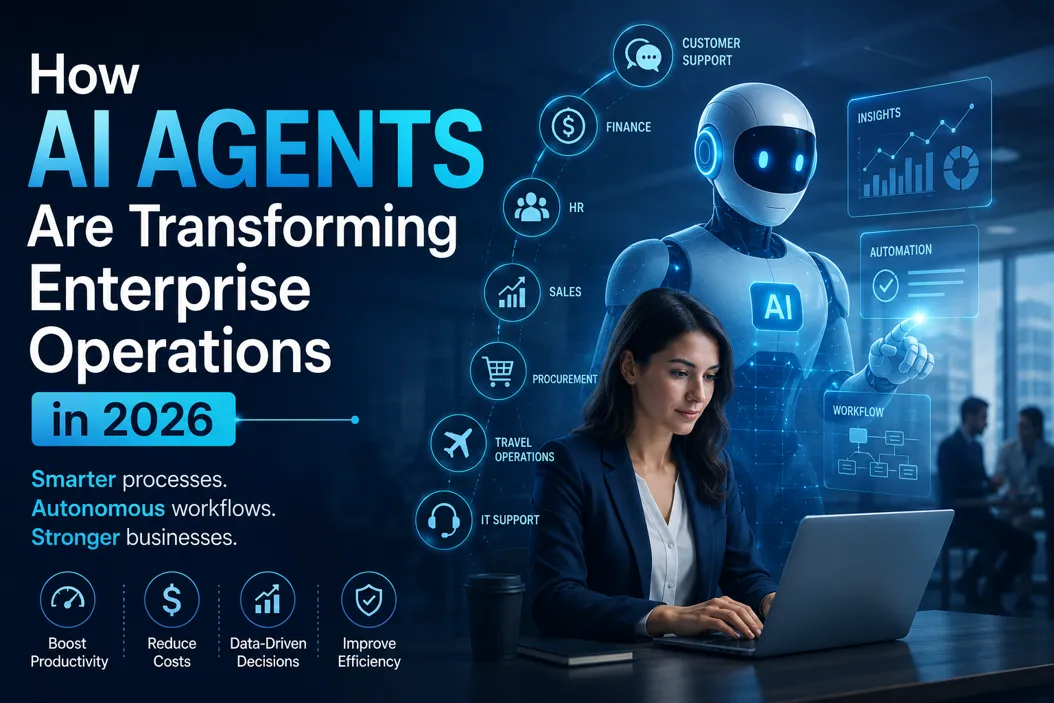

For most of the last decade, "AI" inside the enterprise meant a chatbot that deflected support tickets or a model that scored a lead. Useful, but narrow. The technology answered questions; humans still did the work. That distinction is what quietly collapsed over the past eighteen months. The arrival of capable, tool-using AI agents, software that can reason through a goal, call the right systems, and complete a multi-step task without a human driving each click, has changed what "automation" means. By 2026, agents have moved out of innovation labs and into the daily operating rhythm of finance, support, IT, and travel teams.
The change matters because the ceiling is different. A chatbot's best day still ends with a person picking up where it left off. An agent's best day ends with a closed ticket, a filed expense report, or a reconciled invoice, no handoff required. That is a different economic proposition, and enterprises are treating it as one.
From answering to doing
The clearest way to understand the 2026 agent is to contrast it with what came before. Traditional chatbots follow scripted decision trees: if the user says X, reply Y. Robotic process automation (RPA) was more capable but brittle, it repeated fixed sequences of clicks and broke the moment an interface changed. Agents sit in a different category entirely. They interpret an objective in plain language, decide which steps and tools are needed, adapt when something unexpected happens, and remember context across a workflow.
Practically, that means an agent can be told "process this refund request" rather than programmed with forty rules about how refunds work. It reads the request, checks the order system, verifies the policy, issues the refund through the payment API, and logs the outcome in the CRM. Each of those steps once belonged to a person or a rigid script. Now they belong to one agent that treats them as a single task. The organizations seeing the most value are the ones that stopped thinking of agents as smarter chatbots and started thinking of them as digital coworkers assigned to a function.
Where agents are landing first
 Adoption is not uniform. Agents are showing up fastest in functions defined by high-volume, repeatable, data-heavy work, exactly the tasks that drain skilled employees without using their judgment.
Customer support was the obvious first beachhead. Support agents now resolve routine issues end to end, escalating only genuine edge cases, and they operate across the channels customers already use: web chat, WhatsApp, email, and messaging apps. The headline metric has shifted from "deflection rate" to "resolution rate," a telling sign of the change in expectations.
Finance and travel operations have become a surprisingly strong second front. Corporate travel and expense management is a natural fit: the data is structured, the questions are repetitive, and reporting is often time-consuming. Tools like ITILITE's AI travel analyst, Iris, let finance and travel managers ask questions about their travel program in plain language and receive instant answers, generate reports, uncover spending trends, and identify policy exceptions without digging through dashboards or spreadsheets. Work that once required hours of manual analysis can now be completed with a simple prompt. That compression—from data retrieval to actionable insight in seconds—is exactly the pattern repeating across back-office functions.
IT and internal operations follow close behind, with agents handling password resets, provisioning, and first-line troubleshooting. Sales operations teams are deploying agents to update records, follow up with leads, and keep pipelines clean, the connective tissue work that reps routinely neglect.
The Build-vs.-Buy Shift
 Two years ago, deploying an enterprise-grade AI agent often required a dedicated engineering team, custom integrations, and months of development. In 2026, that barrier has dropped dramatically. Businesses no longer have to build everything from scratch, and that's changing who can adopt AI at scale.
Large enterprises with in-house engineering teams may still prefer custom development using foundation model APIs. However, a growing number of organizations are choosing ready-made platforms that allow teams to design, customize, and deploy AI agents without extensive coding. This significantly reduces implementation time while making AI accessible to non-technical teams.
One of the biggest drivers behind this shift is the rise of the White label AI agent platform. Instead of building proprietary AI infrastructure, agencies, SaaS providers, and consultancies can launch fully branded AI assistants under their own name, customize workflows for different clients, and maintain complete control over the customer experience. This enables them to expand their service offerings without investing heavily in AI engineering.
The impact extends far beyond technology vendors. Marketing agencies can offer branded customer support agents, healthcare consultants can deploy AI assistants for patient inquiries, and HR firms can provide employee help desks—all powered by the same underlying platform while appearing as their own solution. As a result, AI agent technology is reaching mid-market businesses through trusted service providers rather than exclusively through direct enterprise software vendors.
For operations leaders, the takeaway is clear: building a custom AI agent is no longer the only viable path. In many cases, adopting a White label AI agent platform delivers enterprise-grade capabilities, faster deployment, lower development costs, and the flexibility to create branded AI experiences without maintaining complex infrastructure.
What actually changes inside the organization
The interesting part is not the technology; it is what it does to how work is structured. Three shifts stand out.
First, measurement moves from activity to outcomes. When a team's routine throughput is handled by agents, tracking "tickets touched" or "reports generated" stops being meaningful. Leaders are re-anchoring on business results, resolution, cost saved, cycle time, because the agents are measured that way too.
Second, headcount stops scaling linearly with volume. The old assumption that more customers or more transactions required proportionally more staff no longer holds for the automatable layer. Teams are absorbing growth without expanding, and redirecting human effort toward judgment, relationships, and exceptions.
Third, the human role shifts to oversight and edge cases. The best deployments keep a human in the loop for anything ambiguous, sensitive, or high-stakes. Employees increasingly manage a small fleet of agents rather than doing the base work themselves, a genuine change in job design that the smartest organizations are planning for rather than stumbling into.
The guardrails that separate winners from cautionary tales
 None of this is risk-free, and 2026 has produced its share of cautionary tales. An agent with the authority to act is an agent that can act wrongly, at scale and fast. The enterprises getting this right treat governance as a first-class part of deployment, not an afterthought.
That means tightly scoping what each agent can access and do, agents should touch only the specific systems and data a task requires, with permissions that can be revoked instantly. It means enterprise-grade security around the data agents handle, particularly for finance, travel, and customer records where a leak is catastrophic. And it means auditability: every action an agent takes should be logged and reviewable, so that "the AI did it" is never an excuse but always a traceable event.
How to start without overreaching
For leaders feeling pressure to "do something with agents," the sane path is narrow and concrete. Pick one high-volume, low-ambiguity workflow, expense report intake, tier-one support, meeting scheduling, and deploy a single agent against it with clear success metrics and a human reviewing outcomes. Prove the value, tighten the guardrails, then expand to the next workflow. The organizations extracting real returns in 2026 are rarely the ones that attempted a sweeping transformation. They are the ones that shipped one useful agent, learned from it, and compounded.
The larger point is that AI agents have crossed from novelty to infrastructure. The question facing enterprise operations leaders is no longer whether agents will change how their teams work, that is already happening, but whether they will shape that change deliberately or inherit it by default. In 2026, the gap between those two postures is becoming the gap between the operations teams that pull ahead and the ones that spend the year catching up.
































Sign in to leave a comment.