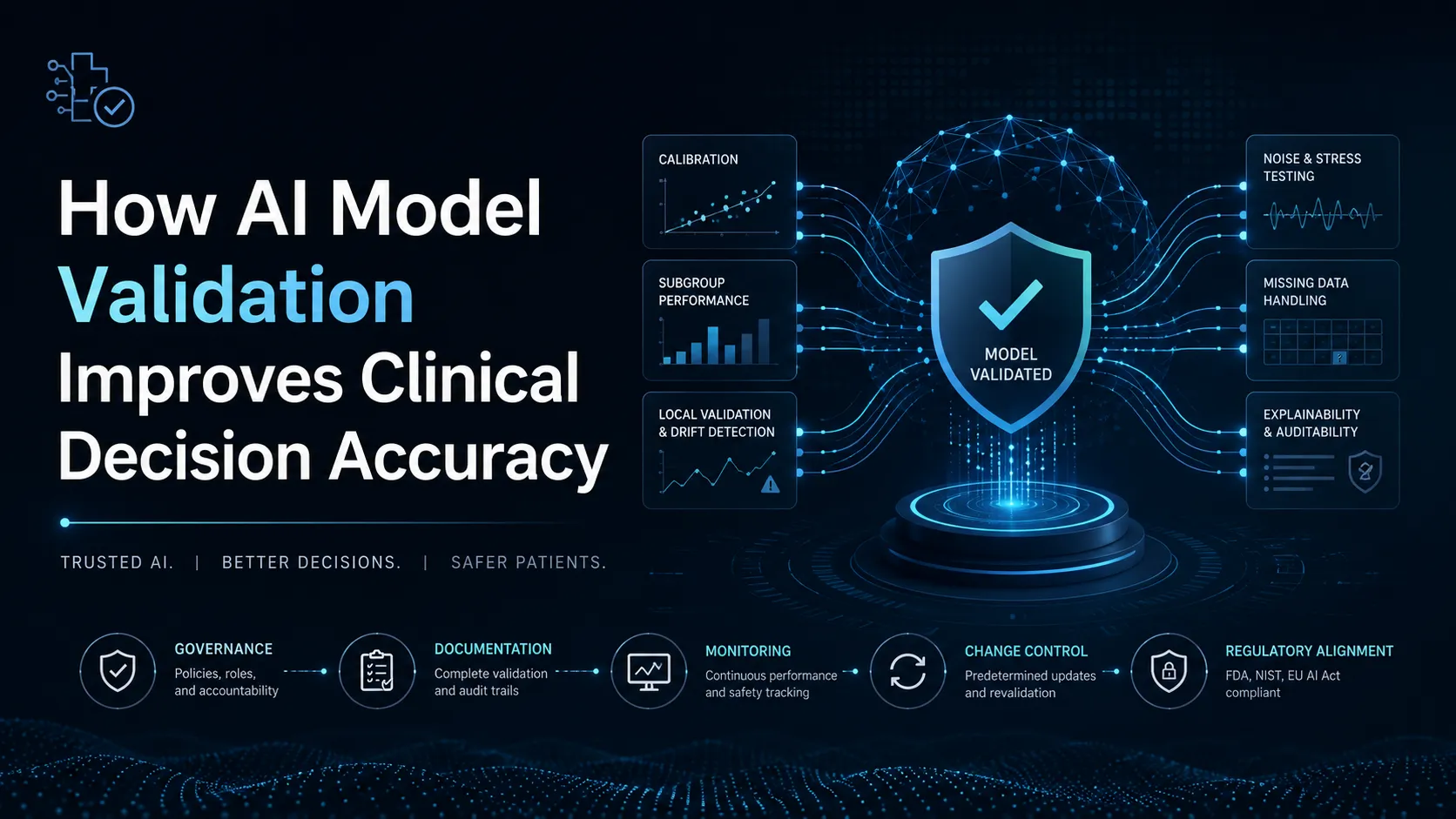

How AI Model Validation Supports Accurate Clinical Decision-Making
I have watched a clinical AI tool clear every internal benchmark and still fail the people who depended on it. The model looked flawless in the lab. High accuracy. Clean report. Sign-off from the data team. Then it reached the ward and missed the cases it was brought to catch.
The difference between that failure and a model a clinician actually trusts comes down to one thing. How it was validated. AI model validation is the work that turns a raw algorithm into a recommendation safe enough to shape a real care decision. Done well, it does more than flag a weak model. It tells a doctor when the output deserves weight and when it does not, which is exactly what makes the call at the bedside more accurate. Here is how that works.
Where Accurate Clinical Decisions Start: Validation Beyond the Benchmark
A high benchmark score tells you that a model learned its training data. It does not tell you the output will hold up on a patient it has never seen. That distinction is where decision accuracy is won or lost. The Epic Sepsis Model is the case every health system should study. Epic reported strong numbers. Then researchers at Michigan Medicine ran an external check and found a sensitivity of 33% and an AUC of 0.63. The model missed roughly two-thirds of sepsis cases and buried clinicians in false alerts. A doctor who trusted that output made worse calls, not better ones. Epic later dropped the one-size-fits-all version for site-specific tuning, which is the correction of proper AI model validation surfaces early.
The stakes scale with adoption. The FDA has authorized more than 1,400 AI-enabled medical devices through the end of 2025, and almost all are decision-support tools. A human still makes the final call. So validation is not an academic score. It decides whether the recommendation in front of a tired clinician at 3 am sharpens the decision or corrupts it. A model that passes the benchmark but fails validation does not stay neutral. It actively pulls decisions the wrong way.
The AI Model Validation Checks That Make a Bedside Decision More Accurate
Real AI model validation covers several distinct checks, and each one maps to a specific way the clinical decision gets better. None of them shows up in a single accuracy figure, which is why a clean benchmark hides so much.
Calibration: when a risk score means what it says
Calibration confirms that a "70% risk" output is right about 70% of the time in your population. This is what lets a clinician weigh the number rather than guess at it. A miscalibrated model that reads 70% when the true risk is closer to 30% does not just mislead. It pushes the care team toward overtreatment, which carries its own patient harm. A calibrated model gives the doctor a figure they can act on with confidence, and that confidence is the whole point of a decision-support tool.
Subgroup performance: accuracy that holds for every patient
A model tuned on one patient mix can quietly underperform on another. Subgroup validation confirms that the output remains accurate across age, sex, and demographic groups. Skip it and the damage compounds. A blind spot produces biased recommendations. Those recommendations expose the organization to liability and equity scrutiny. That scrutiny then invites regulators. Validate the subgroups, and the doctor gets a recommendation that holds up for whoever walks through the door, not just for the average patient in the training set.
Local validation and drift detection: accuracy that survives your site and your timeline
When clinical AI fails, the cause is rarely a code defect. It is a mismatch between the population the model was trained on and the one it now serves. A sepsis model built on academic-center data behaves very differently in a rural county hospital. Local validation, run on your own data before deployment, catches that gap before a patient does. Drift detection then watches for the slow decay that sets in as patient patterns shift after launch. The FDA now lets manufacturers pre-register a Predetermined Change Control Plan so models can be updated and revalidated without starting over. Together, they keep the recommendation as sharp in month twelve as it was on day one.
Noise and stress testing: accuracy when the input is messy
Real clinical data is rarely clean. A typo, a mislabeled unit, a noisy sensor reading. Noise and stress testing feed the model these imperfect inputs on purpose to see whether the output stays stable or swings wildly. A model that gives a very different answer over a tiny change in input is not safe to guide a decision. One that holds steady hands the clinician a recommendation that does not flip on small data errors they cannot even see, which is the kind of failure that quietly erodes trust over time.
Missing-data handling: accuracy when records are incomplete
In production, fields go missing all the time. A lab value never resulted, an interface timed out, a box was left blank. This check confirms the model degrades gracefully instead of producing a confident but nonsensical output when a feature is absent. A model that fills a gap with a bad assumption hands the doctor a number that looks trustworthy and is not. Graceful handling keeps the recommendation honest about what the model actually knows, so the clinician knows when to lean on it and when to set it aside.
Explainability and auditability: accuracy that a clinician can question
An explanation that a physician cannot interrogate does not warrant blind adherence. Explanation verification guarantees that the system is capable of generating an explanation of how the output was generated, while auditability ensures that the rationale behind this generation process is recorded for future assessment. This becomes important at the moment of consultation, when the clinician has to verify the recommendation by applying it to the patient being examined. This is also relevant during the subsequent safety analysis, which questions the logic behind a certain clinical recommendation. An explanation that is open to interrogation is indeed a usable one.
How Governance Keeps Clinical Decisions Accurate After Go-Live
Validation is no mere technical process; it is a governance decision by accountable people. This accountability keeps decisions accurate long-term. The CMIO validates the clinical fit. The compliance department audits the traceability record. The project lead oversees performance post-launch as well as pre-launch. Clinical AI is officially considered high risk under the new EU AI Act, requiring model validation documentation, while the NIST framework offers US organizations similar guidance.
Skip this layer, and the failure stays invisible. Clinicians do not file a complaint. They stop trusting the tool and work around it, so even a model with decent metrics dies in adoption and stops supporting any decision at all. Teams that build healthcare AI solutions the right way treat governance, audit trails, and continuous monitoring as part of the product rather than paperwork bolted on at the end. That discipline keeps a model trustworthy through the first hard edge case, which is where most tools quietly break.
The Bottom Line
The lesson is consistent across every failed and every trusted clinical model I have seen. AI model validation is the mechanism that lets a system genuinely support a care decision instead of quietly skewing it. Each check earns a piece of that trust. Calibration makes the number honest. Subgroup testing makes it fair. Local validation makes it fit your site. Noise testing, missing-data handling, and explainability keep it steady, complete, and answerable. One caveat is worth naming. Validation is never one and done. Even a well-checked model drifts as the world around it changes, so revalidation has to be scheduled, not improvised. Get it right and the model makes the clinician sharper. Get it wrong and it works against them in silence.

























Sign in to leave a comment.