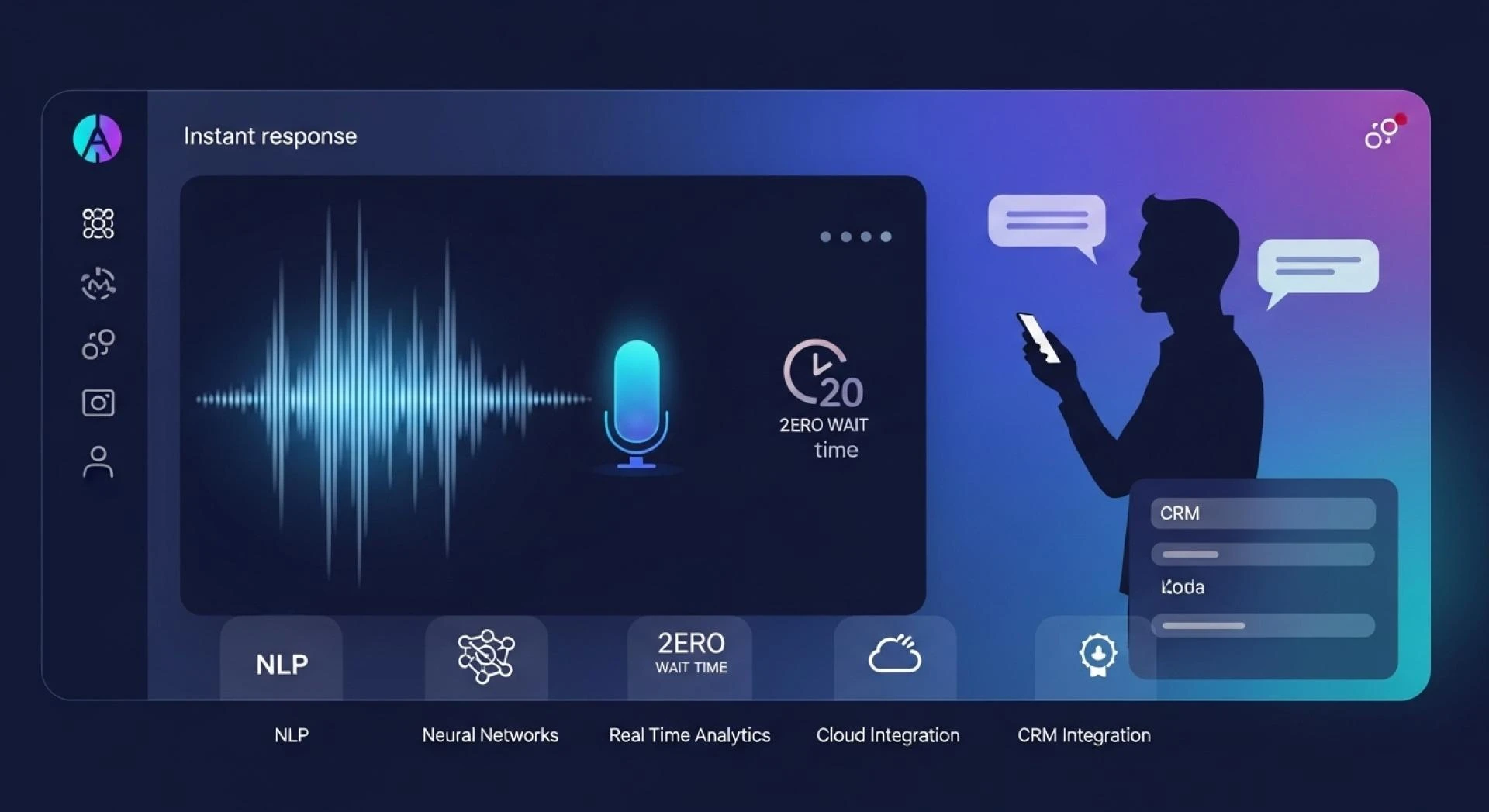

In the fast-evolving world of customer experience, speed and personalization are the twin pillars that shape modern expectations. Customers today do not just want answers. They want answers right away, and they want the exchange to feel natural, empathetic, and contextual. Traditional customer service models, including legacy IVR phone systems and human-only support centers, often struggle to meet these expectations. Call queues stretch for minutes. Conversations feel robotic. Resolutions slow down. Satisfaction slips.
AI voice bot solutions have entered this landscape as a transformative force. They provide instant responses, deliver contextual conversations, adapt to individual users, and learn continuously from every interaction. They eliminate long hold times. They communicate in natural language. Most importantly, they enable enterprises to scale customer support without increasing headcount or compromising quality.
This article explores how AI voice bot solutions are designed to deliver human-like conversations while ensuring zero wait time. It explains the technology powering their conversational intelligence, how they integrate with organizational systems, and why they are setting the new benchmark for real-time customer engagement.
Understanding AI Voice Bot Solutions
AI voice bots are automated systems that use artificial intelligence and natural language processing to engage in real-time voice-based communication with users. These bots do more than respond to commands. They understand the intent behind spoken language, detect tone, consider context, retrieve information, take action, and maintain a fluid dialogue.
Unlike traditional IVR systems that force callers to navigate numeric options, AI voice bots allow customers to speak naturally. Instead of “Press 2 for account support,” users simply say, “I want to know why my bill is higher this month,” and the bot knows what they mean.
This shift moves customer service from rigid menu trees to intuitive, conversational dialogue.
Why Human-Like Interactions Matter in Customer Engagement
A conversation feels human when it is fluid, empathetic, relevant, and responsive. Human-like conversations build trust. They reduce emotional friction. They create a sense of being heard and understood.
Customers respond positively to conversational experiences because they reflect how people naturally communicate.
But human-like interactions require more than vocabulary. They require:
- Understanding emotional patterns in speech
- Responding with contextually relevant information
- Remembering previous conversations and preferences
- Maintaining clarity and continuity in dialogue
AI voice bots are engineered to deliver these capabilities at scale. They can handle thousands of simultaneous conversations without losing consistency. This makes them valuable in industries like banking, retail, healthcare, telecommunications, travel, logistics, and hospitality.
The Technology Enabling Human-Like Voice Conversations
To provide seamless and natural conversations, AI voice bots rely on an integrated stack of advanced technologies. These include:
1. Automatic Speech Recognition (ASR)
ASR converts the user’s spoken language into machine-readable text. Modern ASR models are trained on diverse accents, speeds, speech patterns, and dialects. This allows the bot to accurately understand users from different regions and languages.
2. Natural Language Understanding (NLU)
NLU interprets the meaning behind the spoken words. It extracts intent, context, sentiment, and key variables. This step ensures the bot understands what the user is asking and why.
3. Dialogue Management Engine
This engine maintains the flow of conversation. It decides how the bot should respond, what action to take, and how to keep the exchange coherent and natural.
4. Text-to-Speech (TTS) and Speech Synthesis
Once the bot decides what to say, TTS converts text back into spoken audio. Advanced voice bots use neural-based speech synthesis that produces expressive, realistic, and emotionally aware speech. This makes the conversation sound less robotic and more human.
5. Integration with Data and Business Systems
AI voice bots are connected to CRM systems, order databases, customer profiles, payment gateways, scheduling systems, and more. This allows them to take actions such as checking balances, booking appointments, processing returns, and verifying identities in real time.
Zero Wait Time: The Core Advantage
One of the most critical benefits of AI voice bots is their ability to engage with users instantly. They never get overwhelmed by spikes in call volume. They do not require breaks. They respond immediately at any hour.
This eliminates one of the most frustrating elements of traditional customer support: waiting.
No call queues.
No hold music.
No tickets that take days to resolve.
Customers get immediate acknowledgment and support. This alone significantly boosts satisfaction.
How AI Voice Bots Personalize Conversations in Real Time
Human-like conversations depend on personalization. AI voice bots use customer data and real-time interaction signals to tailor dialogues. They can:
- Recall previous conversations and interactions
- Recognize returning customers
- Adjust tone based on emotional cues
- Offer contextual recommendations
For example, a customer contacting an eCommerce brand about a delayed package will not be asked to repeat order information already stored in the system. The bot identifies the user, fetches shipment data, and presents an update instantly.
This ability to personalize without friction is what transforms the conversation from transactional to relational.
Continuous Learning and Improvement
Modern AI voice bots learn from every conversation. They analyze patterns in dialogue, evaluate success metrics, adapt to language variations, and refine their responses. This learning loop strengthens accuracy, empathy, and fluency over time.
Feedback loops help training models understand:
- Which answers clarify user concerns
- When misunderstandings occur
- How emotional tone affects customer perception
- What resolutions are most effective
This makes voice bots smarter, faster, and more intuitive with real-world usage.
Key Benefits Enterprises Gain from AI Voice Bot Solutions
1. Scalable Customer Support
Voice bots handle thousands of conversations simultaneously. Enterprises no longer need to expand support teams during seasonal peaks or product launches.
2. Cost Efficiency
They reduce the workload for human agents, lowering hiring, training, and operational costs while improving service coverage.
3. Consistency and Accuracy
Voice bots provide reliable and uniform responses. Unlike human agents, they do not vary in mood, tone, or knowledge.
4. Always On Availability
Customers can get assistance at any time of day, including holidays and weekends.
5. Improved Customer Satisfaction
Instant responses and conversational ease result in a positive user experience and stronger customer loyalty.
Human Agents and AI Voice Bots Working Together
AI voice bots do not replace human support. Instead, they act as the first line of engagement. They handle common queries, triage customer intent, and solve routine tasks. When a situation requires human judgment or emotional sensitivity, the bot transfers the conversation to a human agent along with full context, so the user does not need to repeat themselves.
This collaboration results in:
- Faster resolutions
- Reduced workload on agents
- Better outcomes for complex cases
Agents are free to focus on tasks where empathy and critical reasoning are essential.
Real-World Use Cases of AI Voice Bots
AI voice bot solutions are being deployed across industries to streamline interactions and enhance the overall experience.
Banking and Financial Services
Bots assist users with account inquiries, loan applications, credit card information, and fraud alerts.
Healthcare
Bots help schedule appointments, manage patient reminders, and answer basic medical service questions.
Retail and E-commerce
Bots provide order tracking, returns processing, product recommendations, and offers.
Travel and Hospitality
Bots handle booking clarifications, itinerary updates, check-in instructions, and on-trip support.
Telecommunications
Bots assist with plan upgrades, billing clarifications, and technical troubleshooting.
The Future of AI Voice Conversations
As generative AI models continue to evolve, voice bots will gain more nuanced language abilities, emotional intelligence, real-time reasoning, and adaptive personality traits. They will sound even more natural, interpret complex requests more effectively, and collaborate with multiple systems simultaneously.
In the future, customers may not be able to distinguish whether they are speaking with a human or AI. What matters is that the conversation delivers clarity, comfort, and convenience.
The future of customer engagement is instant, adaptive, voice-driven, and always available.
Final Thoughts
AI voice bot solutions are redefining how businesses interact with customers. They enable real-time support without wait times, deliver natural and empathetic conversations, and scale customer engagement to new levels. By combining advances in speech recognition, natural language understanding, dynamic dialogue systems, and real-time data integration, AI voice bots create experiences that feel genuinely personal and human.
Organizations that adopt AI voice bots are not just improving operational efficiency. They are creating a new benchmark for customer expectations. A world where conversations are effortless, immediate, and meaningful.


























Sign in to leave a comment.