

Consistency is the quiet engine behind every social account that actually grows. Not the loudest creative, not the biggest budget. Just showing up, in the same voice, at the same reliable rhythm, across every platform that matters. Yet for most growing businesses, that's exactly where things fall apart.
In this post, you'll learn what content consistency really means at an operational level, why it cracks under the weight of scale, and how AI-driven content workflows hold the line on tone, cadence, creative variety, approvals, and multi-platform delivery. You'll also get a practical checklist for evaluating platforms before you commit.
What Content Consistency Actually Means?
People hear "consistency" and picture a steady posting schedule. That's part of it, but it's the shallow part. Operationally, consistency has four distinct dimensions, and a business can fail at any one of them while nailing the others.
Voice consistency means your captions sound like the same brand whether they're written by your founder on a Tuesday or a freelancer on a Friday. Cadence consistency is the dependable rhythm of publishing, with no three-week silences followed by a panic burst of five posts. Visual consistency keeps your colors, layouts, and image style recognizable as someone scrolls. And strategic consistency ensures every post still ladders up to a coherent message rather than random topical noise.
The quick takeaway: consistency isn't one thing you maintain. It's four things you have to coordinate at once.
Why Consistency Breaks Down as You Scale?
The stakes here keep rising. Smart Insights reports, based on February 2025 data, that 63.9% of the world's population uses social media, with average daily usage of 2 hours and 21 minutes. Sprout Social, citing DataReportal, puts the figure at around 5.66 billion active social media users worldwide in 2026. Your audience is reachable at enormous scale, but only if you actually show up reliably enough to be remembered.
Here's the part most people miss: consistency doesn't break because teams are lazy. It breaks because of structural friction that grows with the business.
1. More platforms, more divergence
A single founder posting to Instagram can hold a consistent voice in their head. Add LinkedIn, Facebook, X, Pinterest, and Google Business Profile, and that mental model fractures. Each platform has its own format quirks and tone expectations, so the brand drifts a little on every channel until none of them quite match.
2. More hands, more variation
When two or three people contribute content, each brings their own phrasing, punctuation habits, and instincts. Without a tight system, "on-brand" becomes a matter of opinion, and your feed starts to read like a committee wrote it, because one did.
3. Competing priorities crush cadence
For most growing businesses, social media is one job among ten. The moment a product launch or a staffing crunch hits, posting is the first thing to slip. That's how you end up with a feed that's energetic in January and silent by March.
How AI-Generated Workflows Hold Consistency Together?
An AI social media post generator addresses these breakdowns at their source rather than patching the symptoms. Instead of relying on individual discipline, it encodes your standards into a repeatable system. Let's break down how that works across each dimension of consistency.
1. Locking in a single, stable voice
A well-trained generator learns your brand from your website, past content, or details you provide, then applies that voice to every caption it drafts. The result is phrasing that stays recognizably you regardless of who hits publish or which platform the post lands on. You stop relying on each contributor to internalize the brand and instead let the system enforce it.
This matters most when you're delegating. A new team member's first week no longer introduces tonal whiplash, because the baseline voice is already baked in and they're editing rather than inventing.
2. Protecting cadence without daily effort
Cadence is where automation earns its keep. When content is generated and queued in advance, your publishing rhythm no longer depends on someone remembering to post during a hectic week. The schedule holds steady because it's no longer hostage to daily availability.
The practical effect: those embarrassing three-week gaps disappear. Your audience and the platform algorithms both reward that reliability with sustained reach.
3. Creative variation without chaos
Here's a tension worth naming. Consistency shouldn't mean repetition. If every post looks and reads the same, you train your audience to scroll past. Strong AI workflows balance this by generating varied angles, formats, and visuals that still sit inside your brand guardrails.
The best platforms also check new posts against recent history so you don't accidentally recycle the same message. That's consistency and freshness: repeated themes without repeated phrasing.
4. Streamlining approvals
Approval bottlenecks quietly kill cadence. A post sits in someone's inbox for four days, the moment passes, and the schedule slips. Modern workflows fix this with structured review steps: content is drafted automatically, then a decision-maker approves, edits, or regenerates in minutes rather than rebuilding from scratch.
This is the underrated benefit of social media automation—it doesn't just speed up creation, it removes the friction in the middle that usually causes content to stall.
5. Coordinating multi-platform execution
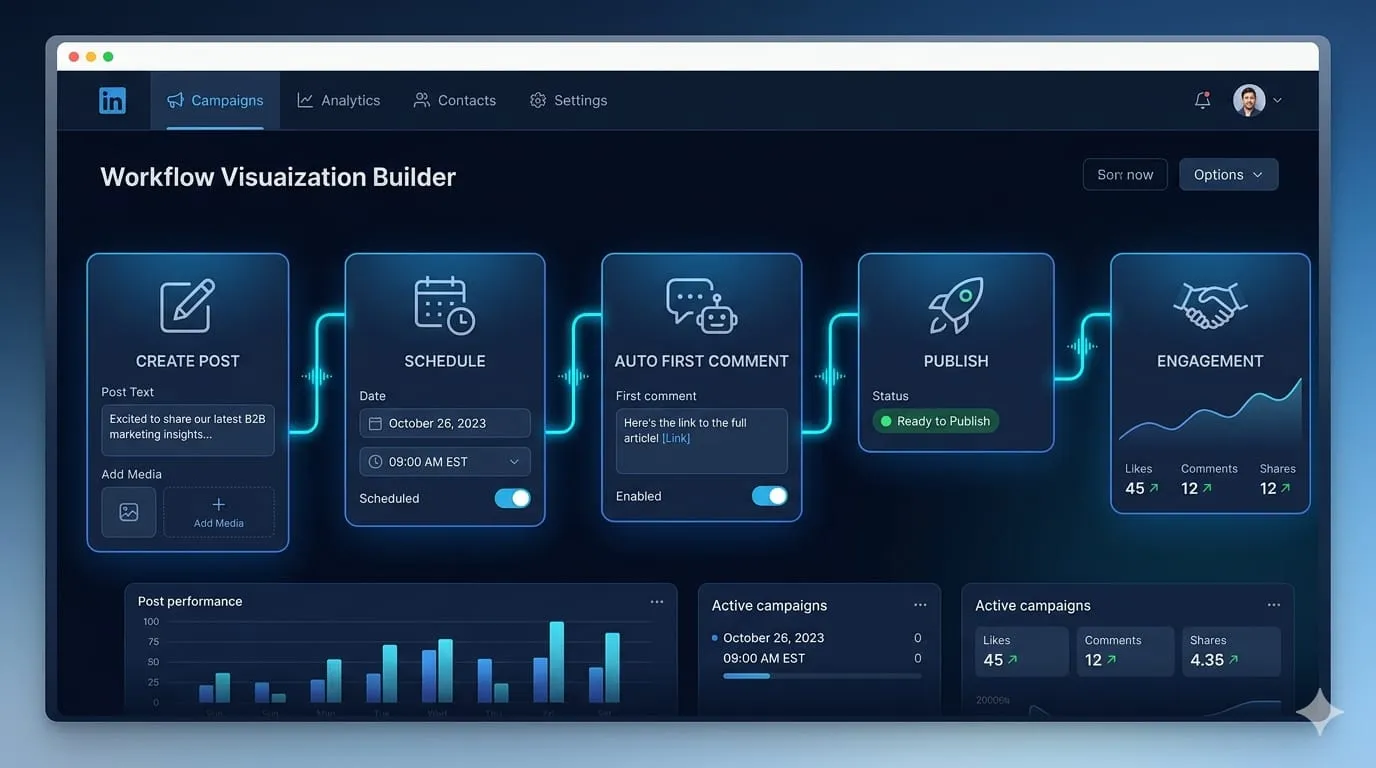
Publishing the same core idea natively across several channels—respecting each platform's format—is exhausting by hand. Automated workflows handle the adaptation and distribution from one place, so your message stays coherent everywhere without five separate manual efforts. That single source of truth is what keeps a five-channel presence from feeling like five different brands.
What to Evaluate Before You Adopt a Platform?
Not every tool delivers on these promises, and the gap between a capable platform and a shallow one is wide. Before committing to any social media automation tools, run candidates through a focused evaluation.
1. Brand learning depth
- Does it genuinely learn your voice, or just apply generic templates? Test it with real inputs and judge whether the output sounds like your brand or like everyone else's.
- Can it absorb your existing content and visual style, not just a few keywords?
2. Creative range and safeguards
- Does it vary formats and angles, or repeat the same structure endlessly?
- Does it check against recent posts to prevent duplication? Without this, "consistency" slides into monotony.
3. Workflow flexibility
- Can you choose your level of control, whether fully hands-off, or review-and-approve before anything goes live? Different teams need different oversight, and a rigid tool forces an awkward fit.
4. Performance visibility
- Does it report on what's actually working? Consistency without measurement is just routine. You want analytics that connect your cadence and content choices to engagement and growth.
If you're starting from scratch, prioritize brand-learning depth and ease of setup, since those determine whether you'll actually stick with the system. If you already post regularly but inconsistently, weight workflow flexibility and scheduling reliability instead, since those are your real bottlenecks.
A Common Mistake to Avoid
Don't treat automation as a reason to disengage entirely. Generating and scheduling content keeps your presence steady, but it doesn't replace real-time replies, comments, and community conversation. The strongest approach uses automation to guarantee the baseline of voice, cadence, and distribution, so your team's freed-up energy goes toward the human interactions that automation can't fake.
Used this way, the technology becomes a consistency engine rather than a crutch.
Bringing It Together
Content consistency isn't a single habit you maintain through willpower. It's the coordination of voice, cadence, creative variation, approvals, and multi-platform delivery—and every one of those gets harder as your business grows. AI-driven workflows hold those threads together by encoding your standards into a repeatable system, so reliability no longer depends on whoever happens to have a free afternoon.
The next step is practical: audit where your consistency actually breaks. Is it drifting voice, missed posting windows, approval stalls, or fragmented channels? Match a platform to that specific gap, then test it with real content before you scale.
A Closer Look at ClickGrow
If consistency is your core challenge, ClickGrow.ai is built squarely around it. The platform focuses on social media automation where AI creates, schedules, and publishes on-brand content across your channels while you stay focused on running the business. It learns your brand directly from your website or details you enter manually, so the voice it produces stays recognizably yours from the first post. Smart scheduling protects your cadence by posting at optimal times for each platform, while unique-content checks against 90 days of history keep your feed fresh rather than repetitive—the exact balance of steadiness and variety that consistency demands. It supports 39 languages, applies an industry-specific content strategy so your messaging stays on-theme, and includes analytics to show what's working. You also choose your oversight level: fully autonomous, or review-and-approve before anything goes live. For a growing business, that combination turns consistency from a daily struggle into a dependable system.





















Sign in to leave a comment.