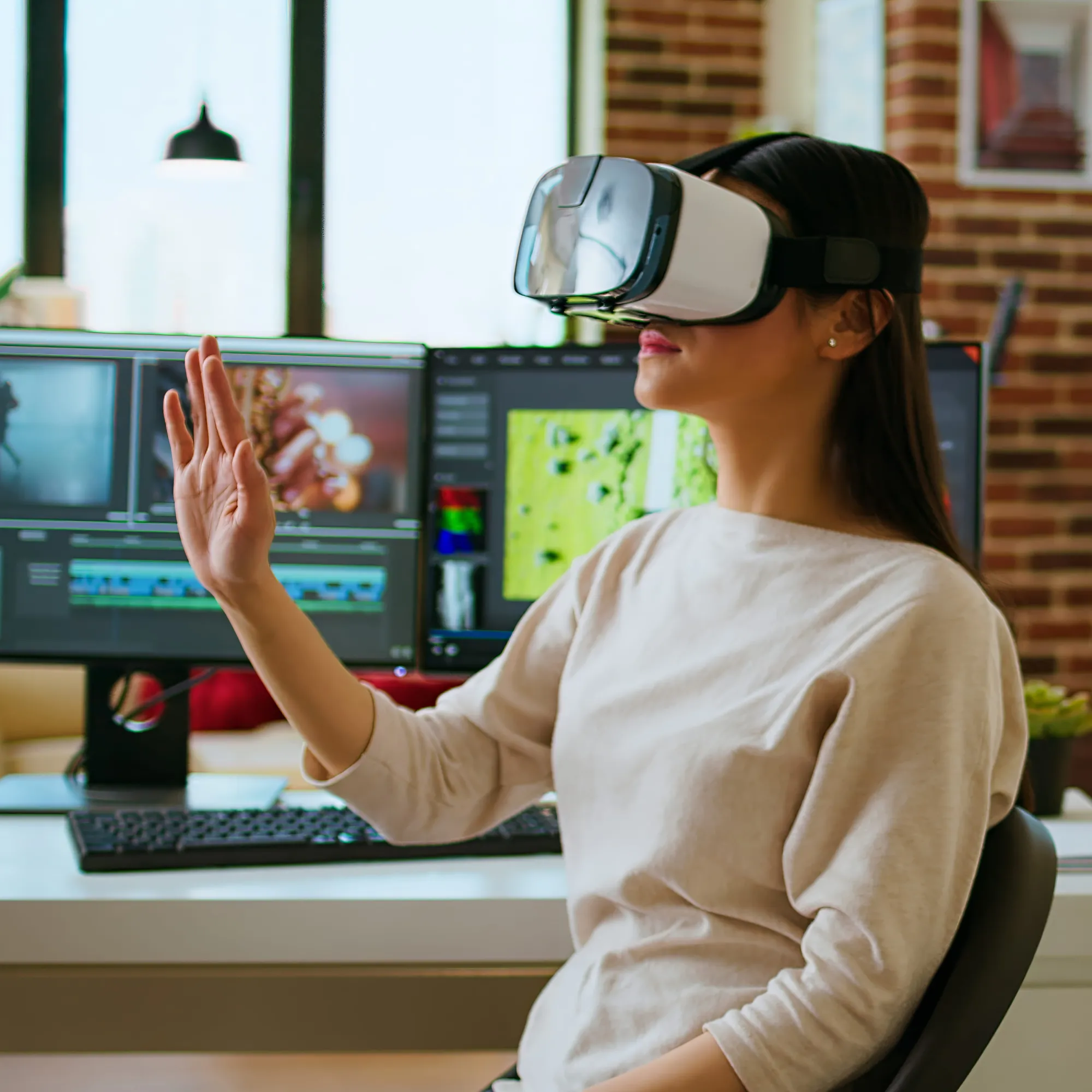

Modern commercial displays are moving beyond static two-dimensional flat panels into dynamic spatial environments. As enterprise operations, healthcare simulation centers, and higher education institutions seek more engaging ways to present complex data, spatial computing and spatial rendering are altering how teams interact with visual information. Integrating physical environments with digital content through augmented virtual reality creates collaborative spaces where multi-user teams evaluate 3D models, simulate complex industrial workflows, and conduct immersive training without requiring individual head-mounted displays.
The transition toward spatial display environments represents a fundamental shift in AV architecture. Rather than pushing pre-rendered video files to individual screens, modern spatial setups rely on real-time rendering engines, optical tracking sensors, and low-latency network pipelines. This shift allows organizations to turn ordinary walls, glass, and dedicated rooms into interactive canvases that respond immediately to human movement and dynamic data feeds.
Emerging Utility in Enterprise and Higher Education
Traditional interactive displays served their purpose well for basic annotation and video conferencing. However, complex technical environments demand higher levels of spatial depth and real-time interaction. In industrial corridors like Cleveland and Akron, manufacturing engineers use spatial visualization rooms to inspect digital twins of heavy machinery before physical production lines are built. Across university research labs in Columbus and healthcare simulation facilities in Buffalo, interactive spatial projections enable medical students to manipulate volumetric anatomy scans in real time collectively.
In commercial logistics and distribution hubs near Charlotte, operations teams deploy room-scale spatial displays to map warehouse traffic patterns and simulate supply chain bottlenecks before altering physical floor layouts. These practical applications demonstrate that spatial displays are operational tools designed to accelerate decision-making and reduce costly real-world errors.
Several core technological elements define these modern display environments:
- Spatial Projection and MicroLED Walls: High-density pixel arrays and short-throw laser projection systems project depth-mapped digital assets onto physical walls and floors, creating a three-dimensional perspective without user isolation.
- Real-Time Engine Integration: Content management platforms leverage spatial engines such as Unreal Engine and Unity to render dynamic assets instantly in response to user movement and live input.
- Multi-User Motion Tracking: Ceiling-mounted infrared sensors and optical camera arrays track multiple participants simultaneously, dynamically adjusting visual perspectives as users move through the physical space.
- Direct Data Streaming: Live IoT sensor feeds and enterprise resource planning data merge directly with spatial visual layers, converting static facility maps into live operational dashboards.
| Feature Category | Traditional AV Displays | Modern Spatial Immersive Systems |
| Visual Output | Static 2D video or flat interactive touch | Perspective-aware 3D spatial rendering |
| User Experience | Passive viewing or single-touch interaction | Multi-user collaborative immersion without headsets |
| Data Processing | Media player file playback | Real-time GPU rendering and edge computing |
| Network Demand | Standard 1GbE local network streaming | Uncompressed low-latency 10GbE AV-over-IP |
Infrastructure and Network Readiness
Deploying advanced spatial display environments requires careful planning around physical room conditions and network capabilities. Unlike standard conference room screens, spatial displays depend on precise optical calibration, ambient light control, and dedicated high-bandwidth network pipelines.
According to AVIXA standards for display image contrast and human factors engineering, room lighting design directly dictates visual clarity in multi-projection spaces. High ambient light levels can wash out complex depth cues, while improper display angles can induce eye fatigue in users during extended collaborative sessions. Physical enclosures must also account for seasonal temperature fluctuations in Northern climates, where HVAC adjustments in older facilities can cause subtle changes in ceiling-mounted camera rigs.
From corporate campuses to historical higher education buildings across Northeast Ohio, existing network infrastructure often presents bandwidth bottlenecks. Uncompressed real-time spatial rendering requires high-performance AV-over-IP networking built on 10GbE managed switches and BICSI-defined structured cabling standards.
Following CISA cybersecurity guidance for connected building systems, these rendering environments must sit on isolated virtual local area networks (VLANs) to prevent unauthorized network access. Organizations modernizing aging facilities often rely on experienced integration partners, including S3 Technologies, to assess network readiness and implement low-latency transport architectures to prevent lag during live spatial simulations.
Technical Evaluation Criteria
Technology leaders evaluating spatial display implementations should prioritize the following core system metrics:
- Frame Rate and System Latency: Confirm end-to-end rendering latency remains under 20 milliseconds to maintain visual fluidity and prevent motion discomfort during interactive sessions.
- Network Bandwidth Allocation: Ensure physical network architecture includes dedicated VLAN segmentation and 10GbE switches to support uncompressed spatial data streams without choking local traffic.
- System Interoperability: Verify native compatibility with industry-standard 3D software suites, Building Information Modeling (BIM) platforms, and web-based data APIs.
- Calibration and Maintenance Protocols: Select platforms equipped with automated camera-based auto-alignment tools to compensate for physical structural settling and ambient room drift over time.
Frequently Asked Questions
1. What is augmented virtual reality in commercial display technology?
It refers to spatial display systems that overlay real-time 3D digital assets onto physical environments, enabling multiple users to view and interact with dynamic spatial content without wearing individual headsets.
2. How does spatial display technology differ from traditional VR headsets?
Spatial displays project content onto room surfaces or specialized glasses-free 3D screens, allowing group collaboration, natural eye contact, and situational awareness, whereas VR headsets isolate individual users inside enclosed display goggles.
3. What network infrastructure is required to support immersive display systems?
Immersive spatial displays require low-latency AV-over-IP networks, typically backed by 10GbE managed switches, Cat6A structured cabling, and dedicated VLANs to handle uncompressed, real-time rendering feeds reliably.
4. How can universities and trade schools use immersive spatial environments?
Educational institutions use these environments for medical simulation, engineering design reviews, architectural walkthroughs, and vocational training, where students practice complex procedures safely in realistic 3D settings.
5. Are spatial display systems compatible with existing corporate AV networks?
Yes, when properly configured. Integrators segment spatial rendering traffic onto dedicated network subnets to ensure high-bandwidth video streams do not disrupt core business network operations or compromise system security.
Building a Flexible Display Strategy
Modernizing visual communication systems requires balancing advanced display capabilities with long-term facility infrastructure. When hardware, network pipelines, and spatial software align, displays evolve from passive screens into vital collaborative tools that enhance productivity and learning outcomes across enterprise environments.
To discover how modern spatial concepts can enhance your organization's physical spaces, learn more about emerging technology solutions designed for enterprise and educational environments.



























Sign in to leave a comment.