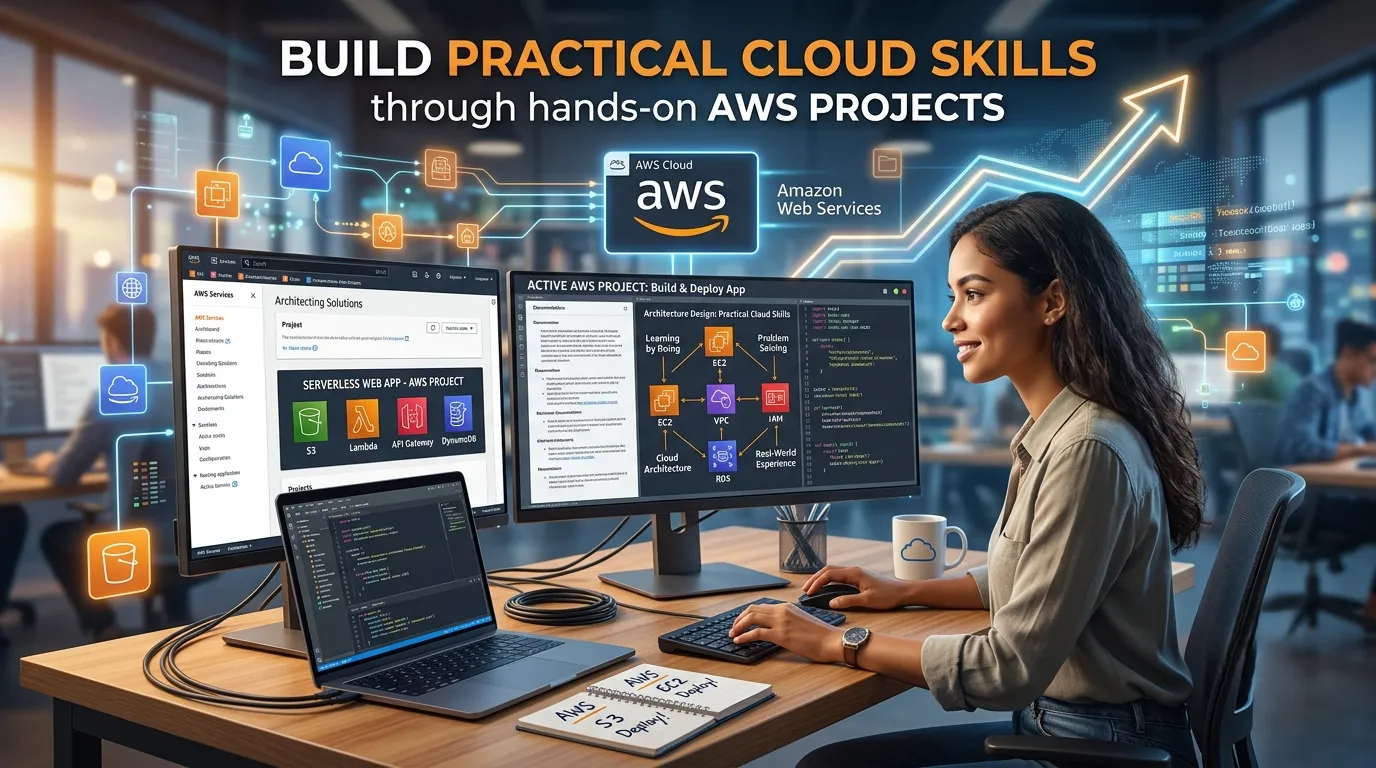

Cloud computing has become an important part of modern IT infrastructure, and Amazon Web Services (AWS) is one of the widely used cloud platforms for building and managing applications. While theoretical knowledge can help learners understand cloud concepts, practical experience is equally important for developing job-ready skills. This is where hands-on AWS Projects can make a significant difference.
Working on projects allows learners to apply cloud concepts in realistic scenarios, experiment with different AWS services, and understand how various components work together. From deploying a simple website to building scalable applications, projects can help develop a stronger understanding of cloud computing.
Why Practical Experience Matters in Cloud Computing?
Cloud computing involves several concepts, including computing, storage, databases, networking, security, monitoring, and automation. Learning these concepts individually may not always provide a complete understanding of how cloud environments operate.
Turning Theory into Practical Knowledge
Projects provide an opportunity to put theoretical concepts into practice. Instead of simply learning what a cloud service does, learners can use it to solve a specific problem.
For example, studying Amazon EC2 can explain how virtual servers work, but launching an EC2 instance, configuring it, connecting it to a database, and deploying an application provides a much deeper understanding of the service.
Understanding How AWS Services Work Together
Real-world cloud applications rarely depend on a single service. A project may combine services such as Amazon EC2, Amazon S3, Amazon RDS, Amazon VPC, and AWS IAM.
Working with multiple services helps learners understand how different components communicate and how cloud infrastructure can be designed to support an application.
How AWS Projects Develop Practical Cloud Skills
Hands-on projects can help develop several technical and problem-solving skills that are useful in cloud computing roles.
1. Cloud Infrastructure Management
One of the fundamental skills developed through AWS projects is the ability to create and manage cloud infrastructure.
Learners can practice launching virtual machines, configuring storage, setting up networks, managing permissions, and adjusting resources according to application requirements. These activities provide practical exposure to infrastructure management and cloud resource configuration.
2. Application Deployment
Deploying applications on AWS can help learners understand the process of moving software from a development environment to the cloud.
A basic project could involve hosting a website on Amazon S3, while a more advanced application might use EC2, Elastic Load Balancing, and a managed database. Through such projects, learners become familiar with deployment processes, configuration, troubleshooting, and application availability.
3. Database and Storage Management
Data management is an important component of most cloud applications. AWS offers services designed for different storage and database requirements.
Projects can provide hands-on experience with services such as Amazon S3 for object storage and Amazon RDS for managed relational databases. Learners can practice storing data, connecting applications to databases, managing access, and considering factors such as scalability and reliability.
4. Networking and Security
Cloud networking and security can be difficult to understand through theory alone. Projects provide a practical environment for exploring these concepts.
By creating an Amazon VPC, configuring subnets, setting security groups, and managing access through IAM, learners can understand how cloud resources are isolated and protected. These exercises also demonstrate why access control and secure configurations are essential in cloud environments.
AWS Projects Can Improve Problem-Solving Skills
Cloud environments often involve troubleshooting unexpected issues. A project may fail because of incorrect permissions, network configurations, application settings, or resource limitations.
Learning Through Troubleshooting
When learners encounter errors during a project, they have to investigate the cause and identify an appropriate solution. This process develops analytical and troubleshooting skills.
For instance, if an application cannot connect to a database, the learner may need to check network access, security group rules, credentials, or database availability. Solving such problems provides practical experience that is difficult to gain through passive learning.
Understanding Performance and Scalability
Projects can also demonstrate how applications respond to increasing workloads. Learners can experiment with different configurations and explore AWS services designed to support scalability.
This can help them understand concepts such as load balancing, auto scaling, resource optimization, and high availability.
AWS Projects Can Strengthen a Professional Portfolio
A collection of completed cloud projects can provide evidence of practical skills when applying for internships, entry-level positions, or cloud-related roles.
Demonstrating Hands-On Experience
Instead of simply listing AWS services on a resume, candidates can describe how they used those services to build or deploy an application. A project portfolio can include the project's objective, AWS services used, architecture, implementation process, and challenges encountered.
Building Confidence for Technical Discussions
Projects can also make it easier to discuss cloud concepts during technical interviews. Candidates who have actually configured resources and solved project-related problems can explain their approach using practical examples.
Types of AWS Projects to Consider
The right project depends on a learner's current knowledge and career goals.
Beginner-Level Projects
Beginners can start with relatively simple projects such as hosting a static website using Amazon S3, creating an EC2-based web server, or setting up basic cloud storage.
These projects can introduce fundamental AWS concepts without requiring extensive programming or cloud administration knowledge.
Intermediate-Level Projects
Once the basics are understood, learners can work on projects involving multiple services. Examples include building a web application with EC2 and RDS, creating a serverless application using AWS Lambda and API Gateway, or developing a data-processing workflow.
Advanced-Level Projects
Advanced learners can explore projects involving infrastructure automation, containerization, monitoring, CI/CD pipelines, and scalable architectures. Such projects can provide exposure to more complex cloud environments and DevOps practices.
Tips for Getting the Most from AWS Projects
Simply completing a project is not enough; learners should focus on understanding why each service and configuration is being used.
Start Small and Gradually Increase Complexity
Beginning with a manageable project helps build confidence and reduces unnecessary complexity. As skills improve, additional AWS services and features can be introduced.
Document the Project
Keeping documentation of the architecture, configuration steps, challenges, and solutions can make the learning process more effective. This documentation can also become part of a professional portfolio.
Focus on Real-World Problems
Projects based on realistic business or technical problems can provide more meaningful experience. For example, designing a scalable application or securing cloud resources can help learners think beyond simply completing a tutorial.
Conclusion
Practical experience plays an important role in developing cloud computing skills. AWS Projects allow learners to move beyond theoretical concepts and gain hands-on experience with infrastructure, application deployment, storage, databases, networking, security, and troubleshooting.
By starting with simple projects and gradually progressing toward more complex solutions, learners can develop technical confidence and create a portfolio that demonstrates their practical understanding of cloud technologies. Whether the goal is to enter cloud computing, DevOps, development, or infrastructure management, project-based learning can be a valuable part of the journey.




























Sign in to leave a comment.