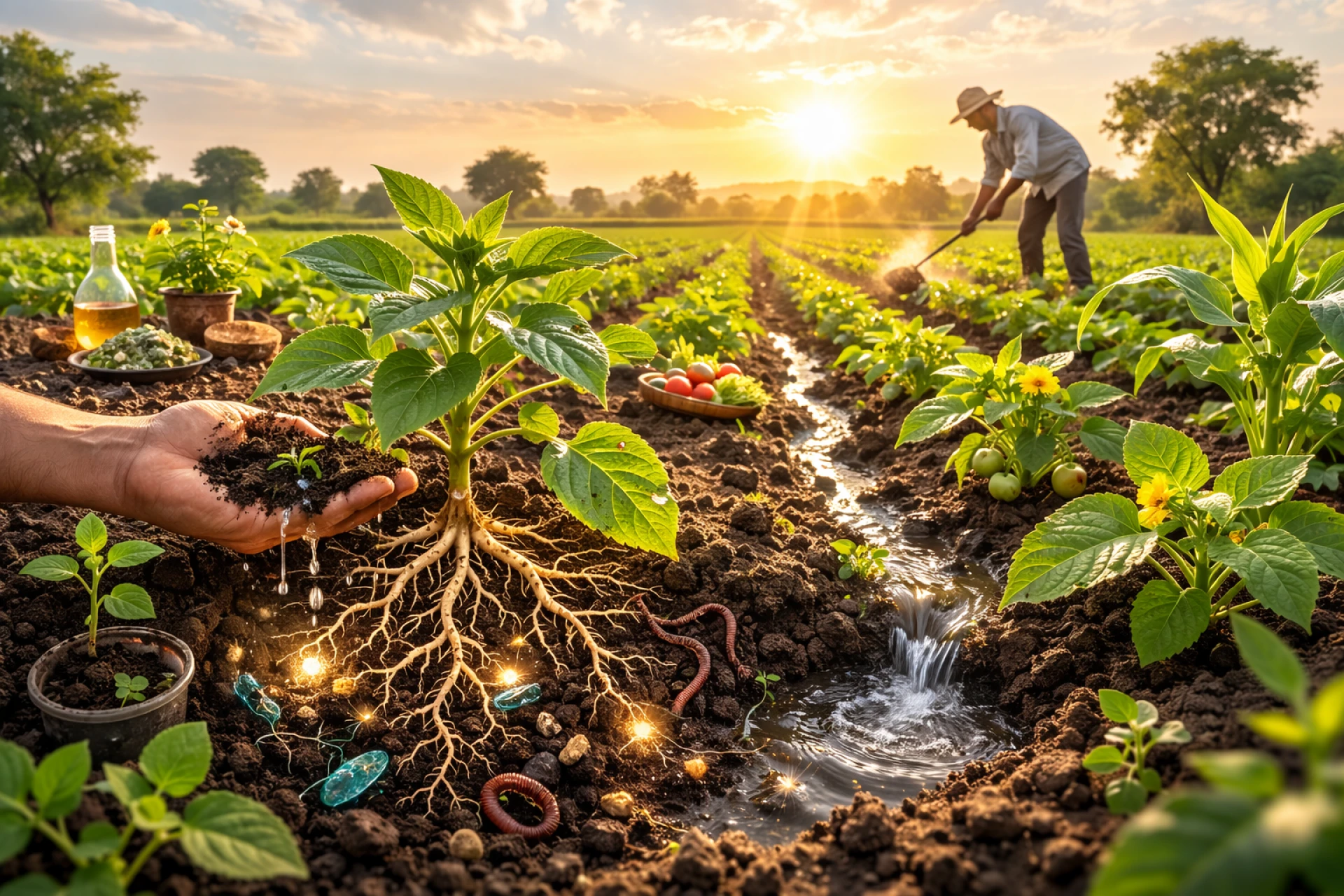

Modern farming is no longer about relying on a single input or method to protect crops. Today’s growers are combining nutrition, crop protection, and soil management practices to build stronger and more resilient fields. This balanced approach, often called integrated crop care, focuses on improving plant health at every stage of growth. One of the most important additions to this strategy in recent years is the use of biostimulant-based solutions that help crops perform better under real field conditions.
Farmers are increasingly recognizing that yield improvement is not only about controlling pests and diseases. It is also about helping plants grow efficiently, absorb nutrients effectively, and tolerate environmental stress. This is where biostimulant products are making a noticeable difference.
Understanding Integrated Crop Care in Today’s Agriculture
Integrated crop care combines different agricultural practices to support plant growth from seed to harvest. It includes balanced fertilization, pest and disease management, soil health improvement, and growth support solutions. Instead of reacting to problems after they appear, integrated crop care encourages preventive strategies that strengthen the plant naturally.
Healthy crops are more capable of handling fluctuations in weather, moisture, and nutrient availability. By combining conventional inputs with biological and plant-growth-support technologies, farmers can maintain consistent crop performance throughout the season.
In this evolving system, the role of plant growth enhancers has expanded significantly, particularly with the introduction of advanced biostimulant technologies designed to improve plant metabolism and nutrient efficiency.
Why Plant Strength Matters as Much as Pest Control?
For decades, crop protection focused heavily on managing pests, weeds, and diseases. While this remains essential, farmers now understand that strong plants are naturally more resilient. Crops that develop healthy root systems and balanced nutrient uptake are less vulnerable to stress.
Environmental factors such as drought, salinity, temperature fluctuations, and irregular rainfall often affect crop growth even before pest pressure begins. Strengthening plant processes from early stages helps reduce these risks.
This shift in thinking has encouraged the adoption of solutions that work at the physiological level, supporting root growth, improving soil structure, and enhancing nutrient availability.
The Role of Humic-Based Solutions in Crop Performance
Among the different categories of plant growth support products, humic-based formulations have gained strong attention. These products are derived from organic matter and are known for improving soil structure and nutrient availability.
An agri humic plant biostimulant helps activate microbial activity in the soil while improving the soil’s ability to hold nutrients and moisture. This allows crops to access nutrients more efficiently without increasing fertilizer application rates.
Better nutrient availability directly supports root expansion, which in turn improves plant stability and growth consistency. Over time, fields treated with humic-based inputs often show better soil texture and enhanced crop uniformity.
Humic substances also help reduce nutrient lock-up in the soil, allowing plants to use existing resources more effectively.
Improving Nutrient Efficiency Through Soil Activation
One of the biggest challenges in farming is nutrient loss. Fertilizers applied to the soil are not always fully absorbed by plants. Factors like soil composition, moisture levels, and microbial activity influence nutrient availability.
A humic acid biostimulant works by improving nutrient exchange processes in the soil. It enhances the root’s ability to absorb essential nutrients such as nitrogen, phosphorus, and potassium.
This improvement in nutrient efficiency reduces wastage and supports stronger plant development. Farmers often observe improved crop vigor and better leaf structure when nutrient uptake becomes more efficient.
In integrated crop care programs, such solutions are typically applied during early crop stages to support root establishment.
Biostimulants and Stress Management in Crops
Stress management has become a key focus area in agriculture. Crops frequently face environmental stress that can impact flowering, fruit development, and yield quality.
When plants experience stress, their metabolic processes slow down. Growth becomes uneven, and productivity may decline. Plant growth support solutions help maintain metabolic balance during these periods.
A second application of an agri humic plant biostimulant during active growth stages can support continued root activity and nutrient flow. This ensures that plants maintain steady development even under challenging field conditions.
Such preventive strategies are becoming an essential part of integrated crop programs across cereals, oilseeds, fruits, and vegetables.
Combining Crop Nutrition and Growth Support
Integrated crop care is most effective when plant nutrition and growth support work together. Fertilizers provide essential nutrients, while growth-support solutions improve how efficiently plants use those nutrients.
A well-designed crop plan may include soil application during early stages and foliar sprays during critical growth phases. These steps help maintain plant strength throughout the crop cycle.
A second use of a humic acid biostimulant later in the growth phase often supports better flowering and fruit setting. Balanced plant growth during this stage contributes significantly to final yield quality.
The focus is not only on quantity but also on consistency across the field.
How Farmers Are Integrating Modern Crop Solutions?
Across different agricultural regions, farmers are gradually adopting integrated strategies that combine biological inputs, crop protection products, and plant nutrition programs.
This shift is driven by practical field experience. Growers are seeing that balanced crop programs improve soil structure over time while maintaining productivity.
Companies such as Dhanuka Agritech Limited are supporting this transition by offering solutions that align with integrated farming practices. By combining research-driven formulations with field-level adaptability, these solutions help farmers strengthen their crop management strategies.
The goal is not to replace existing practices but to enhance them for better long-term results.
Soil Health as the Foundation of Integrated Crop Care
Healthy soil is the backbone of consistent crop productivity. Soil structure influences water retention, nutrient availability, and microbial activity. Over time, repeated cultivation and environmental factors can affect soil balance.
Growth-support formulations help restore this balance by improving organic activity and nutrient cycling. This results in better root penetration and improved moisture management.
As farmers continue to focus on soil health, integrated crop care programs are evolving to include more solutions that support soil structure along with crop growth.
Dhanuka continues to encourage awareness around balanced crop programs that combine plant nutrition, crop protection, and soil improvement for stable field performance.
Practical Field Benefits Farmers Are Observing
Farmers who incorporate integrated crop care strategies with plant-growth-support solutions often report gradual but noticeable improvements. These include:
- Stronger root systems
- Better crop uniformity
- Improved nutrient efficiency
- Reduced stress symptoms
- More consistent yield quality
While results depend on crop type and climate conditions, consistent use of balanced crop care programs helps improve overall farm productivity.
Another advantage is flexibility. These solutions can be applied across different crops and adapted based on regional soil conditions.
The Future of Integrated Crop Care
Agriculture is moving toward smarter and more efficient production systems. Farmers are seeking solutions that not only improve yield but also support sustainability and soil health.
Integrated crop care will continue to evolve as new research improves our understanding of plant physiology and soil biology. Growth-support technologies are expected to become even more targeted and efficient.
The role of plant-strengthening solutions will expand as farmers look for ways to maintain productivity under changing climate conditions.
Conclusion
Integrated crop care is shaping the future of agriculture by combining multiple strategies to support plant health and productivity. Instead of relying on a single approach, farmers are building balanced programs that include nutrition, crop protection, and plant-growth-support technologies.
By improving nutrient efficiency, strengthening root development, and supporting stress tolerance, modern crop solutions are helping farmers achieve healthier harvest outcomes. As awareness continues to grow, integrated crop care will remain an essential pathway toward sustainable and consistent agricultural success.





























Sign in to leave a comment.