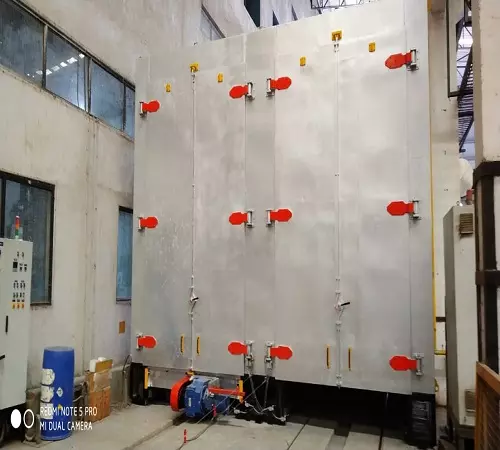

Uniform temperature distribution is one of the most important requirements in any industrial batch oven. If heat is not evenly distributed, some parts may overheat while others remain under-processed. In real production, I’ve seen coated components discolor on one side while the opposite side remained uncured. The root cause was not the heater — it was poor airflow inside the batch oven.
A properly designed batch oven ensures that heat reaches every corner of the chamber and every surface of the load. This happens through forced air circulation, controlled airflow paths, precise temperature control, and proper chamber design. When all these elements work together, the oven delivers consistent and repeatable results.
Let’s break down how this actually happens inside an industrial batch oven.
Why Uniform Temperature Distribution Matters in a Batch Oven
Uniform temperature distribution ensures that every product inside the batch oven receives the same thermal exposure. Without uniformity, manufacturers face problems like:
- Uneven curing
- Inconsistent hardness
- Color variation
- Warping or distortion
- Incomplete drying
- Product rejection
One common issue I’ve seen is when operators load parts tightly together. What actually happens is airflow gets blocked, and the center parts heat much slower. Even if the oven shows the correct temperature, the load itself remains uneven.
That’s why airflow design matters more than just heater capacity.
Forced Convection Airflow in a Batch Oven
The most important factor for temperature uniformity is forced convection airflow. A batch oven uses recirculation fans or blowers to move heated air continuously across the chamber.
Instead of heat rising and creating hot spots near the top, the fan pushes air across the entire workspace. This continuous movement eliminates stagnant zones.
In real production environments, this makes a huge difference. Without forced airflow:
- Top area becomes hotter
- Bottom area stays cooler
- Center load heats slowly
With forced convection:
- Air mixes continuously
- Heat spreads evenly
- Temperature stabilizes faster
Most industrial batch ovens use high-volume circulation fans designed for uniform air velocity across the load.
Airflow Pattern Design Inside a Batch Oven
Airflow pattern determines how heat moves inside the chamber. Engineers design the ducting and air channels carefully so that hot air flows over, under, and around the load.
Common airflow designs include:
Horizontal Airflow
Hot air moves from one side wall to the opposite wall. This is commonly used for tray loading and rack systems.
Vertical Airflow
Air moves from top to bottom or bottom to top. This works well for stacked loads.
Combination Airflow
Some batch ovens use a balanced airflow pattern that distributes air from multiple directions.
What actually happens is the air exits from perforated ducts and returns through suction channels. This creates a continuous loop that maintains uniform temperature.
Role of Baffles and Air Distribution Plates
Baffles help direct airflow evenly across the chamber. Without baffles, air tends to take the shortest path and bypass some areas.
Adjustable baffles allow operators to:
- Control airflow direction
- Balance temperature zones
- Optimize for different load sizes
In practical use, this helps when processing irregular-shaped components. Air can be redirected to ensure full coverage.
Recirculation System in a Batch Oven
A batch oven does not continuously heat fresh air. Instead, it recirculates most of the internal air. This improves both uniformity and efficiency.
Here’s how it works:
- Air passes over heating elements
- Fan circulates hot air across load
- Air returns to plenum chamber
- Air reheats and recirculates
This cycle repeats continuously. Because the same air keeps circulating, temperature stabilizes across the chamber.
High recirculation rates improve:
- Heat transfer
- Temperature uniformity
- Recovery time after door opening
Multiple Temperature Sensors Improve Accuracy
Industrial batch ovens use multiple thermocouples instead of one sensor. This helps monitor temperature at different locations.
In real production, a single sensor can be misleading. The sensor may show correct temperature while another corner remains cooler.
Multiple sensors allow:
- Accurate work zone control
- Balanced heating
- Reduced temperature deviation
Advanced control systems adjust heaters automatically based on sensor feedback.
PID Temperature Control System
A batch oven uses PID temperature control to maintain stable heat levels. This controller continuously adjusts heater output to prevent overshoot and fluctuation.
Without PID control:
- Temperature overshoots
- Heat fluctuates
- Uniformity decreases
With PID control:
- Temperature stabilizes quickly
- Heat remains consistent
- Product quality improves
This becomes especially important for curing, drying, and heat treatment processes.
Importance of Chamber Insulation
Insulation plays a major role in maintaining uniform temperature distribution. Poor insulation causes heat loss at certain points.
This leads to:
- Cold spots near walls
- Temperature drop near doors
- Uneven heating
High-quality insulation ensures:
- Minimal heat loss
- Stable chamber temperature
- Uniform heat retention
Industrial batch ovens typically use mineral wool or ceramic fiber insulation to maintain consistent heat.
Door Sealing and Pressure Balance
Another factor that affects temperature distribution is door sealing. If the door leaks, cold air enters the chamber.
This creates:
- Cold spots near door
- Temperature imbalance
- Longer heating time
Proper sealing prevents air leakage and maintains internal pressure balance.
In real production, worn-out door gaskets often cause uniformity issues. Replacing them usually improves performance immediately.
Proper Loading Inside a Batch Oven
Even the best-designed batch oven cannot maintain uniformity if loading is incorrect.
Correct loading practices:
- Leave space between parts
- Avoid stacking tightly
- Use racks or trays
- Allow airflow around components
One common mistake is overloading the oven. What actually happens is airflow cannot reach inner parts, causing uneven heating.
Proper spacing allows hot air to circulate freely.
Temperature Uniformity Testing
Manufacturers perform temperature uniformity surveys to verify batch oven performance. Multiple sensors are placed across the chamber to measure deviation.
This helps confirm:
- Work zone accuracy
- Airflow balance
- Heater performance
Regular testing ensures consistent batch processing.
Applications That Require Uniform Batch Oven Heating
Uniform temperature distribution is critical for:
- Powder coating curing
- Rubber ageing
- Composite curing
- Drying processes
- Heat treatment
- Stress relieving
- Paint baking
- Adhesive curing
In all these applications, uneven heating leads to product defects.
Benefits of Uniform Temperature Distribution
A well-designed batch oven provides:
- Consistent product quality
- Reduced rejection rate
- Faster heating cycles
- Better curing results
- Improved process repeatability
- Lower energy consumption
- Stable production output
In real manufacturing environments, uniform heating directly improves reliability.




























Sign in to leave a comment.