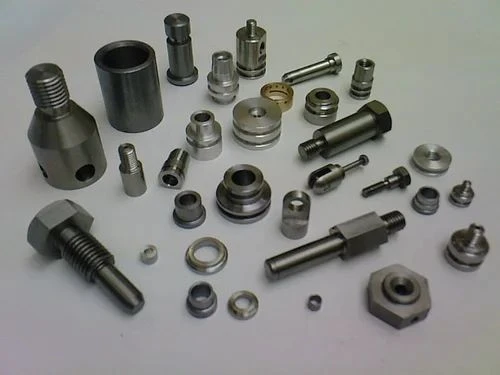

CNC components constructed of duplex Steel have gained significant application across various industries because of their excellent features and performance. Duplex Steel, a type of stainless Steel, has a unique microstructure comprising austenite and ferrite phases. As a result, the material possesses a remarkable balance of strength, corrosion resistance, and toughness, making it an excellent choice for demanding applications.
Duplex Steel is a good material for CNC parts due to its durability. Duplex Steel has yield strengths ranging from 450 to 620 MPa, making it stronger than other materials used in CNC machinings, such as austenitic stainless Steel and carbon steel. The greater durability enabled by this strength improves the dependability of manufactured parts in harsh conditions. The corrosion resistance of Duplex Steel is unparalleled, and it is also rather strong. Its excellent resistance to localized corrosion, including pitting and crevice corrosion, makes it suitable for application in harsh settings such as the maritime and chemical industries. Duplex Steel is an excellent material for parts subjected to mechanical and corrosive environments due to its strong resistance to stress corrosion cracking.
Compared to other materials commonly used for CNC components, Duplex Steel stands out for its strength and corrosion resistance. Here are some common materials with which we can compare Duplex Steel:
Duplex Steel is stronger than austenitic stainless steels such as 304 or 316. The yield strength of duplex Steel is greater than that of austenitic stainless Steel, which typically ranges between 200 and 300 MPa. Duplex Steel's higher strength makes it appropriate for use in situations involving significant stress and load.
The corrosion resistance of duplex Steel is the same as that of austenitic stainless Steel. Conversely, Duplex Steel has a higher resistance to stress corrosion cracking and pitting in chloride-rich environments. This increases its usefulness for applications requiring high corrosion resistance.
Duplex Steel is superior to carbon steel because it is stronger and more corrosion-resistant. Carbon steel typically has lower yield strength than Duplex Steel. Furthermore, carbon steel is more prone to corrosion, especially in hostile environments. Duplex Steel is frequently used in CNC parts instead of carbon steel due to its excellent strength and corrosion resistance.
Lightweight aluminum alloys are ideal for aeronautical purposes, while Duplex Steel is stronger. The tensile strength of aluminum alloys such as 6061 and 7075 is lower than that of Duplex Steel. However, in some cases, aluminum alloys, particularly those treated or coated, have excellent corrosion resistance. Aluminum is the material of choice when conserving weight is critical.
Titanium alloys have extremely high strength-to-weight ratios. However, Duplex Steel is often stronger overall. Duplex Steel offers higher corrosion resistance to titanium, especially in chloride-rich environments. However, titanium alloys continue to be preferred in lightweight component applications.
Duplex Steel outperforms other materials such as austenitic stainless Steel, carbon steel, aluminum, and titanium alloys regarding strength and corrosion resistance. Its improved strength enables long-lasting CNC parts, and its corrosion resistance permits constant operation even in difficult situations. Duplex Steel is the finest material when you need something that will not rust and can endure high temperatures.
Nissan Steel is a leading manufacturer and supplier of Duplex 2205 CNC Component, Super Duplex S32750 CNC Component, and 316 Stainless Steel Flanges . visit us for more .



























Sign in to leave a comment.