

Headline: SWIFT MT760 Verification: How Banks Authenticate Guarantees
Suggested URL slug: https://blog.bailifinancelimited.com/2026/11/02/how-does-swift-mt760-verification-work-7-essential-steps/
A practical guide to authenticating bank guarantees and standby letters of credit through the SWIFT network.
Introduction: Understanding SWIFT MT760 Verification
How does SWIFT MT760 verification work, and how can a beneficiary establish whether a bank guarantee or Standby Letter of Credit (SBLC) is genuine? These questions matter in international trade finance, structured finance, commercial transactions, and cross-border financial arrangements where parties rely on bank-issued financial instruments.

A SWIFT MT760 verification involves checking the authenticity, origin, integrity, and relevant contents of a financial message transmitted through the Society for Worldwide Interbank Financial Telecommunication (SWIFT) network. Banks use this messaging infrastructure to communicate authenticated financial instructions and information, including the issuance of guarantees and standby letters of credit.
However, an important distinction exists: receiving a document that displays SWIFT MT760 formatting doesn't establish that a bank issued it. Equally, receiving a PDF, screenshot, email attachment, or purported SWIFT confirmation doesn't independently establish authenticity.
Proper verification requires the beneficiary's bank or another appropriately authorised financial institution to authenticate the message through recognised banking channels. It must also establish whether the issuing institution sent the message, whether the message reached the intended recipient, and whether its contents correspond with the underlying transaction.
For businesses considering an SBLC, bank guarantee, or international trade finance arrangement, understanding this process helps reduce exposure to fraudulent documents, misleading intermediaries, and unauthorised financial representations.
This guide explains the seven essential stages of SWIFT MT760 verification, the responsibilities of participating banks, common warning signs, a practical transaction example, and a case study illustrating how a beneficiary should approach authentication.
Keywords: How does SWIFT MT760 verification work?, How to verify a SWIFT MT760 bank guarantee, How banks authenticate SWIFT MT760 messages, How to check whether an MT760 is genuine, Can a beneficiary verify an MT760 independently?, How long does SWIFT MT760 verification take?, SWIFT MT760 verification, MT760 authentication, SWIFT MT760 message, Bank guarantee verification, SBLC verification, SWIFT message verification, MT760 bank guarantee, Authenticated SWIFT message, International bank guarantee, Standby Letter of Credit verification, Difference between MT760 and MT799, How to authenticate an international bank guarantee, How does SWIFT MT760 authentication work?, How to identify a fraudulent SWIFT MT760, MT760 verification process for international trade finance
1. What Is a SWIFT MT760 Message?
A SWIFT MT760 is a standardised financial message that banks use to issue or communicate a demand guarantee or Standby Letter of Credit through the SWIFT financial messaging network.
It belongs to Category 7 of the SWIFT MT message standards, which covers documentary credits, guarantees, and standby letters of credit.
According to SWIFT's official MT760 message reference guide, the message can serve several purposes:
- Issuing a demand guarantee directly to a beneficiary that is a financial institution.
- Advising a guarantee to a bank responsible for notifying the beneficiary.
- Issuing a counter-guarantee to another financial institution that will issue a local undertaking.
- Communicating a counter-counter-guarantee within a more complex banking arrangement.
The distinction matters because an MT760 doesn't always represent a guarantee issued directly to the final beneficiary. It can also form part of a banking chain involving an issuing bank, an advising bank, a counter-guarantor, and a local guarantor.
Official technical reference: SWIFT Category 7 – MT760 Message Reference Guide.
Message Reference Guide+1
What Does MT760 Actually Represent?
An MT760 communicates the issuance of an independent undertaking, subject to its actual wording and applicable rules.
Depending on the transaction, the undertaking may support:
- International trade obligations.
- Construction and infrastructure contracts.
- Payment obligations.
- Advance payment obligations.
- Performance obligations.
- Financial obligations.
- Commercial agreements requiring bank-backed security.
For example, an importing company may request its bank to issue an SBLC in favour of an overseas supplier. The issuing bank sends the relevant MT760 message to the beneficiary's bank or an advising institution, following the agreed banking arrangements.
The receiving bank then follows its internal procedures to authenticate and advise the undertaking.
It is important to understand that SWIFT provides the messaging infrastructure. It doesn't independently guarantee the financial institution's ability to pay, assess the commercial merits of the transaction, or transfer the guarantee's face value into the beneficiary's account.
In fact, SWIFT expressly explains that it operates a secure financial messaging network rather than functioning as a bank or holding customer funds.

2. How Does SWIFT MT760 Verification Work?
SWIFT MT760 verification follows a bank-to-bank authentication process. The beneficiary's bank examines the incoming communication, establishes its apparent origin, checks the message information, and determines whether it can properly advise the undertaking.
The process generally involves seven essential steps.
Step 1: The Issuing Bank Prepares the MT760
The process begins when the applicant requests a financial institution to issue a bank guarantee or standby letter of credit.
The applicant usually submits relevant transaction documents, including:
- The underlying commercial agreement.
- The beneficiary's legal information.
- The requested guarantee amount.
- The required currency.
- The proposed validity period.
- The applicable guarantee wording.
- The payment and presentation conditions.
- Any applicable regulatory and compliance documentation.
The issuing bank evaluates the applicant, reviews the transaction, conducts the required due diligence, and determines whether it can issue the undertaking.
Once the bank approves the transaction, its authorised personnel prepare the MT760 message using the applicable SWIFT message standards.
The bank must ensure that the message reflects the approved undertaking. Errors involving beneficiary details, amounts, expiry dates, governing rules, or payment conditions can create disputes or affect the beneficiary's protection.
Step 2: The Issuing Bank Transmits the Message Through SWIFT
After preparing and authorising the message, the issuing bank transmits it through its SWIFT messaging interface.
The message travels to the designated receiving financial institution through the appropriate SWIFT messaging service.
The receiving institution must have the relevant messaging arrangements and authorisations to communicate with the sender.
One important security mechanism is the Relationship Management Application (RMA).
RMA allows participating financial institutions to manage their correspondent relationships and control which counterparties can exchange particular categories of SWIFT messages.
For example, a receiving bank may restrict incoming financial messages to approved counterparties. Its RMA arrangements help prevent unwanted or unauthorised message traffic.
However, an RMA relationship alone doesn't establish that a specific MT760 represents a valid, enforceable guarantee. It is one component of the broader messaging security framework.
SWIFT describes RMA as a control that helps institutions manage counterparties and restrict unwanted message traffic.
Swift Developer Documentation+2
Step 3: The Beneficiary's Bank Receives the MT760
When the receiving bank receives the MT760, its messaging infrastructure processes the incoming communication.
The bank can then examine the message through its authorised internal systems.
At this stage, the receiving institution should establish:
- Whether the message arrived through an accepted SWIFT channel.
- Whether the sender's identity corresponds with the expected issuing or advising institution.
- Whether the message passed the applicable authentication and security controls.
- Whether the receiving institution can identify the intended beneficiary.
- Whether the message relates to the expected transaction.
The receiving bank may also examine the message's transmission information, reference details, and associated banking records.
Importantly, the beneficiary shouldn't confuse an electronic copy of an MT760 with the original authenticated interbank communication.
A PDF displaying SWIFT message fields may look technically convincing. Nevertheless, it doesn't independently prove that the issuing bank transmitted the message.
The decisive verification step is authentication by the receiving bank through its recognised banking systems and communication procedures.
Step 4: The Receiving Bank Authenticates the Message
This is the central stage of SWIFT MT760 verification.
The receiving bank checks the apparent authenticity of the incoming message and determines whether the communication originated from the financial institution identified as its sender.
Depending on its procedures and the transaction structure, the receiving bank may:
- Review the authenticated incoming SWIFT message.
- Check the sender's BIC (Business Identifier Code).
- Examine the message's technical and reference information.
- Confirm the relevant correspondent banking relationship.
- Review any applicable RMA permissions.
- Contact the issuing institution through established, independently verified banking channels where clarification is necessary.
A BIC identifies a financial institution or relevant business entity within the SWIFT identification framework. However, knowing a bank's BIC doesn't establish that the bank issued a particular instrument.
Similarly, a message reference number isn't sufficient proof of authenticity when presented independently.
The receiving bank must rely on the actual authenticated communication and its established verification procedures.
Where the message passes authentication, the bank can proceed to examine the undertaking's contents and determine whether it can advise the instrument.
Where authentication fails or remains uncertain, the bank should investigate the discrepancy before representing the instrument as authenticated.
Step 5: The Bank Examines the MT760's Contents
Authentication and document examination are related but separate activities.
A message may originate from the expected financial institution and still contain incorrect, incomplete, or commercially unacceptable terms.
Therefore, the receiving bank must examine the undertaking's relevant contents.
Some important MT760 fields include:
| SWIFT field | Information communicated |
|---|---|
| :20: | Undertaking transaction reference |
| :30: | Date of issue |
| :22D: | Form of undertaking |
| :40C: | Applicable rules |
| :23B: | Expiry type |
| :31E: | Date of expiry, where applicable |
| :50: | Applicant details |
| :52A: | Issuing bank identification |
| :59: | Beneficiary details |
| :32B: | Undertaking amount and currency |
| :45C: | Document and presentation instructions |
The precise fields and sequences depend on the applicable SWIFT standard and message structure.
The receiving bank should pay particular attention to the following matters.
A. Issuing bank identification
Does the issuing institution correspond with the institution expected under the transaction?
B. Beneficiary identification
Does the message correctly identify the beneficiary, including its legal name and other relevant identification details?
C. Guarantee amount
Does the amount match the commercial agreement and the approved transaction?
D. Expiry date
Does the undertaking provide a clear and acceptable expiry date or expiry mechanism?
E. Applicable rules
Does the instrument identify the applicable rules, such as the ICC Uniform Rules for Demand Guarantees (URDG 758), where agreed?
F. Demand requirements
Does the undertaking clearly state how the beneficiary must submit a demand for payment and which supporting documents it must provide?
G. Governing law and jurisdiction
Where specified, are the governing law and jurisdiction acceptable to the relevant parties?
These checks help establish whether the authenticated message also contains terms that meet the beneficiary's requirements.
Step 6: The Advising Bank Confirms the Outcome
Once the receiving institution completes its authentication and examination procedures, it determines the appropriate next step.
If the bank can satisfy itself as to the apparent authenticity of the guarantee, it may advise the undertaking to the beneficiary.
The advising bank communicates the relevant instrument details and makes the terms available to the beneficiary through its established procedures.
However, an important legal distinction applies.
Under Article 10 of the ICC Uniform Rules for Demand Guarantees (URDG 758), an advising bank signifies that it has satisfied itself as to the apparent authenticity of the guarantee and that its advice accurately reflects the terms received.
This doesn't automatically mean that the advising bank assumes an independent obligation to pay the beneficiary.
In other words:
- An issuing bank undertakes the payment obligation under its guarantee.
- An advising bank authenticates and communicates the undertaking within its role.
- A confirming bank, where applicable, assumes an additional undertaking under the relevant instrument and applicable framework.
These roles shouldn't be confused.
The ICC explains these distinctions in its official URDG 758 rules.
Step 7: The Beneficiary Receives the Advised Instrument
Following successful authentication and advice, the beneficiary receives the undertaking through the agreed banking arrangement.
At this point, the beneficiary should review the instrument against the underlying commercial agreement.
It should confirm that:
- The beneficiary's name is correct.
- The amount and currency are correct.
- The validity period is acceptable.
- The undertaking covers the intended obligation.
- The presentation requirements are clear.
- The governing rules are acceptable.
- The issuing bank is acceptable from a credit-risk perspective.
If the bank identifies discrepancies, the parties may need to arrange clarification, correction, or an amendment through the appropriate banking channels.
A properly authenticated MT760 is an important part of transaction security. Nevertheless, authentication doesn't replace legal review, credit assessment, or examination of the undertaking's actual terms.

3. What Information Should You Check When Verifying an MT760?
Whether you're an applicant, beneficiary, intermediary, or financial adviser, you should understand which information matters during MT760 verification.
The following checklist provides a practical starting point.
| Verification requirement | What to establish |
|---|---|
| Issuing institution | Confirm the identity of the issuing bank |
| BIC | Check the institution's identification details |
| SWIFT authentication | Obtain confirmation through the receiving bank |
| Message reference | Match the undertaking reference with transaction records |
| Beneficiary | Confirm the correct legal entity |
| Applicant | Confirm the underlying applicant |
| Amount | Match the amount and currency |
| Issue date | Check the stated issue date |
| Expiry | Confirm the expiry date or mechanism |
| Applicable rules | Review URDG 758, ISP98, or other stated rules |
| Payment conditions | Understand the requirements for a complying demand |
| Amendments | Confirm that subsequent changes are properly authenticated |
A beneficiary shouldn't rely on the checklist alone. Its bank must perform the relevant authentication and examination procedures.
Why the Issuing Bank's Identity Matters
Not all financial institutions present the same credit risk.
Even where a guarantee passes message authentication, the beneficiary must consider the issuing bank's financial position, country risk, applicable regulatory environment, and ability to honour a complying demand.
For example, an authenticated guarantee from a bank with limited international correspondent relationships may present different commercial risks from one issued by an internationally established institution.
This is a credit-risk consideration, not an authentication failure.
A genuine SWIFT message doesn't automatically establish that the issuing bank has sufficient financial capacity to meet every potential obligation.

4. Can You Verify a SWIFT MT760 Without Going Through a Bank?
In practical banking terms, an individual or company cannot independently authenticate an MT760 simply by examining a document or entering a reference number into a public website.
SWIFT doesn't provide a general public MT760 verification portal where anyone can enter an instrument number and obtain authoritative confirmation of its authenticity.
The beneficiary should approach its bank or another appropriately authorised financial institution.
The institution can determine whether it has received the relevant message and whether the communication passes its authentication procedures.
Methods That Don't Independently Prove MT760 Authenticity
Several documents and procedures can create a false impression of verification.
1. PDF copies of MT760 messages
A PDF can reproduce the appearance of a SWIFT message. However, anyone with document-editing software can alter or create a similar-looking document.
2. Screenshots of banking systems
A screenshot doesn't provide independent evidence that the displayed information corresponds with an authenticated interbank message.
3. Email confirmations
An email from an intermediary claiming that a bank has issued an MT760 doesn't replace confirmation through the beneficiary's bank.
4. MT799 pre-advice
An MT799 is a free-format SWIFT message. It may communicate information or pre-advice in a transaction, depending on its contents and purpose. It isn't automatically a bank guarantee or proof that an MT760 has been issued.
5. Third-party verification certificates
A private company may issue a certificate stating that an instrument has been checked. However, the certificate doesn't replace the issuing and receiving banks' own authentication procedures.
The correct approach is to establish the instrument's status directly through recognised banking channels.
5. What Is the Difference Between MT760 Authentication and MT760 Verification?
Although professionals sometimes use these expressions interchangeably, they refer to different aspects of the process.
MT760 authentication focuses on whether the message is genuinely attributable to the stated sender and whether the communication has maintained its integrity through the relevant security controls.
MT760 verification is broader. It includes authentication and examination of the undertaking's contents, transaction references, beneficiary details, expiry conditions, and other relevant information.
Consider this example:
A receiving bank obtains an MT760 from the expected issuing institution. Its technical checks establish that the message is authentic.
However, the message identifies the wrong beneficiary.
The bank may have authenticated the communication, but the transaction still contains a material discrepancy that requires resolution.
Therefore, successful message authentication shouldn't be treated as automatic approval of every term within the undertaking.
6. What Is the Difference Between MT760, MT799 and MT767?
Understanding the differences between SWIFT message types helps prevent confusion during international trade finance transactions.
| Message type | Main purpose |
|---|---|
| MT760 | Issuance of a demand guarantee or standby letter of credit |
| MT799 | Free-format communication between financial institutions |
| MT767 | Amendment to a demand guarantee or standby letter of credit |
| MT768 | Acknowledgement of receipt of a guarantee or standby letter of credit-related message |
| MT769 | Advice of reduction or release of a guarantee or standby letter of credit |
These messages perform different functions within banking communication.
For instance, a bank may use an MT799 to communicate information before issuing an undertaking. However, the beneficiary shouldn't assume that an MT799 constitutes an issued guarantee.
Likewise, an MT767 communicates an amendment rather than automatically replacing the original MT760.
The parties must examine the authenticated amendment and establish how it affects the original undertaking.
The official SWIFT Category 7 documentation provides the technical definitions and message specifications.
Message Reference Guide+1
7. Common SWIFT MT760 Verification Scams and Warning Signs
International trade finance transactions can involve multiple intermediaries, brokers, consultants, and financial institutions. This creates opportunities for fraudsters to exploit limited banking knowledge.
Understanding the warning signs can help businesses avoid unnecessary financial exposure.
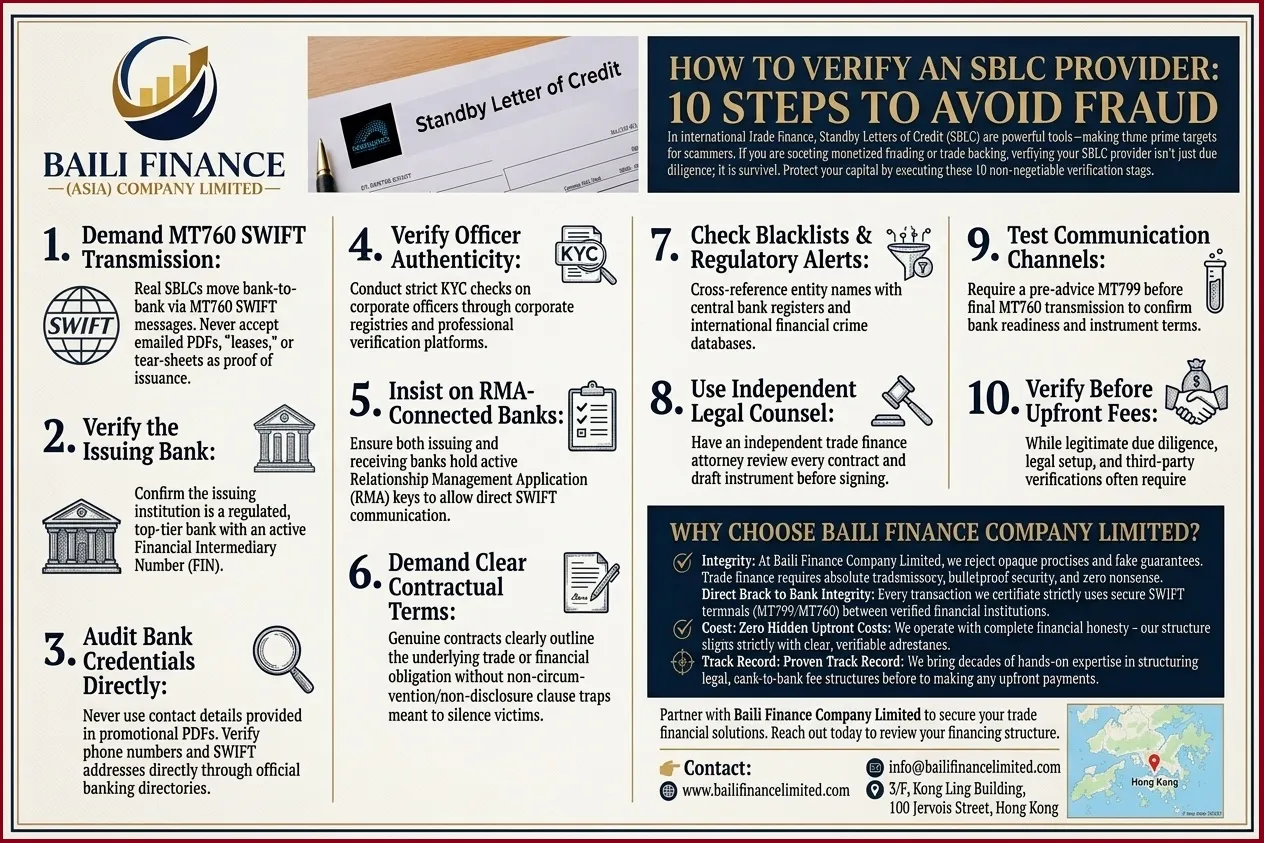
Warning Sign 1: The Seller Provides Only a PDF
A counterparty may provide a document that appears to show a completed SWIFT MT760.
The document may contain a BIC, reference number, beneficiary name, guarantee amount, and purported transmission information.
Nevertheless, these details don't establish that the issuing bank transmitted the message.
What to do: Request verification through your bank using the appropriate banking channels.
Warning Sign 2: An Intermediary Guarantees Verification
An intermediary may claim that it can independently confirm an MT760 without involving the beneficiary's bank.
This claim requires scrutiny.
Unless the intermediary has an appropriately authorised banking role and can establish the relevant authentication process, its statement shouldn't be treated as conclusive.
Warning Sign 3: Pressure to Pay Verification Fees to Individuals
Fraudsters sometimes request additional payments for purported SWIFT activation, message release, authentication codes, or guarantee verification.
Some legitimate banking services involve charges. However, any charges should have a documented contractual or banking basis and should be confirmed directly with the relevant institution.
Don't transfer money to an individual or unrelated account simply because someone claims that the payment will release or authenticate an MT760.
Warning Sign 4: The Issuing Bank Cannot Be Independently Contacted
If the counterparty refuses to identify the issuing institution or prevents normal bank-to-bank communication, the beneficiary should treat the transaction as unresolved.
The issuing bank's identity must be independently established.
Warning Sign 5: The Guarantee Contains Unclear Payment Conditions
An undertaking may be authentic but commercially unsuitable.
For example, an instrument may contain restrictive demand requirements, an unacceptable expiry mechanism, or conditions that don't correspond with the intended transaction.
The beneficiary should obtain appropriate legal and banking advice before accepting such terms.
Warning Sign 6: Claims That SWIFT Guarantees Payment
SWIFT provides financial messaging services. It doesn't guarantee the financial obligations of banks using its network.
A claim that SWIFT itself guarantees payment under an MT760 misrepresents the network's function.
The central rule is simple: never treat a copy, intermediary statement, or purported SWIFT confirmation as a substitute for authenticated bank-to-bank verification.

8. Real-World Example: Verifying an MT760 for an International Supply Contract
Consider a hypothetical transaction involving a manufacturing company in Germany and an equipment supplier in Singapore.
The manufacturing company agrees to purchase industrial machinery valued at USD 5 million.
Under their agreement, the supplier requires a standby letter of credit to support the buyer's payment obligations.
The buyer approaches its relationship bank and requests an SBLC for USD 5 million in favour of the Singaporean supplier.
How the Verification Process Works
Stage 1: Application
The buyer submits the supply contract, beneficiary details, financial information, and proposed SBLC wording to its bank.
Stage 2: Issuance
Following its credit and compliance assessments, the issuing bank approves the transaction and prepares the MT760.
Stage 3: Transmission
The issuing bank sends the authenticated SWIFT MT760 to the supplier's designated bank in Singapore.
Stage 4: Authentication
The Singaporean bank receives the message and examines its authenticity through its authorised SWIFT infrastructure.
It checks the sender's identity, message details, and relevant banking relationship.
Stage 5: Examination
The receiving bank reviews the undertaking's amount, beneficiary details, expiry date, applicable rules, and demand requirements.
Stage 6: Advice
After satisfying itself as to the apparent authenticity of the undertaking, the bank advises the SBLC to the supplier.
Stage 7: Acceptance
The supplier reviews the instrument against the supply contract and confirms that its terms meet the agreed requirements.
The parties can then proceed with the commercial arrangement under their contract.
What Does This Example Demonstrate?
The transaction demonstrates that MT760 verification involves more than receiving a message or inspecting a document.
It requires the participation of financial institutions that can authenticate the communication, examine the undertaking, and perform their respective banking responsibilities.
It also demonstrates why beneficiaries should arrange their verification procedures before entering into a transaction that depends on a bank guarantee or SBLC.
9. Case Study: How an MT760 Verification Process Can Prevent a Financial Loss
Illustrative case study
The following case study is a hypothetical scenario based on common trade finance verification risks. It isn't presented as a documented transaction involving Baili Finance Limited or an identified bank.
Background
An international construction company plans to enter into a USD 12 million infrastructure contract with an overseas contractor.
As part of the contractual arrangement, the construction company requests a bank guarantee to protect its advance payment.
The contractor introduces a financial intermediary that claims to have arranged an MT760 from an international bank.
The intermediary sends the beneficiary a PDF showing what appears to be a completed guarantee message.
The document includes:
- A purported issuing bank.
- A SWIFT BIC.
- A guarantee reference number.
- An undertaking amount of USD 12 million.
- An expiry date.
- The construction company's name as beneficiary.
The intermediary then requests payment of an additional processing fee before the beneficiary can receive the original instrument.
The Problem
Rather than paying the requested fee immediately, the construction company contacts its relationship bank.
Its bank reviews the documentation and requests the information necessary to establish whether an authenticated MT760 has actually arrived.
The bank cannot identify a corresponding authenticated incoming message in its records.
The construction company then requests further clarification through the appropriate banking channels.
The intermediary fails to provide satisfactory evidence that the issuing bank transmitted the guarantee.
The Verification Outcome
The beneficiary treats the instrument as unverified and suspends the proposed payment.
It also requests that the contractor arrange a properly documented guarantee through an acceptable issuing institution.
As a result, the construction company avoids relying on a document that its bank cannot authenticate.
Lessons for International Businesses
This hypothetical scenario demonstrates five important principles:
- Never rely exclusively on a PDF or screenshot of an MT760.
- Establish the issuing bank's identity independently.
- Involve the beneficiary's bank before accepting the instrument.
- Examine the guarantee's commercial and legal terms.
- Don't pay unexplained fees based on claims of SWIFT message release or authentication.
The principal lesson is that verification should take place before the beneficiary makes an irreversible financial commitment.
10. How Long Does SWIFT MT760 Verification Take?
There isn't one universal verification timeframe for every MT760 transaction.
The duration depends on the participating financial institutions, correspondent banking arrangements, internal compliance procedures, message complexity, and whether the receiving bank needs additional information.
Several factors can influence the process.
1. Banking relationships: Established correspondent relationships may simplify communication between the participating institutions.
2. Message accuracy: Complete and consistent information can reduce the need for clarification.
3. Compliance checks: Banks may need to conduct customer due diligence, sanctions screening, transaction reviews, and other regulatory assessments.
4. Issuing bank responsiveness: Where additional confirmation is necessary, the issuing bank's response time can affect the overall process.
5. Transaction complexity: Counter-guarantees, multiple advising banks, and cross-border arrangements may require additional coordination.
Businesses should therefore avoid accepting unsupported promises that an MT760 will always be verified within 24 or 48 hours.
A realistic timetable should come from the financial institutions handling the transaction.
11. What Happens If an MT760 Fails Verification?
When an MT760 fails verification, the beneficiary shouldn't assume that the instrument is genuine or proceed as though the bank has accepted it.
The receiving institution may identify several possible problems.
- The message doesn't appear in its authenticated incoming records.
- The purported sender doesn't match the expected issuing institution.
- The message contains inconsistent transaction references.
- The communication fails applicable authentication checks.
- The receiving bank cannot establish the apparent authenticity of the undertaking.
- The guarantee contains discrepancies requiring clarification.
The appropriate response depends on the nature of the problem.
Recommended Actions
First, suspend reliance on the instrument. Don't release goods, funds, collateral, or other contractual benefits solely on the basis of an unverified document.
Second, request clarification through your bank. Ask the receiving institution to identify the specific authentication or documentary issue.
Third, involve the issuing bank through independently established channels. Don't rely on contact details supplied exclusively by the intermediary whose document is under investigation.
Fourth, obtain legal advice where necessary. If the transaction involves a substantial financial commitment, an experienced trade finance lawyer can assess the contractual implications.
Finally, document the verification process. Keep the relevant banking correspondence, transaction references, contractual documents, and any discrepancy notices.
A failed verification doesn't necessarily prove fraud. It means the beneficiary hasn't established the required authenticity and should resolve the matter before relying on the instrument.
12. The Role of ICC URDG 758 in MT760 Verification
The International Chamber of Commerce (ICC) publishes internationally recognised rules governing demand guarantees.
One important framework is the Uniform Rules for Demand Guarantees, URDG 758.
These rules provide a framework for the issuance, examination, presentation, and payment of demand guarantees when the instrument expressly incorporates them.
They address several important matters, including:
- The responsibilities of guarantors and beneficiaries.
- The independence of guarantees.
- The contents of guarantee instructions.
- The role of advising institutions.
- The requirements for presenting a demand.
- The examination of demands.
- The handling of non-complying presentations.
- Expiry and termination.
Article 10 addresses the advising of guarantees and amendments. It explains the advising party's responsibility regarding apparent authenticity and accurate transmission of the terms received.
Article 14 addresses the presentation of documents under a guarantee.
Article 19 explains how a guarantor examines a demand, while Article 20 establishes the examination period and payment obligations for complying demands.
Importantly, URDG 758 doesn't apply automatically to every MT760. The undertaking must expressly incorporate the rules, subject to its terms.
Where an SBLC uses ISP98, the relevant provisions of that framework may instead govern its operation.
The choice of rules should therefore reflect the instrument's nature, transaction requirements, and applicable legal advice.
For further reading, consult the ICC's original publication:
External authority: ICC – Uniform Rules for Demand Guarantees (URDG 758).
13. How to Protect Your Business Before Accepting an MT760
Businesses should establish a verification procedure before agreeing to accept a bank guarantee or SBLC.
Waiting until after signing a commercial contract can create unnecessary pressure, especially where delivery deadlines, advance payments, or other financial obligations depend on the instrument.
Consider the following recommendations.
Work With an Acceptable Issuing Bank
Before entering into the arrangement, establish which financial institutions the beneficiary will accept.
The beneficiary should consider the issuing bank's reputation, creditworthiness, jurisdiction, regulatory status, and international banking relationships.
Agree on the Guarantee Wording in Advance
Both parties should review the proposed undertaking before issuance.
This helps prevent disputes involving beneficiary details, expiry dates, demand conditions, applicable rules, and other material terms.
Establish the Verification Route
Identify the beneficiary's receiving bank and confirm how it will receive and authenticate the MT760.
Where possible, agree on the relevant advising arrangements before the issuing bank transmits the message.
Review the Instrument Independently
Don't assume that authentication makes every commercial term acceptable.
Have the instrument reviewed by appropriate banking and legal professionals.
Keep All Banking Communications Documented
Maintain records of the application, approved wording, message references, amendments, banking correspondence, and final advice.
A properly documented transaction provides a clearer basis for resolving discrepancies and disputes.
14. Why Professional Guidance Matters in SWIFT MT760 Transactions
A bank guarantee or standby letter of credit can involve several financial and contractual relationships.
The applicant must satisfy the issuing bank's requirements. The issuing bank must issue the undertaking in accordance with the approved instructions. The advising bank must perform its responsibilities. The beneficiary must understand the protection provided by the instrument.
Where an intermediary participates, its role and authority must also be clearly established.
Professional trade finance guidance helps businesses understand these responsibilities before committing to a transaction.
At Baili Finance Limited, our focus is on providing businesses with information and guidance concerning international trade finance instruments, including bank guarantees and standby letters of credit.
We believe that understanding the transaction structure, the participating financial institutions, and the verification requirements is essential before proceeding.
However, businesses should distinguish between financial consultancy, transaction coordination, bank issuance, and independent bank authentication. These are separate functions, and only the appropriately authorised financial institutions can authenticate their own banking communications and undertake the obligations stated in their instruments.
For further information about our company and its services, visit Baili Finance Limited.
Frequently Asked Questions About SWIFT MT760 Verification
1. How does SWIFT MT760 verification work?
SWIFT MT760 verification works through an authenticated bank-to-bank messaging process. The beneficiary's bank receives the incoming MT760, examines its sender and message information, checks its authenticity through authorised banking systems, and reviews the guarantee's terms. If satisfied with its apparent authenticity, the bank may advise the undertaking to the beneficiary.
2. Can a beneficiary verify an MT760 independently?
A beneficiary can review the instrument's contents and request information from the issuing institution. However, it cannot independently establish the authenticity of an interbank SWIFT message simply by examining a PDF, screenshot, or reference number. The appropriate route is to ask its bank to authenticate the communication through recognised banking channels.
3. What is the difference between an MT760 and an MT799?
An MT760 is used to issue a demand guarantee or standby letter of credit. An MT799 is a free-format message that banks use to communicate information. An MT799 may support preliminary communication, but it doesn't automatically constitute a guarantee or replace an MT760.
4. Does an authenticated MT760 guarantee payment?
An authenticated MT760 establishes an important aspect of the communication's authenticity. However, payment depends on the actual undertaking, the issuing bank's obligations, and the beneficiary's compliance with the applicable demand requirements. Authentication doesn't eliminate the issuing bank's credit risk or guarantee that every demand will be honoured.
5. How long does it take to authenticate an MT760?
The timeframe varies between financial institutions and transactions. Banking relationships, compliance procedures, message accuracy, and additional confirmation requirements can affect the duration. There is no universal SWIFT MT760 verification deadline applicable to every transaction.
6. Can an MT760 be fake?
Yes. Fraudsters can create counterfeit documents that imitate SWIFT MT760 messages. They may reproduce BICs, reference numbers, bank names, and message fields. However, a convincing-looking document doesn't prove that the issuing bank transmitted an authenticated message. Beneficiaries should verify the communication through their banks.
7. What is a SWIFT BIC, and why is it important?
A Business Identifier Code (BIC) identifies a financial institution or another eligible business entity within the SWIFT identification framework. It helps banks identify counterparties during financial communication. However, a valid BIC alone doesn't prove that a specific guarantee exists or that the institution issued a particular MT760.
8. What happens if an MT760 contains incorrect beneficiary details?
The beneficiary should immediately inform its bank and request clarification. The issuing institution may need to issue an appropriate authenticated amendment or replacement, depending on the nature of the discrepancy and the instrument's terms. The beneficiary shouldn't assume that incorrect details can be ignored.
9. What is the role of the advising bank in MT760 verification?
The advising bank receives and examines the guarantee's apparent authenticity before advising it to the beneficiary. Under URDG 758, it also signifies that its advice accurately reflects the terms received. Advising a guarantee doesn't, by itself, make the advising bank independently liable for payment.
10. Can an MT760 be amended after issuance?
Yes. A guarantee or SBLC may be amended through the appropriate banking procedure. An MT767 is the standard SWIFT message type used for amendments to demand guarantees and standby letters of credit. The beneficiary should examine the authenticated amendment and determine its effect on the original undertaking.
11. Is SWIFT MT760 the same as a bank guarantee?
No. MT760 is the SWIFT message type used to communicate the issuance of a demand guarantee or standby letter of credit. The bank guarantee is the underlying undertaking, while MT760 is the messaging format through which the relevant banking communication takes place.
12. Does SWIFT itself authenticate the financial strength of the issuing bank?
No. SWIFT provides secure financial messaging services. It doesn't independently assess the issuing bank's creditworthiness or guarantee payment under its financial instruments. The beneficiary must conduct appropriate credit and counterparty risk assessments.
13. What is the difference between MT760 verification and MT760 monetisation?
Verification concerns establishing the authenticity and relevant contents of an MT760. Monetisation refers to a separate financing arrangement in which a financial institution may consider providing credit or financing against an eligible financial instrument.
An authenticated guarantee doesn't automatically qualify for monetisation. Any proposed financing remains subject to the lender's credit assessment, instrument review, legal requirements, and internal policies.
14. Can an MT760 be transferred to another beneficiary?
Not automatically. Whether a guarantee can be transferred depends on its wording, the applicable rules, and the relevant legal framework. A beneficiary shouldn't assume that an MT760 is transferable simply because it has been authenticated. Any proposed transfer requires appropriate review and agreement.
15. Is an MT760 under URDG 758 automatically irrevocable?
URDG 758 Article 4 provides that a guarantee governed by those rules becomes irrevocable upon issuance, even if it doesn't expressly state that it is irrevocable. However, URDG 758 must apply to the undertaking through its express incorporation. The actual instrument and governing legal framework must always be examined.
Conclusion: Understanding SWIFT MT760 Verification Before You Transact
Understanding how SWIFT MT760 verification works is essential for businesses participating in international trade finance, structured commercial transactions, and cross-border financial arrangements.
The verification process involves more than reviewing a document that appears to originate from a bank. It requires the receiving institution to authenticate the incoming communication, establish the sender's identity, examine the undertaking's contents, and determine whether it can properly advise the instrument.
The seven essential stages begin with the issuing bank preparing the MT760 and end with the beneficiary receiving the advised undertaking after the appropriate banking checks.
Throughout this process, businesses must distinguish between message authentication, documentary examination, legal enforceability, and the issuing bank's creditworthiness.
These considerations are particularly important when accepting a bank guarantee or SBLC involving substantial financial commitments.
The most important principle is this: never rely on an unauthenticated MT760 document when your business's financial security depends on the instrument.
Always involve the appropriate financial institutions, verify the communication through recognised banking channels, review the guarantee's terms, and obtain professional advice where necessary.
At Baili Finance Limited, we recognise the importance of informed decision-making in international trade finance. Our objective is to help businesses understand financial instruments, transaction structures, and the considerations involved in arranging trade finance solutions.
If you're considering a bank guarantee, SBLC, or another international trade finance arrangement, take the time to understand the process before committing your resources.
Make informed financial decisions. Verify before you transact.
Ready to Structure Your Next SWIFT MT760 or SBLC Transaction?
Don't let uncertainty, poor transaction planning, or unverified financial arrangements put your business objectives at risk.
Whether you're seeking a Standby Letter of Credit (SBLC), arranging a bank guarantee, exploring SWIFT MT760 issuance, or evaluating an international trade finance opportunity, getting the right guidance before committing your resources matters.
At Baili Finance Limited, we welcome enquiries from businesses, corporate clients, investors, and international trade professionals seeking to explore trade finance solutions.
We invite you to take the next step.
Here's what you can discuss with our team:
- Your bank guarantee and SBLC requirements.
- Your proposed SWIFT MT760 transaction structure.
- The intended amount, currency, and transaction purpose.
- Your preferred issuing bank and beneficiary arrangements.
- The documentation and preliminary requirements for your transaction.
- Potential trade finance solutions aligned with your business objectives.
TAKE THE NEXT STEP
Your Next Trade Finance Transaction Starts With The Right Conversation.
Don't leave your financial arrangements to assumptions. Speak with Baili Finance Limited about your requirements and explore the appropriate way forward.
CONTACT BAILI FINANCE LIMITED
Visit: www.bailifinancelimited.com
Baili Finance Limited — Supporting informed decisions in international trade finance.
Your transaction deserves proper preparation. Start the conversation today.
Intermediaries/Consultants/Brokers are welcome to bring their clients 100% protected. Our brokers receive 2% commission for referral. We assist Clients and brokers in their attempt to secure funding by working on their funding requests that may require innovative financing. In complete confidence, we will work together for the benefits of all parties involved.
#TradeFinance #SWIFTMT760 #MT760Verification #BankGuarantee #SBLC #StandbyLetterOfCredit #InternationalTradeFinance #FinancialInstruments




















Sign in to leave a comment.