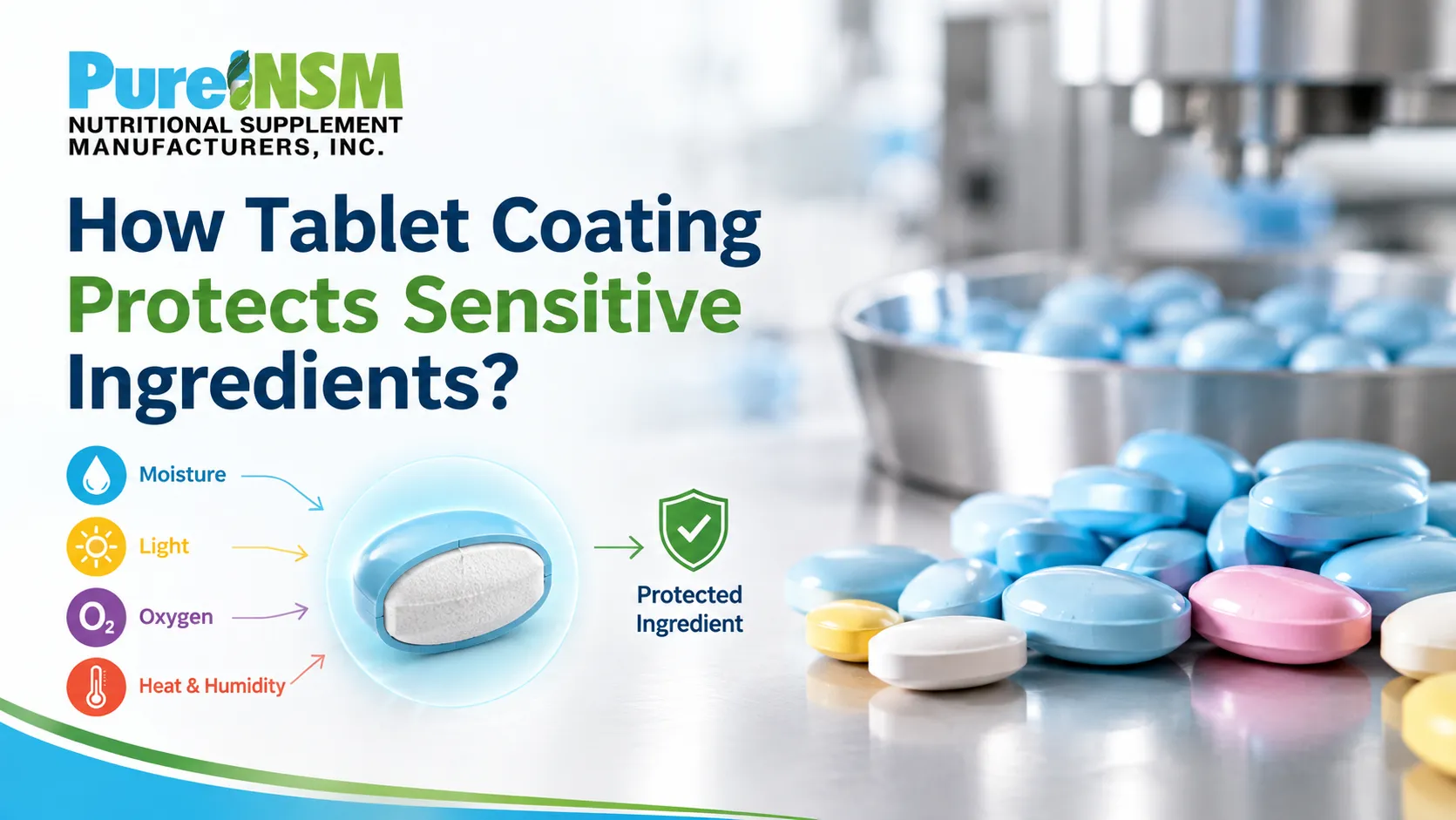

Tablet coating is not only used to make tablets look smooth, attractive, or easier to swallow. A well-designed coating can also act as a protective barrier for sensitive ingredients.
Some active ingredients can lose quality when exposed to moisture, oxygen, light, heat, or other environmental conditions. A suitable film coating can reduce exposure to these factors and help maintain the tablet's physical and chemical stability during storage.
This is especially important for moisture-sensitive, light-sensitive, oxygen-sensitive, and hygroscopic ingredients used in pharmaceutical and nutraceutical tablets.
However, coating is not a simple "protective layer" that works the same way for every product. The polymer, coating thickness, formulation, process conditions, packaging, and sensitivity of the tablet core all affect the final result.

What Is Tablet Coating?
Tablet coating is the process of applying a thin layer of coating material around a tablet core.
Depending on the product, the coating may contain:
- Film-forming polymers
- Plasticizers
- Pigments or opacifiers
- Anti-tacking agents
- Moisture-barrier materials
- Other functional excipients
Modern film coating can provide several functions at the same time, including improving appearance, masking taste or odor, protecting the tablet, and modifying drug release.
For sensitive ingredients, the key purpose is often to create a controlled barrier between the tablet core and the surrounding environment.
Why Do Some Tablet Ingredients Need Protection?
Active ingredients can be sensitive to different environmental conditions.
Moisture
Moisture can be one of the biggest problems for hygroscopic ingredients. Some ingredients absorb water from the surrounding air, which can cause changes in the tablet and may accelerate chemical degradation.
For example, moisture can promote hydrolysis, a chemical reaction in which water contributes to the breakdown of a sensitive compound. Research on moisture-sensitive tablets shows that water exposure can contribute to degradation and changes in physical properties.
Light
Some ingredients are photosensitive, meaning exposure to light can cause chemical changes.
Light can trigger degradation reactions in certain active ingredients. A coating containing suitable light-blocking materials can reduce the amount of light reaching the tablet core. The effectiveness depends on factors such as coating composition and thickness.
Oxygen
Oxygen can contribute to oxidation of susceptible ingredients.
A protective coating can reduce the direct exposure of the tablet core to the surrounding environment. However, coating should not be viewed as the only protection. The bottle, blister, seal, headspace, and storage conditions can also affect oxygen exposure.
Temperature and Humidity
Temperature and humidity can work together to accelerate degradation.
FDA stability guidance notes that drug products may be affected by factors such as water vapor, reactive gases, light, and temperature. Laboratory studies can help determine which environmental factors actually affect a specific product.
How Does Tablet Coating Protect Sensitive Ingredients?
The basic idea is simple:
Environment → Coating Barrier → Tablet Core
The coating creates an additional barrier around the tablet. Depending on its design, that barrier can slow the movement of water vapor, reduce light exposure, and limit contact with other environmental factors.
But the coating does not make the tablet completely isolated from its surroundings.
Its performance depends on:
- Polymer selection
- Coating formulation
- Coating thickness
- Film uniformity
- Surface defects
- Drying conditions
- Tablet core properties
- Packaging
- Storage environment
A recent review of coating technologies explains that film coatings can act as barriers against moisture, light, and oxygen, but the protection depends strongly on the polymer and coating process used.
1. Moisture-Barrier Coating
For many sensitive tablets, moisture protection is a major reason for using a functional coating.
A moisture-barrier coating works by reducing the rate at which water vapor reaches the tablet core.
Common film-forming materials include polymers such as:
- HPMC
- PVA
- Ethyl cellulose
- Certain methacrylate polymers
- Other specialized coating systems
Some formulations also combine polymers with hydrophobic materials to improve water-vapor resistance.
Research has shown that HPMC-based and other polymer coatings can reduce moisture uptake in certain hygroscopic tablet systems. However, performance varies by formulation and coating conditions, so one polymer should not automatically be assumed to work for every ingredient.
Why is this important?
Lower moisture exposure can help reduce:
- Hydrolysis
- Sticking
- Swelling
- Cracking
- Physical instability
- Loss of active ingredient
The goal is not simply to make the tablet waterproof. The goal is to provide enough protection for the product's intended shelf life and storage conditions.
2. Light-Protection Coating
Light-sensitive ingredients may require protection from visible or ultraviolet light.
A coating can be designed with opacifying or light-blocking components to reduce light transmission through the film.
Coating thickness and the concentration of the light-blocking component can affect the level of protection.
For example, an opaque tablet coating may be useful when the active ingredient is sensitive to light but the product needs to remain in a relatively simple package.
However, packaging can provide another layer of protection. FDA notes that light protection may also be provided by opaque or amber containers and secondary packaging.
This means the best strategy may involve both tablet coating and protective packaging.
3. Protection Against Oxygen and Oxidation
Some active ingredients are vulnerable to oxidation.
A carefully selected coating can reduce the interaction between the tablet surface and environmental gases. Certain polymers can provide stronger barrier properties than others.
However, oxygen protection is not determined by the coating alone.
The complete product system may include:
- Tablet coating
- Blister or bottle
- Closure system
- Desiccant
- Oxygen-control packaging
- Headspace management
- Appropriate storage conditions
This is important because a highly protective coating cannot compensate for poor packaging if oxygen or moisture can easily enter the final container.
4. Coating Can Separate Incompatible Ingredients
Tablet coating can sometimes help manage interactions between materials.
This is particularly relevant when different active ingredients or excipients may interact when they are in direct contact.
A protective barrier can create physical separation and reduce unwanted interactions in certain formulations. Research has described coating approaches that can help stabilize sensitive ingredients and reduce potential interactions between components.
For more complex products, however, formulation compatibility studies are still necessary.
5. Coating Can Improve Physical Protection
Sensitive ingredients are not only affected by chemical degradation.
The tablet itself can also experience:
- Abrasion
- Chipping
- Cracking
- Dust formation
- Surface damage
- Mechanical stress
A properly applied film can improve the mechanical properties and surface characteristics of the tablet.
This can help protect the tablet during handling, packaging, transportation, and storage.
What Makes a Good Protective Tablet Coating?
A protective coating needs to do more than simply cover the tablet.
A good coating should ideally be:
Uniform
The film should cover the tablet consistently. Thin areas or uncovered spots can become weak points in the protective barrier.
Strong
The coating should resist cracking, peeling, and abrasion during handling.
Compatible
The coating materials should not create unwanted chemical or physical interactions with the tablet core.
Stable
The coating should maintain its protective properties throughout the intended storage period.
Suitable for the Product
A moisture-sensitive tablet may need a different coating strategy from a light-sensitive tablet.
This is why tablet coating formulation should start with understanding what is actually causing the ingredient's instability.
How Do Manufacturers Choose the Right Coating?
The first step is identifying the main degradation risk.
For example:
| Ingredient Problem | Possible Coating Goal |
|---|---|
| Moisture sensitivity | Reduce water-vapor penetration |
| Light sensitivity | Reduce light transmission |
| Oxidation sensitivity | Reduce environmental exposure |
| Hygroscopicity | Control moisture uptake |
| Taste or odor | Improve sensory properties |
| Delayed release requirement | Control release in the gastrointestinal tract |
The coating should then be evaluated with the actual tablet formulation.
This is important because a coating that performs well on one tablet may perform differently on another.
The Coating Process Also Matters
Choosing the right coating material is only part of the job.
The tablet coating process can significantly affect the final protective barrier.
Important process variables can include:
- Spray rate
- Inlet air temperature
- Product temperature
- Atomization
- Pan speed
- Drying conditions
- Coating suspension properties
- Coating weight gain
- Mixing and tablet movement
Poor process control can create defects or an uneven coating.
A coating with cracks, pores, weak adhesion, or inconsistent thickness may not provide the expected protection.
Research also shows that coating uniformity and surface defects can influence the performance and stability of coated tablets.
How Is Protective Coating Performance Tested?
A manufacturer should not assume that a coated tablet is protected simply because the tablet looks good.
Testing can compare coated and uncoated tablets under controlled conditions.
Depending on the product, testing may include:
- Moisture uptake
- Assay of active ingredient
- Degradation products
- Dissolution
- Disintegration
- Appearance
- Tablet hardness
- Friability
- Light exposure
- Accelerated stability
- Long-term stability
For delayed-release or enteric products, dissolution and disintegration testing are particularly important because the coating must provide protection in the intended environment and then perform as designed later. USP describes specific testing procedures for delayed-release tablets with acid-resistant or enteric coatings.
Tablet Coating vs. Packaging: Which One Protects Better?
In many cases, both are important.
Think of protection as a system:
Tablet formulation + coating + packaging + storage conditions
For example, a moisture-sensitive tablet may use a moisture-resistant coating together with a high-barrier blister or bottle and a desiccant.
FDA notes that water vapor and reactive gases can enter through packaging materials or inadequate seals, showing why the container-closure system must also be evaluated.
So, tablet coating should not be treated as a replacement for proper packaging.
Can Tablet Coating Protect Every Sensitive Ingredient?
No.
The right coating can reduce exposure to certain environmental factors, but it cannot solve every stability problem.
If an ingredient is highly unstable, the manufacturer may need to investigate:
- Different excipients
- Encapsulation
- Granulation strategy
- Antioxidants
- Chelating agents
- Protective packaging
- Desiccants
- Modified atmosphere
- Different manufacturing conditions
- A different dosage form
The first step is always to understand why the ingredient is degrading.
Final Takeaway
Tablet coating can protect sensitive ingredients by creating a controlled barrier between the tablet core and environmental factors such as moisture, light, and oxygen.
The most effective approach depends on the specific sensitivity of the ingredient and the complete product design.
A successful protective coating requires the right:
- Polymer system
- Coating formulation
- Coating thickness
- Processing conditions
- Tablet core
- Packaging
- Stability testing
For pharmaceutical and nutraceutical products, coating development should be based on formulation science and controlled testing rather than simply selecting a popular coating material.
When properly designed, protective tablet coating can help maintain ingredient stability, improve tablet quality, and support the intended shelf life of the finished product.
Frequently Asked Questions
1. How does tablet coating protect sensitive ingredients?
Tablet coating creates a protective film around the tablet core. Depending on its formulation, the film can reduce exposure to moisture, light, oxygen, and other environmental factors that may cause degradation.
2. Can film coating protect tablets from moisture?
Yes. Certain film-coating systems are designed to reduce moisture penetration. The level of protection depends on the polymer, coating formulation, coating thickness, processing conditions, and tablet core.
3. What coating is best for moisture-sensitive tablets?
There is no single coating that is best for every moisture-sensitive tablet. HPMC, PVA, ethyl cellulose, methacrylate-based systems, and specialized barrier coatings may be considered depending on the formulation and required protection.
4. Can tablet coating protect light-sensitive ingredients?
Yes. Coatings can include materials that reduce light transmission. Coating thickness and composition can affect the level of photoprotection. Protective packaging can provide an additional layer of light protection.
5. Does tablet coating prevent oxidation?
A suitable coating can reduce environmental exposure, but it does not guarantee complete protection from oxidation. Packaging, formulation, oxygen exposure, and storage conditions should also be evaluated.
6. How do manufacturers test a protective tablet coating?
Manufacturers may compare coated and uncoated tablets using moisture uptake, assay, degradation, dissolution, appearance, and stability testing. The specific tests depend on the ingredient and product requirements.
7. Is tablet coating important for nutraceutical tablets?
It can be particularly useful when a nutraceutical ingredient is sensitive to moisture, light, oxygen, taste, or odor. The coating strategy should be selected based on the ingredient's stability profile and the intended shelf life.





















Sign in to leave a comment.