
E-commerce brands today are surrounded by tools that promise speed, efficiency and scale. Campaigns are automated, bids are optimised and dashboards are designed to track every possible metric. Yet despite marketing automation becoming a foundational part of digital growth strategies, many brands, after a certain point, find themselves hitting an invisible ceiling. Budgets increase, tools multiply, dashboards give the desired metrics, yet outcomes begin to stall. The bottleneck, more often than not, lies not in execution but in how decisions are made.
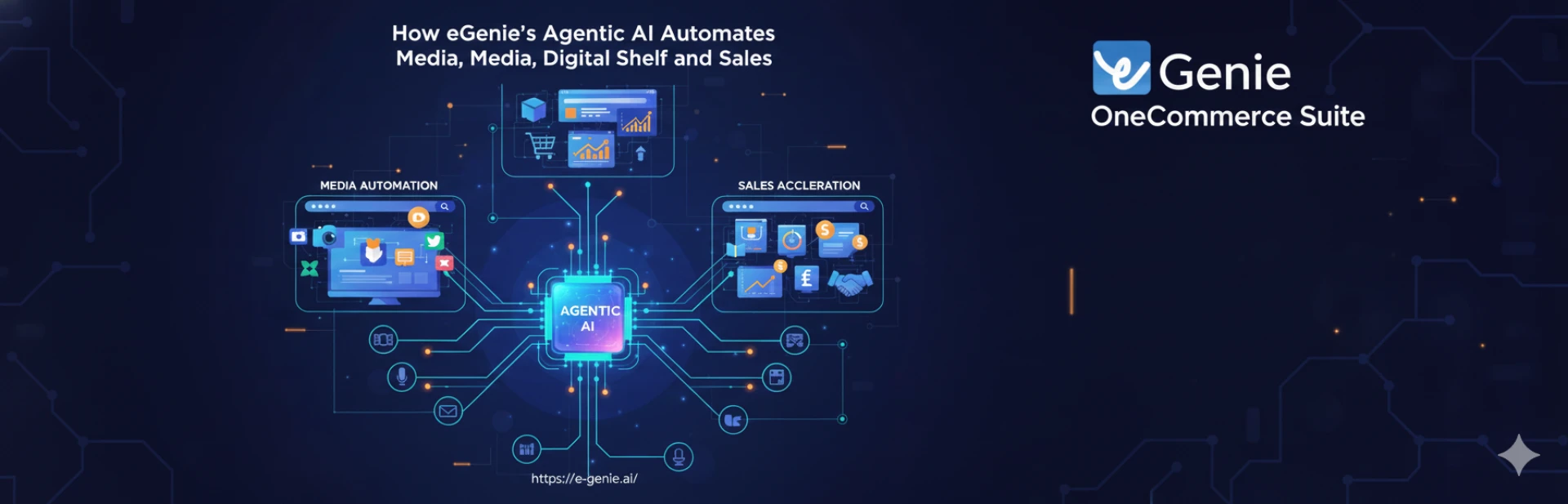
Traditional marketing automation works on a predefined logic, where if X happens, Y is the next step. While this approach improves efficiency, it also assumes stable conditions. This has led to a clear shift from traditional marketing automation to agentic, decision-led systems. Instead of merely executing instructions, agentic AI interprets signals and determines the most appropriate action. e-Genie’s Agentic AI is designed to enable this shift by connecting media performance, digital shelf signals and sales execution into a unified decision-making layer, allowing automation to move beyond tasks and towards intelligent orchestration.
The Growth Ceiling in eCommerce: Where Scale Starts to Break
Even after adopting a full marketing automation suite, most brands often find that campaign performance improvements become incremental rather than exponential. New tools add capability, but not necessarily clarity and teams, as a result, find themselves managing complexity instead of driving outcomes. One of the reasons influencing this change is disconnected execution. Media optimisation, product visibility, content quality and sales performance are frequently managed through separate systems, each optimising its own metrics. While these metrics may perform well individually, they rarely operate with shared context.
Traditional marketing automation suites are built to streamline workflows and standardise execution, but they cannot respond dynamically to real-time marketplace signals such as shifts in demand, availability constraints or competitive pressure. This creates a vacuum between what is happening in the market and how brands must respond to it. At this stage, breaking the growth ceiling requires intelligence that can interpret signals across media, digital shelf and sales and coordinate actions accordingly.
What Makes Agentic AI Different from Traditional Automation
Agentic AI is often misunderstood as a “smarter automation” alternative to traditional automation. In reality, it represents a fundamental shift. Agentic AI behaves like business intelligence software for e-commerce, but with the ability to act as well and not just merely inform. It continuously evaluates inputs across media performance, digital shelf health and sales outcomes. By increasing decision velocity and reducing dependence on manual intervention, agentic AI enables brands to move toward smart execution that keeps pace with modern marketplaces.
This is where its counterpart, traditional automation, falls short. Traditional automation focuses on executing predefined workflows. It acts only when a specific condition is met and stops there.
Let us understand the distinction between the two through a comparison table below:
| Traditional Automation | Agentic AI |
| Executes predefined rules | Interprets signals and decides actions accordingly |
| Operates on static logic | Adapts to changing conditions |
| Optimises individual tasks | Coordinates decisions across functions |
| Reacts after thresholds are met | Acts proactively based on context |
How e-Genie’s Agentic AI Connects Media, Digital Shelf and Sales
The true potential of e-Genie’s Agentic AI lies in its ability to break operational silos. Unlike traditional shelf analytics, metrics generated by Agentic AI are not just static reports but active signals that guide teams to make smarter decisions across functions. By leveraging digital shelf analytics tools, e-Genie continuously evaluates product visibility, content quality, pricing, and availability alongside media performance. These signals are interpreted in context to understand their impact on sales outcomes.
When gaps or shifts are detected on the digital shelf, e-Genie’s Agentic AI responds quickly by adjusting media actions accordingly. This ensures that visibility, spend and conversion efforts stay on the same page, enabling brands to act with greater coordination and accuracy in a dynamic marketplace.
Automation in Motion: How Decisions Get Executed at Scale
Due to shifts in consumer demands and their buying patterns, e-commerce marketplaces move at a high speed, where a single delay between insight and action can have negative consequences. To keep pace, brands need systems that can respond quickly as conditions change. This is where e-Genie’s Agentic AI acts as a game-changer, enabling real-time marketing automation by continuously processing signals across platforms and executing decisions with minimal lag between insight and action. Fluctuations in inventory levels, visibility or product-by-product performance are detected early and acted upon automatically.
This allows media actions to be adjusted in line with current market conditions, rather than relying solely on periodic reviews or manual intervention. In a fast-paced e-commerce marketplace, real-time marketing automation ensures that execution remains aligned with demand, availability and conversion potential at scale.
How e-Genie’s Approach Breaks the Growth Ceiling
Growth at scale is no longer about introducing more tools or human resources to operations; instead, it is about intelligent orchestration where e-Genie’s Agentic AI shines bright. It is one of the best e-commerce automation tools, because in addition to automating more tasks, it automates decisions across functions. By embedding intelligence across execution layers, e-Genie helps brands unlock incremental growth that traditional tools can barely replicate.
Let us analyse the capability-led differentiation of agentic AI:
| Capability Area | Advantages of e-Genie’s Agentic AI |
| Media Optimisation | Context-aware, shelf-linked decisions |
| Digital Shelf | Actionable intelligence, not static analytics |
| Sales Alignment | Media and shelf actions tied to outcomes |
| Scalability | Intelligence scales without automation |
From Automation to Advantage: What This Means for E-commerce Brands
As brands scale, they inevitably outgrow fragmented tools and require a unified marketing automation suite that understands context, prioritises outcomes and executes intelligently rather than working in isolation. With e-Genie’s Agentic AI in place, brands benefit from faster decision cycles, improved coordination within teams and more predictable outcomes, which is challenging to achieve through traditional automation techniques. Media, digital shelf and sales actions are guided by shared intelligence rather than isolated metrics.
Over time, this allows teams to focus less on manual intervention and more on strategic priorities that can be achieved via agentic AI. For brands operating at scale, transitioning from conventional automation towards an intelligent, connected marketing automation suite becomes essential to sustaining growth and responding effectively to evolving marketplace conditions.
To Sum It Up
As e-commerce ecosystems become increasingly fast-paced and interconnected, marketing automation is at an inflection point. What brands prefer in the present dynamic marketplace is an intelligent system that can interpret signals and guide execution across functions. e-Genie’s Agentic AI addresses this gap effortlessly by unifying media, digital shelf and sales within a single decision-making framework. By linking intelligence directly to action, agentic AI reduces reaction time, improves coordination and enables scale without fragmentation.
As AI-led commerce continues to mature with time, growth will increasingly depend on systems that can interpret complexity and execute intelligently. For brands seeking to break growth ceilings sustainably, intelligent marketing automation is here to define the next phase of scale.






























Sign in to leave a comment.