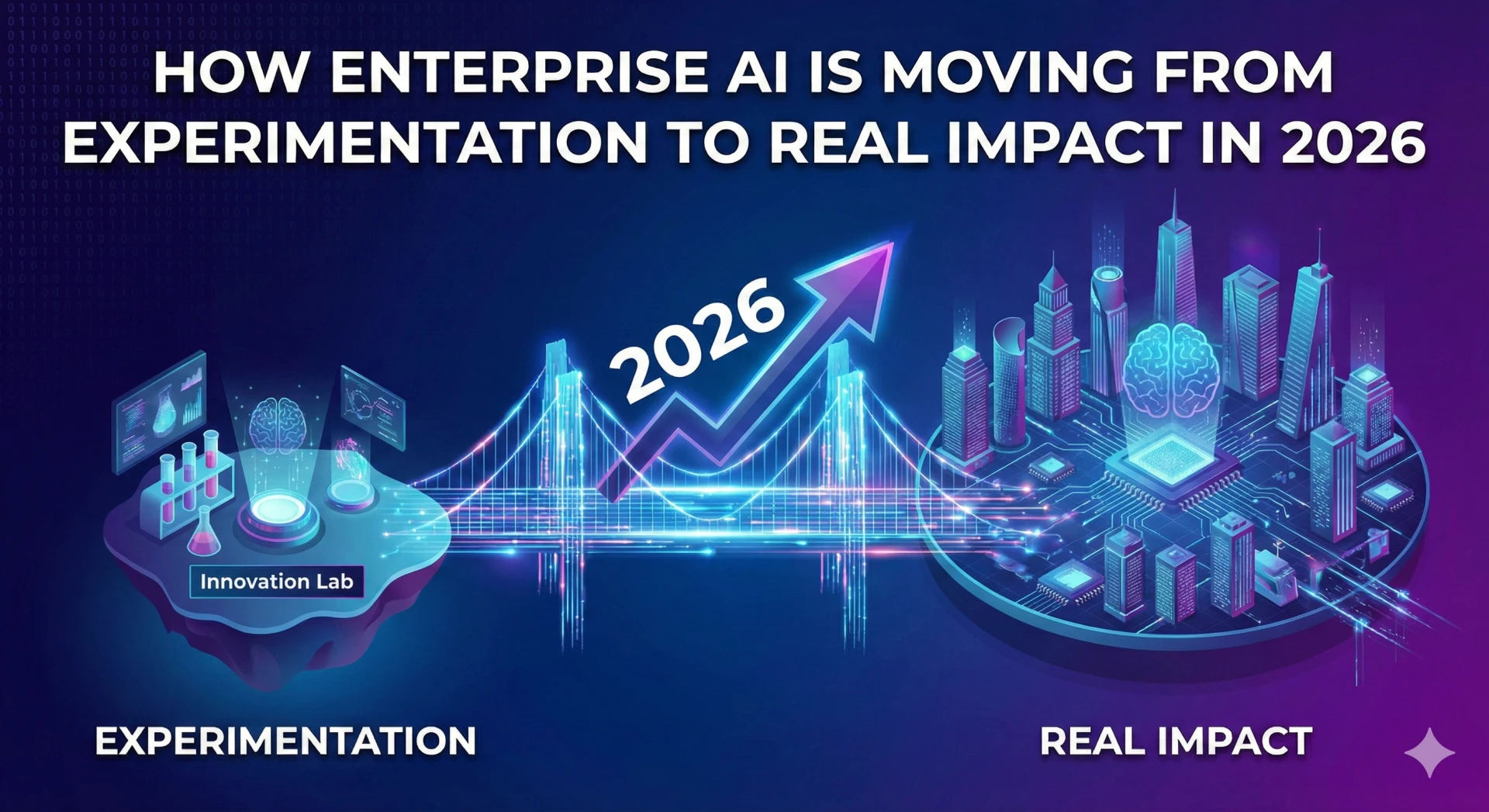

In 2026, enterprise AI is no longer a futuristic concept limited to only innovation labs and small pilot projects. What started as cautious experimentation has evolved into large-scale enterprise-wide AI implementation. Organizations are no longer questioning whether AI works; instead, they are focused on maximizing its impact. Enterprise AI is proving its value in all aspects of business, from efficiency to strategic forecasting.
Moving Beyond Pilots: AI as a Core Business Strategy
Between 2022 and 2024, most enterprises began testing AI in controlled pilot projects. These projects allowed leaders to understand the capabilities, limitations, and implementation challenges. However, in 2026, AI is no longer a secondary project but is instead incorporated into business strategy.
Enterprises are now incorporating AI directly into revenue-generating and cost-saving operations. Manufacturers use predictive maintenance to minimize downtime. Retailers use AI-driven demand forecasting to manage inventory more accurately. Financial institutions use AI to improve credit risk modeling. These operations are fully integrated into the business, showing clear ROI.
Notably, this strategic shift is supported by improved data foundations. Many enterprises are investing in data governance consulting services to ensure data quality, security, and compliance.
AI-Driven Decision Intelligence
In 2026, enterprise AI has transformed decision-making, shifting it from reactive analysis to proactive intelligence. Traditionally, analysis relied on historical data, focusing on what had already happened. AI, on the other hand, predicts what will happen and provides recommendations on the best course of action.
CFOs use AI-driven forecasting models to simulate various financial outcomes in real-time. Supply chain executives apply predictive analytics to forecast disruptions before they happen. Marketing organizations apply intelligent segmentation models to personalize marketing campaigns in an instant.
The rise of generative AI solutions has also contributed to this shift. Organizations are using generative AI to draft reports, create marketing content, design product prototypes, and generate customer insights from unstructured data. Instead of replacing people, generative AI solutions improve productivity, allowing organizations to concentrate on strategy and innovation.
Industry-Wide Transformation
The actual value of enterprise AI emerges when analyzing the extent to which it has been adopted in various industries:
- Healthcare: AI processes diagnostic images, monitors patient vitals, and forecasts potential health risks to enhance patient outcomes and operational efficiency.
- Finance: AI-driven fraud analysis tools detect anomalies in milliseconds, thus preventing financial losses.
- Manufacturing: AI enables smart factories to optimize production schedules and minimize waste.
- Retail and eCommerce: AI engines enable personalized shopping experiences, product recommendations, and automated logistics for the supply chain.
- Telecommunications: AI tools forecast network congestion and optimize traffic routing to enhance service reliability.
These examples are not individual applications but large-scale transformation initiatives reshaping entire industries.
Responsible AI and Governance at Scale
As AI adoption increases, businesses increasingly recognize the importance of governance, transparency, and compliance. In 2026, responsible AI practices are common. Businesses set up AI governance councils to track bias, data privacy, regulatory issues, and ethics.
Strong governance is even more important as the adoption of generative AI solutions increases. Generative models can produce highly realistic data, and therefore, it is necessary to track to monitor and validate them to avoid the spread of misinformation, bias, or misuse. Businesses that are proactive in integrating ethics into AI development reduce reputational and regulatory risks.
This is where structured data frameworks and data governance consulting services become important. They assist businesses in setting up data lineage tracking, access, quality, and compliance. With effective governance, businesses can scale AI initiatives without compromising trust.
Democratization of AI Across Functions
Another major shift in 2026 is the democratization of AI tools. AI is no longer confined to data science teams. Modern AI platforms provide low-code and no-code capabilities, allowing business users to build AI-powered workflows.
HR teams use AI to streamline recruitment processes. Sales teams rely on predictive scoring models to prioritize leads. Operations managers automate repetitive tasks through intelligent automation tools. Generative AI assistants help employees summarize documents, draft communications, and extract insights from complex datasets.
This accessibility accelerates innovation while distributing AI-driven value across departments. Enterprises that foster AI literacy and cross-functional collaboration are seeing the most substantial impact.
Measuring Real Business Impact
The defining feature of enterprise AI in 2026 is the measurable impact.
- Revenue Growth: AI-driven pricing optimization increases margins.
- Operational Efficiency: Automation reduces errors and processing time.
- Customer Retention: AI-driven personalization improves customer satisfaction and loyalty.
- Risk Reduction: Predictive analytics mitigate fraud and compliance risks.
Enterprise AI strategies have moved beyond the proof-of-concept success; current AI strategies prioritize scalability and sustained business value. Boards and executive teams demand clear ROI metrics before expanding AI programs.
The Road Ahead: AI as a Competitive Advantage
The next phase for AI is to move beyond the current state of supportive automation to autonomous decision-making, where enterprises will incorporate AI more into product development, strategic business plans, and the overall innovation cycle.
Generative AI solutions will help enterprises achieve creative and analytical breakthroughs, while strong data governance will help enterprises scale up, thereby providing enterprises with competitive advantages through the alignment of business objectives.
Conclusion
In 2026, enterprise AI has firmly transitioned from experimentation to measurable impact. What began as exploratory innovation has matured into a strategic engine driving efficiency, agility, and growth. Organizations that combine advanced AI capabilities with responsible governance frameworks are unlocking sustained value. AI technologies such as generative AI solutions continue to evolve, and enterprises that invest in structured data strategies and data governance consulting services will lead the next wave of intelligent transformation.











Sign in to leave a comment.