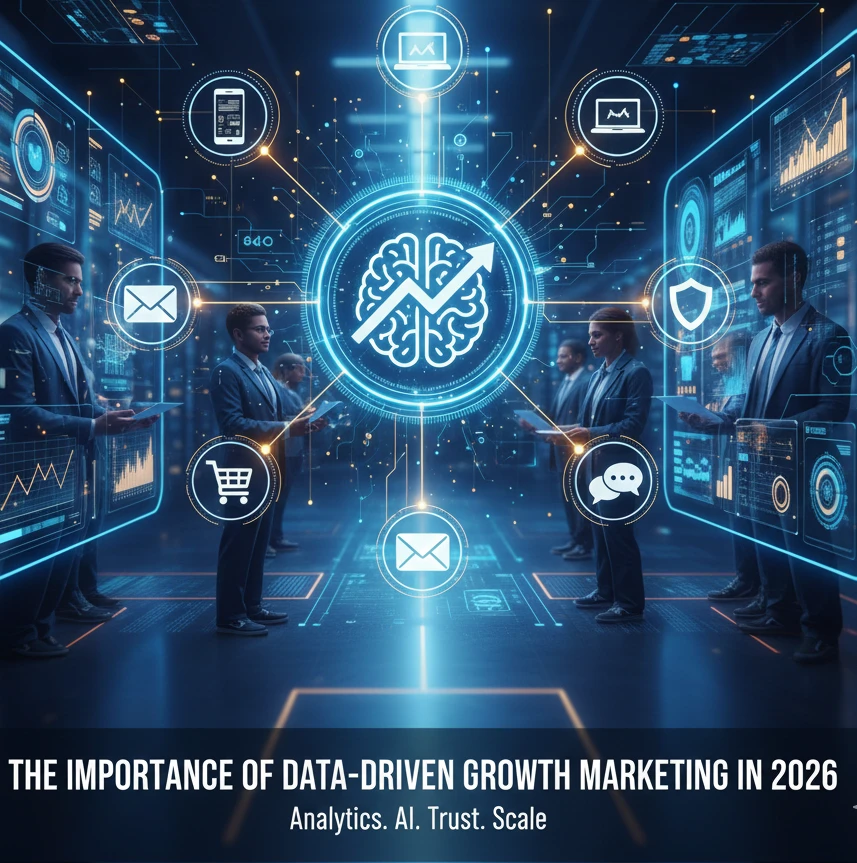

Growth marketing in 2026 is powered by data instead of instinct. So, companies demand scalability in analytics, automation of research, and reliability from predictive intelligence tools. Besides, marketing has more channels owing to the rise of novel social networking and brand rating platforms. In response, leaders are eager to tap into multi-channel attribution, customer journey mapping, and other use cases that tie into the broader marketing strategies.
This post will discuss the importance of data-driven growth marketing in 2026 against the backdrop of intense competition between organizations to gain and retain audiences.
What is Data-Driven Growth Marketing?
Data-driven growth marketing involves real-time data analytics and continuous experimentation. It also focuses on secure, compliant methods. Those methods must help companies acquire, activate, and repurpose data assets for better integration with new technologies and for broad or niche objectives. Think of sales enablement services that highlight the efficient ways to build better offers, gain new customers, resell to current clients, and dominate multiple segments. Such capabilities rely on more than one tool, necessitating responsible consolidation for reporting.
Growth marketing’s effectiveness in revenue generation requires regular monitoring. As a result, tracking user behavior and campaign performance through Google Analytics 4, HubSpot, Salesforce Marketing Cloud, and Adobe Analytics is vital.
Furthermore, the data and marketing needs vary from firm to firm and industry to industry. For instance, a retail brand will leverage data-driven growth marketing insights for in-store product and offer campaigns. Those cases refer to physical environments. However, a completely virtual marketplace selling digital goods will prioritize email, social media, and discussion forum insights since its delivery model and data needs differ.
Why Data-Driven Growth Marketing is Critical in 2026
Customer expectations in the year 2026 are more distinct. On one hand, consumers request compliance with privacy norms and responsible and selective data usage for personalization. On the other hand, frequently encountering irrelevant ads is a sign of unpleasant customer experience (CX). In short, brands must strike a balance between the two contrasting demands from consumers.
That is why switching to transparent, compliant, and ethical data-driven growth marketing is the need of the hour. Reputed data engineering services ensure that marketing teams get actionable insights without exposing consumer data to data loss or cybercrime risks. When handling data insights occurs in a secure computing system, personalizing CX becomes less of a hassle.
Additionally, machine learning and AI enable brands to fill the data gaps and synthesize virtual audience groups, assisting in campaign comparison. Therefore, organizations reduce the use of personally identifiable information (PII) and focus on insights into similar audience profile cohorts. That approach decreases the privacy non-compliance risks associated with conventional marketing data gathering methods revolving around cookies.
Key Benefits of Data-Driven Growth Marketing
The key advantage is speed. Marketing teams can find out which campaigns work and scale them immediately. Moreover, identifying underperforming campaigns assists in determining marketing budget allocation. In turn, the return on ad spend (ROAS) improves.
Another advantage is precision in targeting. Brands can leverage anonymized or synthetic data to target micro segments based on behavior, purchase intent, device usage, and location. For instance, e-commerce sites like Shopify and BigCommerce frequently use behavioral tracking to personalize offers.
Similarly, marketing teams gain visibility across the whole funnel. From lead generation to post-purchase retention, every stage of the process becomes measurable when detailed insights are available. That improves forecasting and revenue planning.
Conclusion
Data-driven growth marketing will gain more momentum in 2026 despite the decline of cookie-based data gathering. The main reason is that it is now foundational to a competitive digital strategy. Consequently, brands that invest in ethical marketing analytics through automation, data engineering, and governance compliance will witness strong year-on-year growth.
Modern growth marketing will prove that robust compliance ratings and personalization goals are achievable through innovative use of data processing tech. While brands will excel at ad targeting and customer engagement, audiences will have fewer doubts about whether their data is safe. Although some transition pains are inevitable, marketers worldwide must collaborate with data and engineering pros to make the trend a success.











Sign in to leave a comment.