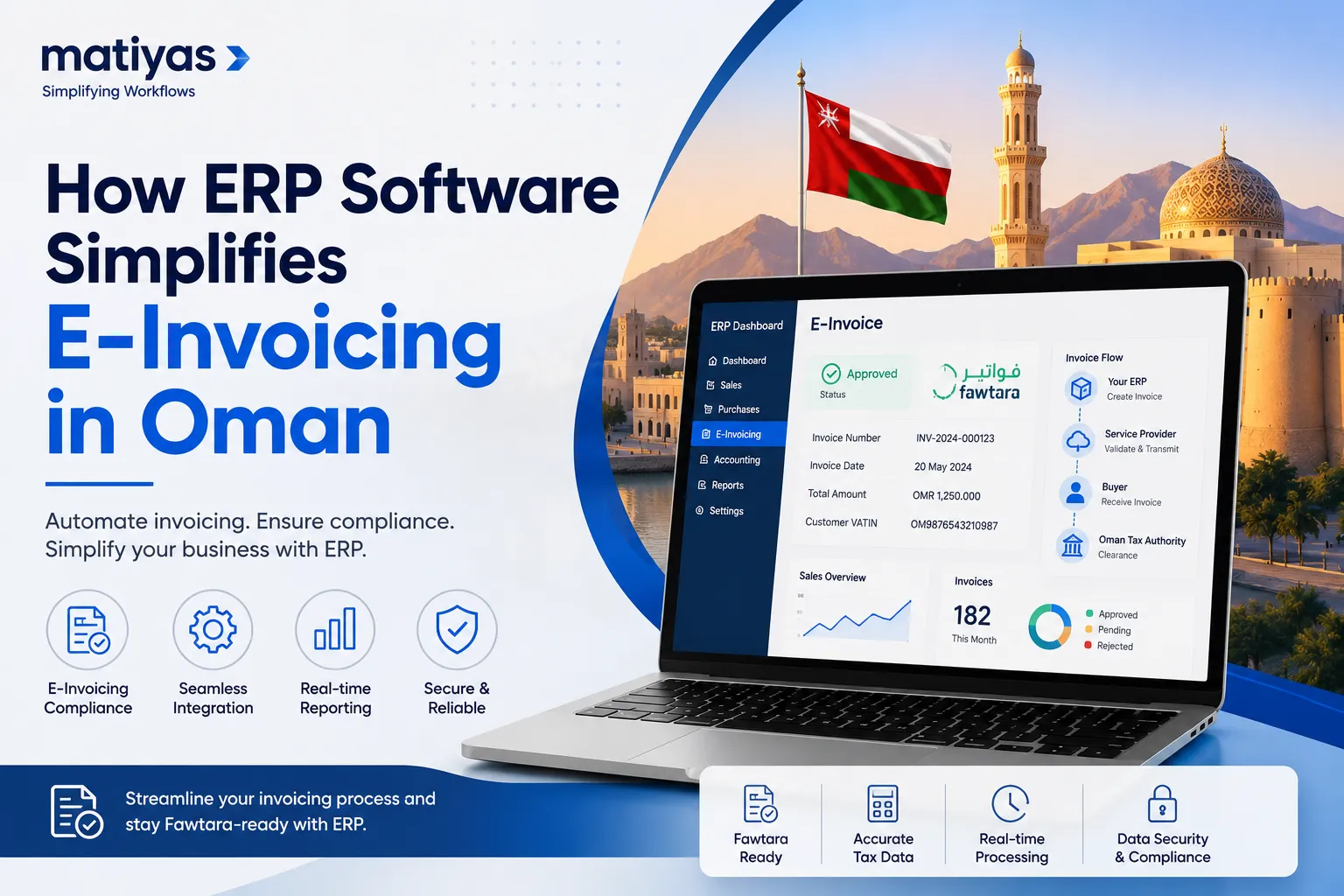

Electronic invoicing is changing how businesses in Oman create, exchange, and manage invoices. As the Sultanate moves toward its Fawtara e-invoicing framework, businesses need to understand the new requirements and how they affect existing invoicing processes. For a detailed overview of the regulations, framework, and implementation requirements, read our complete Oman e-invoicing guide.
For companies processing a large number of sales and purchase transactions, e-invoicing can become difficult if customer information, accounting records, tax data, inventory, and invoices are maintained separately.
This is where ERP software for e-invoicing in Oman can play an important role.
Instead of treating electronic invoicing as an isolated activity, an ERP system connects it with sales, accounting, inventory, customer information, and other business processes. This creates a more automated invoice journey while reducing repeated data entry and improving visibility across departments.
Why E-Invoicing Requires More Than Creating a Digital Invoice
Businesses sometimes associate electronic invoicing with creating an invoice as a PDF and sending it by email.
Structured e-invoicing works differently.
An e-invoice contains invoice information in a structured electronic format that can be processed digitally between participating systems. Under Oman's Fawtara framework, invoice exchange involves businesses, service providers, and the Oman Tax Authority (OTA).
This means businesses need reliable information behind every invoice.
Customer details, tax information, invoice numbers, dates, products or services, quantities, prices, and other required information must originate from business systems and move through the invoicing process accurately.
When this information already exists within an ERP system, businesses have a stronger foundation for automating the process.
The Problem With Disconnected Invoicing Systems
Consider a business where the sales team creates orders in one application, finance maintains accounting information in another, and invoices are prepared manually.
When e-invoicing is added, employees may need to transfer the same transaction information into another platform.
A single sale could therefore involve several separate steps:
A salesperson records the order. Someone verifies the customer and pricing information. Finance prepares or reviews the invoice. Invoice details are entered into an external system. Accounting records are then updated.
Every manual handoff creates another opportunity for information to be entered incorrectly or inconsistently.
An integrated ERP approach aims to reduce these handoffs.
How ERP Simplifies the E-Invoicing Workflow
The main advantage of ERP is that an invoice does not begin as a separate document. It develops from information already created during normal business activities.
Suppose an Oman-based company receives a customer order.
The customer record already exists in ERP. Products or services, quantities, prices, and applicable tax configurations can be associated with the transaction.
Once the sale reaches the invoicing stage, much of the required information is already available.
With the appropriate e-invoicing configuration and integration, invoice data can then move into the required electronic invoicing workflow without employees recreating the complete transaction manually.
The invoice can remain connected to the original customer, sale, accounting entries, and subsequent payment.
This creates a more continuous process from sale → invoice → electronic exchange → accounting → payment.
1. Centralized Customer and Transaction Data
Reliable e-invoicing starts with reliable data.
ERP software provides businesses with a central location for maintaining information related to customers, suppliers, products, services, taxes, prices, and transactions.
When departments work from the same records, inconsistencies can be reduced.
For example, finance does not need to maintain a separate version of customer information from the sales department. Both teams can work with information stored in the ERP environment.
Centralization becomes particularly valuable as invoice volumes increase.
2. Automated Invoice Creation
Manual invoice preparation can consume significant time, particularly when employees repeatedly copy information from orders, delivery documents, or spreadsheets.
ERP systems can connect invoicing directly with sales transactions.
Information such as customer details, items, quantities, pricing, taxes, and transaction references can flow into the invoice based on the underlying business process.
This reduces repetitive work and helps create more consistent invoice records.
Automation does not eliminate the need for appropriate controls. Instead, it allows employees to focus on exceptions and approvals rather than repeatedly entering standard transaction information.
3. Better Tax Data Consistency
Tax information is an important part of invoicing.
When tax calculations or classifications are handled manually for every transaction, inconsistent configurations can create problems.
An ERP system allows businesses to establish tax rules and configurations according to their operational requirements.
These configurations can then be applied within relevant transactions rather than being recreated for every invoice.
For Oman businesses, ERP configuration should be reviewed against applicable VAT requirements and the latest e-invoicing specifications issued by the Oman Tax Authority.
Businesses should also regularly review master data and tax settings as regulatory requirements evolve.
4. Connecting ERP With the E-Invoicing Ecosystem
ERP is only one part of the overall e-invoicing environment.
Oman's Fawtara framework uses a decentralized model in which businesses exchange invoice information through service providers while required information is communicated within the regulated ecosystem.
This makes integration important.
A business should evaluate how invoice information will move from its ERP or accounting environment into the required e-invoicing network.
With an appropriate integration, businesses can reduce the need to manually transfer transaction data between platforms.
The objective is to make electronic invoicing part of the existing sales and finance workflow rather than creating an entirely separate process for employees.
5. Connecting Invoices With Accounting
One major advantage of using e-invoicing ERP software in Oman is the relationship between invoicing and accounting.
A customer invoice affects more than the document sent to the buyer. It may also affect revenue, taxes, accounts receivable, customer balances, and eventually payment records.
When invoicing and accounting operate within the same ERP environment, these activities remain connected.
Finance teams can trace transactions more easily and management can obtain a clearer picture of outstanding receivables and financial activity.
This reduces the gap between operational transactions and financial reporting.
6. Improving Invoice Tracking and Visibility
When invoices are spread across emails, folders, spreadsheets, and accounting applications, finding the current status of a transaction can become difficult.
ERP provides a centralized transaction history.
Authorized users can access relevant invoice records, customer information, related sales transactions, payments, and accounting information from one environment.
Depending on the final integration architecture, businesses may also be able to incorporate e-invoicing processing statuses into their workflows.
This visibility can help finance teams identify exceptions more quickly instead of discovering problems during reconciliation.
ERPNext for E-Invoicing in Oman
ERPNext provides an integrated business management platform covering accounting, sales, purchasing, inventory, CRM, and other operational functions.
For companies preparing for electronic invoicing, this means much of the business information required to create invoices can already originate within one platform.
ERPNext can manage customer and supplier records, sales invoices, purchase invoices, item information, tax configurations, payment entries, accounting transactions, and financial reports.
It also provides customization and integration capabilities that can be used to connect ERP workflows with external systems.
However, implementing ERPNext does not automatically make a business compliant with Fawtara.
The actual solution needs to be assessed against current Oman Tax Authority requirements, technical specifications, approved service-provider arrangements, invoice formats, and the organization's applicable obligations.
Businesses should therefore view ERPNext as the operational foundation upon which the required e-invoicing integration can be built.
A Practical E-Invoicing Workflow With ERP
A well-integrated process could begin when a customer places an order.
The sales team records the transaction in ERP using an existing customer profile. Product, pricing, and tax information is pulled from configured records.
After the required business conditions are met, the invoice is generated using the transaction information already stored in the system.
The relevant invoice data can then be prepared for the required electronic exchange through the configured integration and service-provider environment.
The invoice remains connected to accounting records, and when the customer pays, the payment can be recorded against the corresponding transaction.
Instead of maintaining separate versions of the same sale, the business has one connected transaction lifecycle.
How Businesses Can Prepare Their ERP
Preparing for e-invoicing should begin with understanding the current invoicing process.
Businesses can review where customer information is stored, how invoices are currently generated, who verifies tax details, how accounting entries are created, and how invoice records are archived.
The next step is data quality.
Customer records, tax details, item information, and other master data should be reviewed for missing, duplicated, or inconsistent information.
Companies should then evaluate their ERP's integration capabilities and determine what technical changes may be required to connect with Oman's e-invoicing ecosystem.
Finally, businesses should follow current guidance from the Oman Tax Authority and work with appropriate technology and service providers when implementing their solution.
ERP Turns E-Invoicing Into a Connected Business Process
E-invoicing should not become another isolated system that employees need to manage alongside sales and accounting software.
Its greatest operational value can be achieved when invoicing becomes part of a connected digital workflow.
ERP software for e-invoicing in Oman helps create that foundation by bringing customer data, sales transactions, tax information, invoicing, accounting, and payment records together.
With appropriate configuration and integration, businesses can reduce repetitive data entry, improve invoice consistency, strengthen financial visibility, and prepare their internal systems for Oman's evolving Fawtara environment.
For businesses considering ERPNext, the focus should be on designing an invoicing process that works not only for regulatory requirements but also for everyday operations.
Matiyas Solutions provides ERPNext implementation, customization, integration, and support services for businesses in Oman. Organizations preparing for e-invoicing can assess their current ERP and invoicing workflows to identify the technical and operational changes required for a more connected approach to electronic invoicing.























Sign in to leave a comment.