
Contextual intelligence services have explored realistic use cases of generative artificial intelligence (AI) to revolutionise marketing and manufacturing operations’ productivity. Likewise, each day brings exciting news about conversational AI systems passing law and medicine exams. This post will elaborate on how generative AI and ChatGPT will change business.
What is a Generative AI?
Generative artificial intelligence includes software environments that create unique content like code, visual art pieces, music, videos, articles, and physics simulations. These applications also enhance contextual intelligence services since they estimate the meaning of a user’s instructions.
Large language models (LLMs) and sentiment recognition enable the programs to categorise different clauses and phrases in a user prompt. Later, each generative AI tool can find the words and ideas fitting the context of the user’s description.
Creating multimedia projects using generative AI will change business marketing activities. Besides, the related tools can get training to help them understand an organisation’s established reporting methods. So, managers can employ generative artificial intelligence solutions to minimise report development delays and accelerate decision-making.
What is a Conversational AI?
Conversational artificial intelligence has offered multi-party discussion experiences, usually comprising high-quality responses and logical messages. Therefore, businesses want to implement conversational AI across chatbots, smart home devices, and other virtual assistant apps on mobiles.
A company can develop a conversational AI tool to guide recently recruited employees. It will train them in creating standardised documentation and using the company’s IT resources. Similarly, another conversational AI chatbot can interact with an e-commerce website’s visitors to increase engagement, resolve a customer’s doubts, and improve conversion rate.
Chatbots powered by a conversation AI will rely on extensive databases and machine learning (ML) services for contextual intelligence. Moreover, their AI can integrate natural language processing (NLP) to deliver multilingual experiences and change the global business landscape by overcoming language barriers.
What is ChatGPT? Learn About Its Capabilities
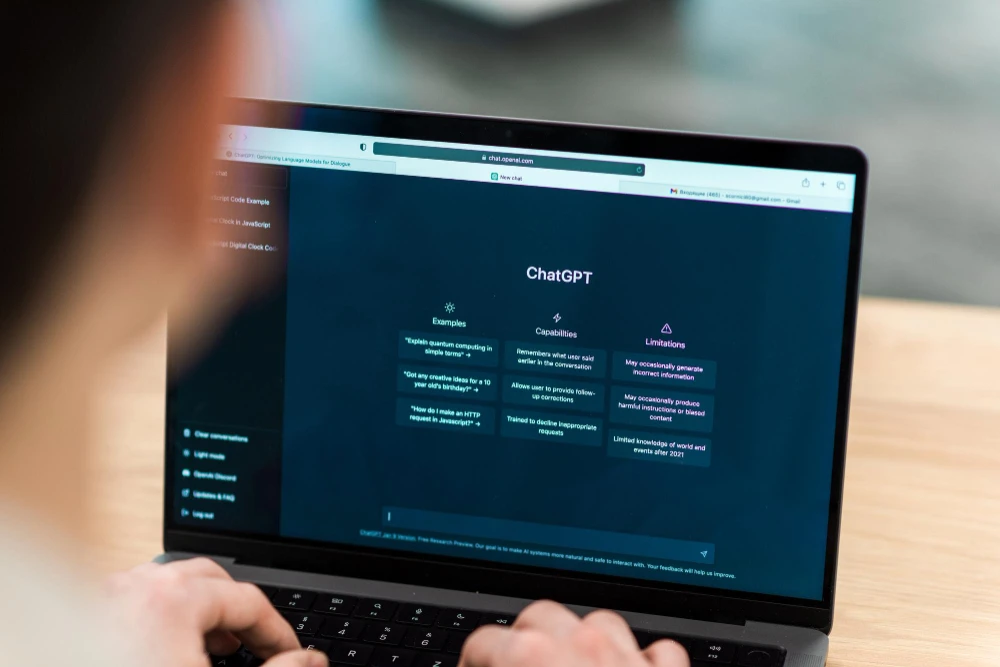
OpenAI’s ChatGPT is an LLM derived from InstructGPT. The team behind ChatGPT trained it using reinforcement learning from human feedback (RLHF). It is a conversational AI application that employs proximal policy optimisation. So, it can develop human-friendly responses to satisfy a user’s prompt or instructions.
GPT is an abbreviation for a generative pre-trained transformer. Since using this conversational artificial intelligence feels like social media chatting, ChatGPT became its trending name that took over the web.
ChatGPT 3.5 series can continue a conversation by asking follow-up questions suitable for the context. It can admit its mistakes when a user brings them to its attention. Afterwards, ChatGPT will add this acquired contextual intelligence to its data management and moderation services that will help prevent them from recurring.
It can also avoid answering potentially controversial queries using a ModAPI, i.e., an application programming interface optimised for content moderation. This integration prevents the exploitation of ChatGPT’s “learning” abilities aimed at inserting misinformation into its knowledge base.
How Will Generative AI and ChatGPT Change Business Operations?
1| Corporate Content Marketing Will Become More Efficient
Creating marketing media like articles or videos is time-consuming. Besides, organisations must ensure marketing content has no plagiarism. Also, it must be highly engaging enough for consumers. Otherwise, copyright and intellectual property claims will damage the company’s reputation if it uses content created by others without procuring the necessary licenses.
Generative AI and ChatGPT will change how a business approaches content creation. After all, these technologies facilitate faster production across blogging, emailing, copywriting, video creation, and voice synthesis.
Although search engine guidelines, leading magazines, research journals, and news publications penalise AI-generated content, editorial modifications made by humans are mostly acceptable. Contextual intelligence services can also help human editors optimise marketing media for particular consumer intent.
2| Job Responsibilities Will Prioritise Creativity
A business using generative AI and ChatGPT can reduce employee headcount or change their job roles. Therefore, managers can encourage employees to focus on creative problem-solving tasks by allocating AI tools for mundane or repetitive workflows.
Artificial intelligence still needs to work on original idea synthesis. It can reproduce facts but does not understand abstract concepts like humans do. So, human professionals will join creativity improvement programs to stay competitive.
This phenomenon indirectly empowers corporations to utilise in-house talent more effectively. Employees can also meet their performance milestones earlier if they stop exhausting their brain power on non-creative activities.
3| New Opportunities for Cost Reduction Will Emerge
ChatGPT or generative AI can help streamline team management and recruitment requirements. If one employee uses artificial intelligence to perform tasks done by five individuals, this situation highlights cost reduction opportunities.
Furthermore, managing a smaller team will be easier than handling a large team. However, there is an initial uptick in financial obligations. Leaders must educate each employee on how to treat AI as a co-worker and complete the tasks. Likewise, an employee’s wage must reflect the AI-enabled productivity gains to prevent talent drain from increased salary expectations.
Therefore, the cost reduction benefits take some time to manifest. If contextual intelligence services can quickly improve AI tools’ output, there will be more remarkable savings due to the faster delivery of results.
4| Generative AI and ChatGPT Will Change Stressful Business Environments
Time is finite, has a monetary value, and does not regenerate. So, the corporate routine plays with the psychological well-being of employees and their reporting managers via deadlines. Professionals start neglecting their mental, social, and spiritual needs. They become robotic to accomplish their targets.
Thankfully, AI tools, contextual intelligence services, and LLM platforms offering features like ChatGPT have the potential to make blue and white-collar jobs less stressful. C-suite has coped with premature blood pressure, eye strain, and high-functioning depression for far too long.
Automation technologies increase workplace productivity without forcing employees to work twice hard. For example, business owners can change work hours, yet they will realise their quarterly targets using ChatGPT and generative AI. Improved psychological well-being also correlates with improved creative problem-solving.
5| Customer Experiences Will Become More Interactive and Dynamic
Many websites have added chatbots that ask visitors a series of pre-configured questions. However, these interactions are predictable. Some consumers also consider chatbots annoying and unnecessary. They find interacting with a human sales representative more satisfying.
So, organisations hire calling and video conferencing professionals who work throughout the day and night to capture leads. Likewise, technical support staff will also help consumers with problems related to billing, warranty, product issues, and demo enquiries.
Workers who operate at night endanger their bodily systems. However, generative AI and other technologies like ChatGPT can reduce the need for human representatives who work all night. The AI-powered chatbots will manage lead acquisition and customer care activities at night. This advantage is significant to global companies that serve clients in different time zones.
6| Software Development and Factory Management Will Witness More Extensive Automation
ChatGPT can write the code necessary to perform a software function. So, it makes software development more efficient. Programmers can leverage AI-powered chatbots to minimise the time and effort spent defining and modifying standard coding requirements.
A generative AI can also allow robots to “follow custom orders” and assemble products that differ in specifications without requiring software changes. This capability will extend to accident prevention systems that will warn workers and factory managers against workplace hazards in real time.
Automating storage and logistics will become possible. Imagine that worker talks to a display and requests an item. A robot will understand her request like a human would. It will find the item and bring it to the worker. The workers will be less exposed to physical injuries if context-aware robots do the laborious tasks.
Conclusion
Generative AI and ChatGPT have use cases that will change how a business realises its customer acquisition and employee development objectives. These solutions promote reporting and corporate correspondence efficiency.
Moreover, your marketing department will benefit from OpenAI’s ChatGPT in creating preliminary versions of marketing assets. You can reduce team size and encourage creative problem-solving in the workplace. Workers will quickly meet their performance milestones and enjoy more rewarding job roles.
A leader in contextual intelligence services, SG Analytics, enables organisations to identify consumer intent and fit them into ideal personas to increase marketing effectiveness. Contact us today if you require natural language processing and sentiment analysis to enhance customer service.






Sign in to leave a comment.