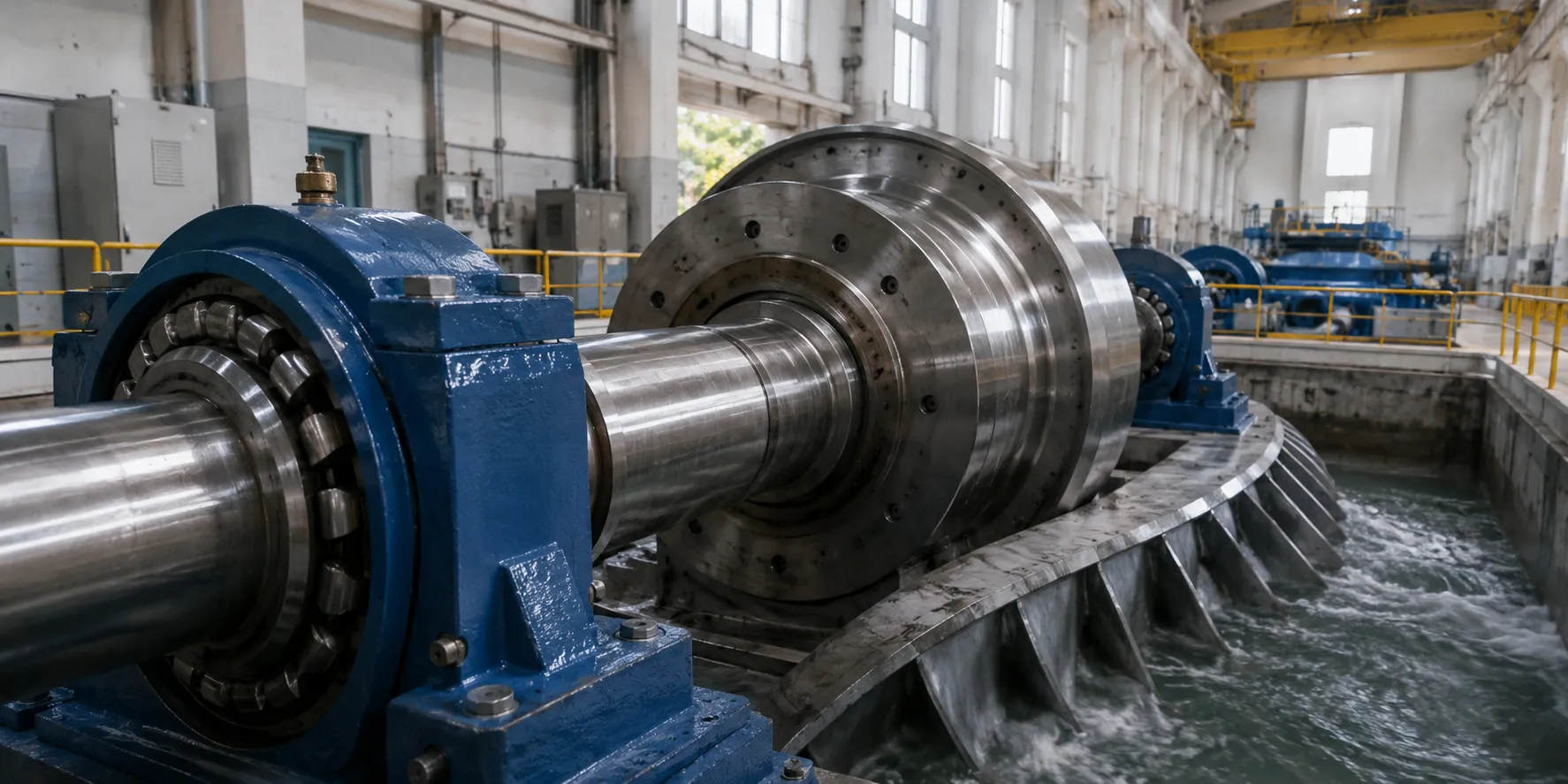

As technology advances, so do the challenges placed on existing resources. With the rising prominence of solar and wind energy, hydropower facilities no longer provide constant, supporting energy. Instead, they help balance irregular, non-constant energy, and as a result, hydropower facilities must also adjust, start, and stop more frequently.
For a bearing manufacturing company, designing components to sustain and endure the challenges of the new operating environment is of great concern. While large components like generators and runners receive the majority of the capital investments, turbine bearings, which operate out of sight, are the components that determine the mechanical availability of the entire plant.
Moving beyond conventional bearing materials and employing high-performance bearing materials is a solid strategy proven to support the reduction of operational risk, maximize plant uptime, and most importantly, minimize long-term Operations & Maintenance (O&M) costs.
The Mechanical Limitations of Legacy Bearings
For most of the past decades, the oil-lubricated Babbitt metal bearings and standard metal-backed bearings were the most prominent choice for the industry. These traditional systems had adequate performance for steady baseload operations, but they had significant mechanical limitations for modern grid operations.
Start-Stop Cycles and Their Effects on Wear
Most oil-lubricated bearings use hydrodynamic oil films that only develop at a certain shaft rotational speed. Bearings will function within a range of boundary lubrication as electrical start-stop cycles occur. As a result, there will be continued metal-on-metal contact that will erode the bearing and damage it with friction.
Risks During Operations
Oil-lubricated systems carry an inherent structural liability: seal degradation. Since these bearings will be a short distance away from the water column, even a small leak will allow oil to flow down into the tailrace. These days, it is impossible to have an oil spill without large fines for environmental damages, a forced shutdown of the facility, and a public relations disaster.
Contamination from Water
River water is not pure water. It contains suspended solids like silt, sand, and ice-flour that are abrasive and, when they breach bearing seals, intrude the lubrication system. In metal bearing systems, these solids become trapped between the shaft surface and bearing surface, and act as abrasives.
Key Applications: Where Bearings Matter Most
High-performance bearings help solve the many different, application-specific problems faced by turbine engineers in a hydropower system.
Kaplan Turbines: Runner Blades and Main Shafts
Kaplan turbines have special adjustable runner blades that constantly pivot to optimize efficiency based on fluctuating water flow. The runner blade hub bearings must operate under rapidly changing loads that are always fully submerged.
By switching to advanced materials that are oil-free and high performance, there is no longer the potential for oil leaking into the river from the hub, and the runner blades will change position in a fluid manner.
Francis & Pelton Turbines: Main Guide and Thrust Bearings
In the Francis and Pelton arrangements, main guide bearings must operate under high radial loads, while thrust bearings must operate under large axial loads caused by the rapidly flowing water.
High-performance bearings help create the large stiffness the framework requires for the shafts to be loaded and aligned with precision, thus helping to avoid uneven wear of the sealing surfaces of the turbine and the above-mounted generator.
Wicket Gates and Operating Mechanisms
Wicket gate assemblies manage the flow of water to the runner and have numerous gates that contain complicated arrays of linkages, levers, and pins. Traditionally, bronze bearings were used to facilitate movement and required manual lubrication. If lubrication were neglected, the linkages would experience high levels of friction that would result in stick-slip or total jamming.
The new systems allow all of the thousands of friction points to operate smoothly without any maintenance.
The High Performance Material Solution
The answer to these systemic issues involves an evolution in material science. Classic bronze bearings have their niche. However, primarily, hydro-turbine components operate in harsh, unlubricated or water-submerged environments.
Even when continuously supplied with grease, traditional bronze bearings struggle in silt-heavy, abrasive environments where water can wash away lubricants, leading to rapid galling
High-performance bearings, on the other hand, incorporate self-lubricating polymers, synthetic elastomeric materials, and fiber-reinforced composites. These newly integrated materials provide three beneficial operational enhancements:
1. Removal of an Oil Liability: By utilizing water-lubricated or entirely dry, composite systems, oil is entirely removed from the wet environments of the turbine. This completely removes the risk of an oil spill and simplifies meeting the applicable agreements.
2. Debris Tolerance: Composite materials, unlike rigid metals or traditional bronze bearing systems, have a measure of flexibility. With the inevitable introduction of a silt particle, the bearing system flexes, allowing the foreign material to safely pass without damaging the turbine shaft.
3. Predictable Maintenance Cycles: Due to their low static coefficient of friction, elastomeric composites do not suffer from boundary lubrication during the initiation of motion. This allows the plant to adopt planning cycles for maintenance instead of operating in an emergency maintenance mode.
If you want to see how the improvement of materials today is changing operating systems for many industries, you can look at a broader industrial example of how machine bearings are changing the industry.
Engineering Long-Term Asset ROI
Upgrading the bearing technology at your facility goes beyond simply replacing a spanning component. It is an investment for the future that offers the prevention of risk and protection for the environment. It also improves the return on investment for the facility.
Removing the mechanical weaknesses of old bearing materials protects the shafts of your turbines from unnecessary wear and protects your finances from large and unplanned service outages.
Maximizing plant longevity requires a specialized engineering approach to the manufacture of bearings and designing high-performance systems that integrate seamlessly into existing Francis, Kaplan, and Pelton turbine frameworks.
Analyzing current wear cycles and operational history allows for the creation of targeted upgrades that ensure decades of reliable, grid-stabilizing service.

























Sign in to leave a comment.