
Are you sure your child's school has a real AI policy or just a vague statement on a website nobody reads?
In March 2026, the International Baccalaureate® organization published its draft AI Design Principles for member schools worldwide. This was not a press release. It was a signal. The IB acknowledged that schools are "navigating AI under real pressure" and released five draft principles meant to give schools "a clear, values-led foundation" they can adapt to their own context. The principles cover human flourishing, deeper learning, critical thinking, data privacy, and human oversight of high-stakes decisions.
If your child attends one of the IB program elementary schools in Hampton Roads or anywhere in the States and beyond, or you are researching the best international baccalaureate schools in the region, this shift directly affects what your 8-year-old's classroom looks like today.
Why Elementary AI Policy Is Nothing Like High School AI Policy
Most public conversation about AI in schools focuses on high school students using ChatGPT to write essays. That is the wrong frame for elementary parents.
At the IB Primary Years Programme (PYP) level — kindergarten through Grade 5 — the question is not about academic dishonesty. It is about cognitive development. An 8-year-old's brain is still building foundational skills: reading comprehension, original thought formation, the ability to tolerate ambiguity and work through it. AI tools that short-circuit this process at age 8 create a different risk than at age 17.
The IB's draft principles include a firm position that "high-stakes decisions about grading, progression, and well-being must never be fully automated" and that "professional judgement remains central." For elementary educators, this is actually liberating: AI can support, but the teacher and the child's own thinking stay at the center.
What "Responsible AI Use" Actually Looks Like in a 2nd, 4th, and 5th Grade Inquiry Classroom
Here is where it gets practical. In a 2nd-grade IB classroom, AI is not a writing tool. It is a discussion starter. A teacher might show students an AI-generated response to a question and ask: "What is this missing? What does it get wrong?" That builds critical evaluation — a core IB Learner Profile trait.
In a 4th-grade classroom working through a transdisciplinary unit on "Sharing the Planet," students might use an AI tool to surface different global perspectives on water access. They then compare, question, and debate. The AI does not conclude. The student does.
In 5th grade, the PYP Exhibition is where this becomes most visible.
The PYP Exhibition is described as "the moment students bring together everything they know about inquiry, collaboration, and taking action." In 2026, IB educators are actively discussing how AI tutors can "personalise learning while keeping student ownership at the centre." The key phrase: student ownership. A well-run IB school does not let AI own the inquiry. It lets AI accelerate the student's ability to ask better questions.
The Cheating Question at the Elementary Level
Yes, it is real, but it is less acute than at the secondary level, and it manifests differently.
An 8-year-old is not submitting an AI-written essay. The concern is subtler: a child using a voice-enabled AI assistant to answer a math problem rather than working through it, or copying a summary from an AI tool during independent reading time.
The best IB program elementary schools address this not through surveillance but through design. When the task is inherently personal — "describe what you noticed during our nature walk" — no AI can answer it authentically. Inquiry-based learning, done well, is structurally resistant to AI substitution.
Tip for Parents: Ask your child's teacher what percentage of assessments require first-person, experience-based responses. In a strong PYP classroom, that number should be high.
How Virginia's Phone-Ban Law Interacts with Classroom Chromebooks and Tablets
Here is the policy wrinkle most Hampton Roads parents have not thought through.
Virginia has expanded its policy to ban phones from bell to bell, and is among the 31 states that now have laws banning phones in classrooms. But the phone ban does not touch school-issued Chromebooks and tablets — the very devices used to access AI tools during class. The result is a regulatory gap: personal phones are out, but school-managed AI-enabled devices are fully in play.
This matters because the discipline around personal devices and school devices is completely different. A child who cannot use a phone is still sitting in front of a Chromebook with access to AI search tools, AI writing assistants, and more. How a school manages that access — through filtering, supervised use protocols, and teacher training — is now one of the most important questions a parent can ask.
Five Questions to Ask Any School About Its AI Stance
Before enrolling at any private IB school, ask these questions directly:
- Does your school have a written AI use policy specific to PYP grade levels — not just a general technology policy?
- How do teachers distinguish between a student using AI as a research partner versus using it to replace their own thinking?
- What AI tools, if any, are available on school-managed devices, and how is access supervised?
- How does your school align with the IB's March 2026 draft AI Design Principles?
- How does your school handle the gap between the state phone-ban law and school-issued device use?
A school that cannot answer questions 1 and 4 with specificity does not yet have a real AI policy. A school that answers all five with confidence is ahead of the curve.
Quick Fact: As of March 2026, Kansas became the 33rd state to enact a K-12 cellphone ban. In total, 41 states have now passed laws addressing phones in school.
The "Low-Tech Childhood" vs. "AI Fluency" Debate Splitting Elementary Parents
This is the real conversation happening in Hampton Roads school communities right now — and there is no clean answer.
One group of parents believes strongly in protecting childhood from screens and AI. Their position has legitimate research support. Excessive early screen exposure is associated with reduced attention spans and delayed language development.
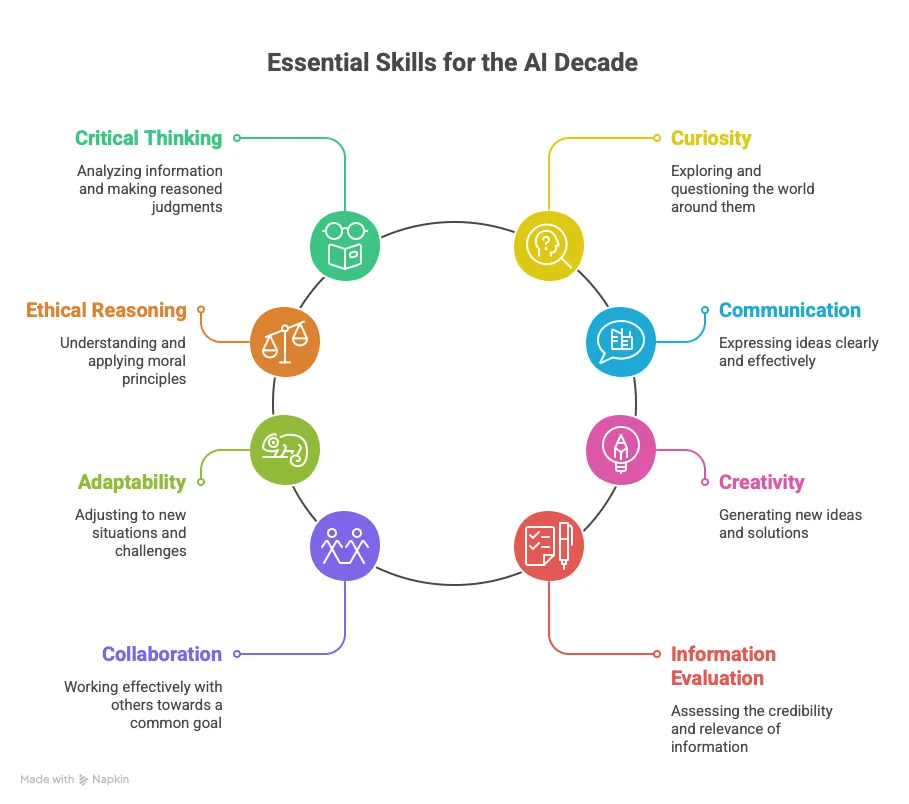
The other group argues that AI fluency is the defining literacy of the next decade, and that shielding children from it entirely creates a future disadvantage.
The best IB schools do not choose sides. They hold the tension intentionally. The IB framework is built for exactly this kind of complexity — using structured inquiry to help children engage with difficult, contested questions rather than accepting one answer. A school that uses AI mindfully, with clear boundaries and strong teacher oversight, is not choosing the "high-tech" side. It is modeling what thoughtful, principled engagement with technology looks like.
That is a lesson worth teaching at age 8.
Key Takeaways
- The IB published its draft AI Design Principles in March 2026, requiring member schools to adapt policies to their own context — with human oversight as a non-negotiable.
- Elementary AI policy is developmentally distinct from secondary policy. The risk is not cheating — it is cognitive outsourcing during critical skill-formation years.
- AI in a strong PYP classroom functions as a research accelerator, not a replacement for student inquiry — especially during the PYP Exhibition.
- Virginia's bell-to-bell phone ban does not cover school-managed Chromebooks and tablets, creating a gap that only school-level AI policy can fill.
- The most important thing parents can do is ask direct, specific questions about a school's AI governance — not just its "technology vision."
Conclusion
AI is not coming to elementary school classrooms. It is already there. The question is not whether your child will encounter it, it is whether the school has thought seriously about how, when, and why. IB program elementary schools that are aligned with the IB's 2026 principles are not anti-AI. They are pro-child. They are building the guardrails that allow AI to deepen learning without replacing the thinking, the curiosity, and the irreplaceable process of a child figuring something out on their own.
Hampton Roads families have one school that is doing this work inside the IB framework with full authorization: Strelitz International Academy, the only IB® Program Elementary School in Hampton Roads, located in Virginia Beach and serving families from Chesapeake, Norfolk, and across the region. As one of the top private schools in Hampton Roads, SIA navigates exactly these decisions, curriculum, technology, and child development through the structured lens of the IB PYP.
Frequently Asked Questions
Does Virginia require IB private schools to follow state AI policies?
Not usually. Virginia rules mainly apply to public schools. Private IB schools follow VAIS accreditation, IB standards, and their own internal AI policies.
When does PYP introduce research skills affected by AI?
Research begins early in PYP, but becomes more structured around Grade 3. By Grade 5 Exhibition, clear AI guidance becomes especially important.
How does IB authorization relate to AI policy?
Authorized IB schools must stay aligned with IB standards. As IB finalizes AI principles, schools will need to show how their policies reflect them.
Can a student transfer mid-year to an IB PYP school?
Yes. There may be an adjustment period, especially if the previous school allowed more AI use, but the PYP framework supports transition.
How do IB PYP schools compare on technology governance?
IB PYP schools follow external IB standards around transparency, safeguarding, and human judgment, giving parents a stronger benchmark than standalone school policies.
Is Your Child's School Ready for the AI Decade Or Still Writing Its Policy?
If you are a Hampton Roads parent comparing elementary school options, the AI governance question is now part of the due diligence conversation, right alongside curriculum, class size, and teacher credentials.
Strelitz International Academy, the only IB® Program Elementary School in Hampton Roads and a leading private IB school serving Virginia Beach, Chesapeake, and Norfolk, is navigating these questions inside a framework that is specifically designed for thoughtful, values-led decision-making.
Schedule a personal tour and ask us directly about our AI approach, our PYP curriculum, and what learning looks like in our classrooms.























Sign in to leave a comment.