
Retail has changed dramatically over the past few years. Customers no longer expect to interact with a brand only through a physical store or traditional website. They want to browse products, compare prices, check availability, place orders, track deliveries, receive offers, and contact businesses whenever it is convenient for them.
This shift has made mobile technology an important part of the retail experience. Among the available platforms, iOS offers retailers an opportunity to create polished, reliable, and highly personalized mobile experiences for customers who use Apple devices.
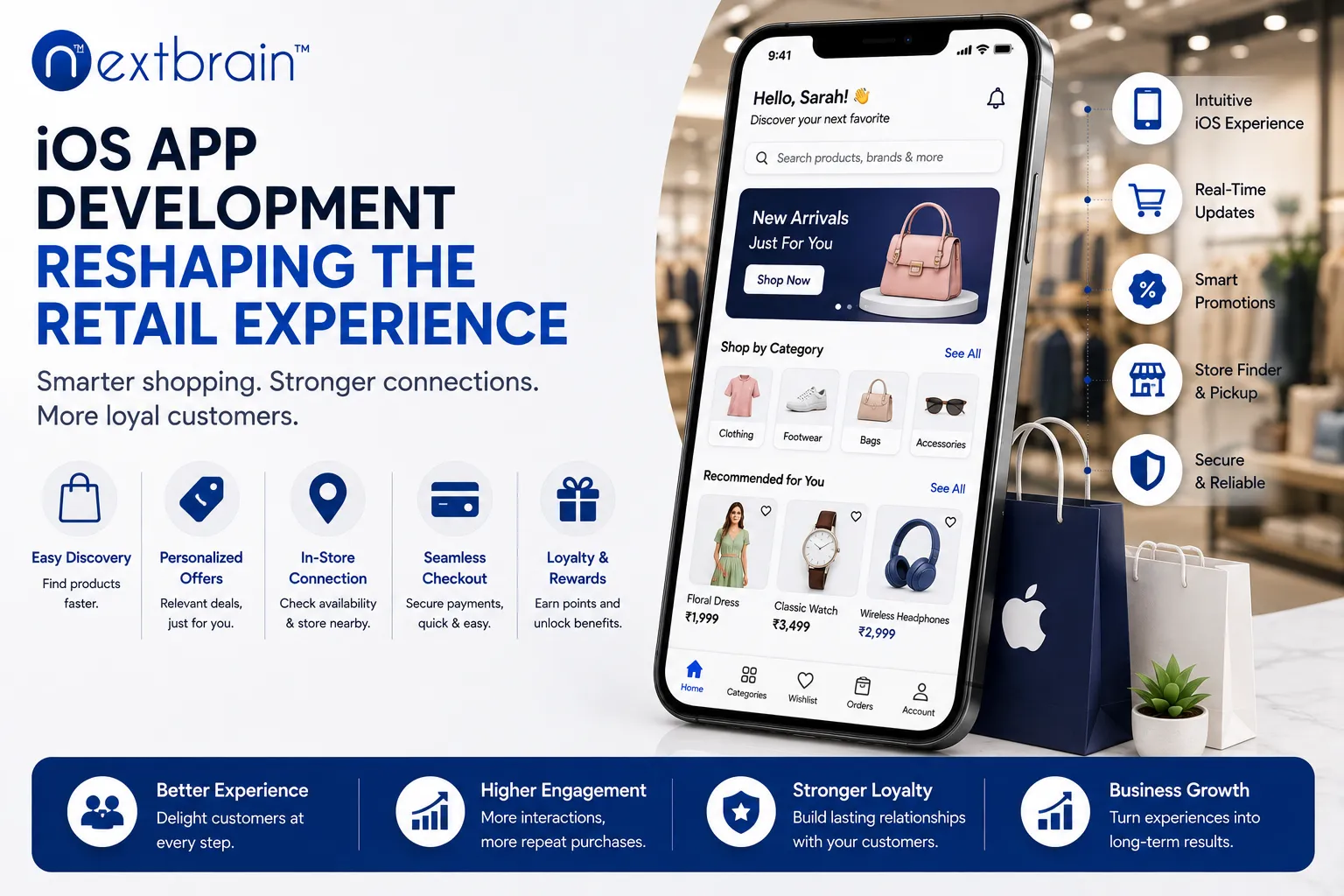
Modern iOS app development is therefore becoming more than simply creating a mobile shopping application. Retailers are using iPhone and iPad applications to connect physical stores with digital channels, simplify purchasing journeys, improve customer engagement, and build stronger relationships with their audiences.
From Shopping Channels to Connected Experiences
Traditional retail often separated the online and offline customer journeys.
A customer might discover a product through a website, visit a store to see it in person, and then complete the purchase through another channel. This fragmented experience can create unnecessary friction.
A well-designed iOS application can bring many of these interactions together.
Customers can use an app to:
- Browse product catalogs
- Check real-time product availability
- Compare products
- Save favorite items
- Receive personalized promotions
- Place orders
- Track deliveries
- Locate nearby stores
- Manage loyalty rewards
- Contact customer support
Instead of treating mobile as another sales channel, retailers can use it as a connection between different parts of the customer journey.
Making Product Discovery More Convenient
Product discovery is one of the most important stages of the retail journey.
Customers increasingly expect to find what they need quickly without navigating complicated menus or searching through large catalogs.
A well-designed iOS application can make product discovery more intuitive through organized categories, search functionality, filters, recommendations, and personalized content.
For example, a fashion retailer can allow customers to browse products by category, size, color, brand, or price. A grocery retailer can organize products based on frequently purchased items or shopping categories.
The goal is to reduce the number of steps between a customer's initial interest and the product they are looking for.
Creating a More Personalized Shopping Journey
Personalization has become an important part of modern retail.
Customers are more likely to engage with content that reflects their interests rather than receiving the same offers as every other shopper.
An iOS application can use customer preferences, previous interactions, saved products, purchase history, and loyalty activity to create more relevant experiences.
For example, customers could receive notifications about products related to previous purchases or reminders about items they have saved.
However, personalization should be useful rather than intrusive. Retailers need to be transparent about data collection and give customers appropriate control over their preferences.
Connecting Physical Stores With Mobile Experiences
One of the most interesting developments in retail is the connection between physical stores and mobile applications.
A customer might discover a product through an app, check whether it is available at a nearby store, visit the location, and then complete the purchase there.
Retailers can also use applications to support features such as:
- Store locators
- Click-and-collect
- Digital receipts
- Product availability
- Loyalty programs
- In-store promotions
- Appointment booking
- Order tracking
This creates a more connected experience instead of forcing customers to choose between online and offline shopping.
Simplifying the Checkout Process
Checkout is another area where mobile applications can significantly improve convenience.
Long checkout processes can discourage customers from completing purchases, particularly when they are shopping from mobile devices.
A well-designed iOS application can simplify the purchasing journey by providing saved customer information, secure payment options, order summaries, and clear delivery details.
The objective should be to make checkout straightforward without compromising security.
For retailers, reducing unnecessary steps can potentially improve conversions while creating a better experience for returning customers.
Strengthening Customer Loyalty
Customer loyalty is no longer based solely on discounts.
Consumers increasingly value convenience, personalized communication, useful rewards, and consistent experiences.
Retail applications can bring loyalty programs directly to customers' smartphones.
Instead of carrying physical membership cards, customers can access rewards, points, offers, purchase history, and other benefits through their applications.
Retailers can also use mobile notifications to communicate relevant promotions and encourage repeat purchases.
The key is relevance. Too many notifications can quickly become frustrating, so retailers should focus on sending messages that provide genuine value.
Using Mobile Apps to Improve Customer Communication
Communication doesn't stop after a customer completes a purchase.
Customers may want information about delivery status, returns, refunds, new products, promotions, or support requests.
An iOS application can provide a direct communication channel between the customer and retailer.
For example, customers can receive order updates without repeatedly visiting a website or contacting customer service.
Retailers can also provide support features within the application, helping customers find answers and resolve issues more efficiently.
Building a Consistent Brand Experience
Brand consistency matters across every customer touchpoint.
A retailer's website, physical store, social media channels, email communication, and mobile application should feel like parts of the same brand.
iOS applications give businesses greater control over the way their digital experience is presented.
From typography and visual design to navigation and interaction patterns, retailers can create an application that reflects their brand identity while keeping the experience simple and functional.
A consistent experience can help customers become more familiar with the brand and make interactions feel more seamless.
Why UX Matters in Retail Applications
Having a mobile application does not automatically guarantee a better customer experience.
If an app is slow, difficult to navigate, or overloaded with unnecessary features, customers may stop using it.
User experience should therefore be considered from the beginning of the development process.
The process can include:
- User research
- Wireframing
- Prototyping
- Interface design
- Usability testing
- Performance testing
- Continuous improvement
Nextbrain's iOS development approach includes wireframes, mockups, prototypes, development, testing, deployment, and post-launch maintenance. Its developers work with technologies such as Swift and Objective-C to create custom iOS applications.
This type of structured process can help retailers identify usability issues before they affect a larger customer base.
Security Is Critical for Retail Applications
Retail applications often handle sensitive information, including customer accounts, addresses, payment-related information, and purchase histories.
Security therefore needs to be considered throughout the development lifecycle.
Retail applications can incorporate measures such as secure authentication, encrypted data, protected APIs, secure data storage, and regular security testing.
Nextbrain states that its iOS development practices include data encryption, secure coding, authentication, secure API integration, security testing, and consideration of App Store requirements.
Strong security can protect customer information while also helping retailers maintain trust.
Integrating Mobile Apps With Retail Systems
A retail application rarely works independently.
It may need to communicate with inventory systems, payment gateways, CRM platforms, ERP software, order management systems, analytics platforms, and other business tools.
Effective integration allows customers to receive consistent information across different channels.
For example, if a product is marked as available in an application, the information should ideally reflect the retailer's actual inventory.
Similarly, orders placed through the application may need to flow into existing fulfillment and customer-management systems.
This makes backend architecture and API integration just as important as the application's visual design.
Supporting Retailers Beyond the Initial Launch
Launching an application is only the beginning.
Customer expectations change, operating systems receive updates, security requirements evolve, and businesses introduce new products and services.
Retailers therefore need to think about the application as an evolving digital product.
Post-launch activities can include:
- Bug fixes
- Performance optimization
- New feature development
- Security updates
- iOS compatibility updates
- User feedback analysis
- Interface improvements
- Backend improvements
Nextbrain's iOS development services include ongoing maintenance, performance optimization, updates, and compatibility support after deployment.
Continuous improvement helps an application remain useful rather than becoming outdated after its initial release.
The Future of iOS in Retail
The role of mobile applications in retail is likely to continue expanding as consumers become increasingly comfortable with digital shopping experiences.
Retailers will need to think beyond simply putting their product catalog inside an application.
The strongest retail applications will focus on the complete customer journey—from discovery and consideration to purchase, delivery, loyalty, and ongoing engagement.
Features such as personalized experiences, connected store experiences, mobile payments, real-time inventory information, loyalty programs, and intelligent analytics can help retailers create more meaningful interactions.
The most successful applications, however, will not necessarily be the ones with the largest number of features. They will be the ones that solve genuine customer problems with minimal friction.
Conclusion
iOS applications are changing the way retailers interact with customers by bringing product discovery, purchasing, loyalty, communication, and customer service into a more connected digital experience.
For retailers, the opportunity goes beyond creating another shopping channel. A thoughtfully designed iOS application can connect physical and digital experiences, simplify customer journeys, strengthen loyalty, and provide businesses with valuable insights into customer behavior.
However, achieving these results requires more than simply developing an application. Retailers need to consider user experience, security, integrations, performance, scalability, and ongoing improvements from the beginning.
As customers continue to expect convenient and personalized shopping experiences, investing in a well-planned iOS application can help retailers remain competitive and build stronger relationships with their customers. If your retail business is planning to build or modernize an iOS application, contact Nextbrain today to discuss your requirements and explore how a custom iOS solution can support your business goals.
Frequently Asked Questions
1. How can iOS apps improve the retail customer experience?
iOS apps can make shopping more convenient by allowing customers to browse products, check availability, place orders, track deliveries, manage loyalty rewards, receive personalized offers, and interact with retailers from their mobile devices.
2. Why should retailers invest in a custom iOS application?
A custom iOS application can be designed around a retailer's specific customers, products, business processes, and goals. It can also integrate with existing systems such as inventory, CRM, payment, and order-management platforms.
3. What features should a retail iOS app include?
Depending on the business model, useful features can include product search, personalized recommendations, secure payments, order tracking, store locators, loyalty programs, push notifications, digital receipts, customer support, and real-time product availability.
4. How important is security for retail iOS applications?
Security is essential because retail applications may handle customer accounts, personal information, payment-related data, and transaction details. Secure authentication, data protection, API security, and regular testing should be considered throughout the development process. Nextbrain's iOS development approach includes security testing, secure API integration, authentication, and data encryption.
5. Does iOS app development end after the application is launched?
No. A retail application needs ongoing maintenance to address bugs, improve performance, introduce new features, and maintain compatibility with newer iOS versions. Continuous updates can help keep the application secure, stable, and relevant as customer expectations change. Nextbrain provides post-launch maintenance, updates, performance optimization, and iOS compatibility support.

























Sign in to leave a comment.