
Modern U.S. supply chains have grown far more complex than the linear, point-to-point networks of a decade ago. A single shipment today might touch a transportation management system, a warehouse floor, a third-party carrier's tracking portal, a customer's order history, and a finance team's invoicing platform — often within the same 24-hour window. Each of these touchpoints generates data: location pings, inventory counts, delivery confirmations, exception alerts, and financial records.
The challenge isn't a shortage of data. It's that this information lives in fragmented systems that rarely talk to each other. Transportation management systems (TMS), warehouse management systems (WMS), enterprise resource planning (ERP) platforms, customer relationship management (CRM) tools, fleet-management software, carrier portals, GPS trackers, IoT sensors, and — still, in many organizations — spreadsheets, all hold pieces of the same operational picture. None of them, on their own, shows the whole story.
This is where a logistics data platform comes in. Rather than functioning as just another application, it acts as a connective layer that pulls information from across the supply chain into a single, usable view. The goal isn't simply to collect more data — it's to make that data consistent, timely, and accessible to the people and systems that need it.
Modern platforms take this a step further, combining integration, analytics, automation, and artificial intelligence so that connected data doesn't just sit in a dashboard — it actively supports faster, smarter decisions. The question worth asking isn't whether your business has enough data. It's whether that data is actually working for you.
What Is a Logistics Data Platform?
In plain business terms, a logistics data platform is a centralized layer that connects the various systems a supply chain organization relies on — TMS, WMS, ERP, CRM, and more — so that information can move between them automatically and consistently. It's not a single application that replaces existing tools; it's the infrastructure that lets those tools share what they know.
This distinguishes it from a traditional database, which simply stores information, and from a standalone logistics application, which typically manages one function (routing, warehouse picking, order entry) in isolation. A logistics data platform sits above and between these tools, giving businesses a coherent view of operations that no single system could provide alone
What Data Does It Connect?
A well-built platform typically draws from a wide range of sources, including:
- Transportation and routing data
- Shipment and order information
- Carrier performance and status data
- Warehouse operations data
- Inventory levels and movement
- GPS and telematics feeds
- IoT sensor readings (temperature, humidity, equipment status)
- Customer records and preferences
- Financial data and invoicing
- Weather and traffic conditions
From Data Collection to Data Intelligence
The real value of a logistics data platform emerges through a progression: Collect → Integrate → Normalize → Analyze → Predict → Act. Raw data collection is just the starting point. Integration brings disparate sources together; normalization makes them consistent and comparable; analysis surfaces patterns; prediction anticipates what's likely to happen next; and action turns insight into operational response. This progression is the foundation for everything discussed in the rest of this article.
Why Supply Chain Data Is Often Fragmented
Even well-resourced organizations struggle with fragmented data, and the reasons are fairly consistent across the industry.
Data silos are the most common culprit. TMS, WMS, ERP, CRM, and fleet platforms are frequently implemented at different times, by different teams, for different purposes — and they often operate with little or no connection to one another.
Inconsistent data formats compound the problem. One system may label a customer by account number, another by name; one may record weight in pounds, another in kilograms. Without normalization, comparing records across systems becomes unreliable.
Manual data entry — still common in the form of spreadsheets, emails, and manual reconciliation — introduces delays and human error at exactly the points where speed and accuracy matter most.
Limited real-time visibility means decision-makers frequently learn about a problem only after it has already affected operations, rather than while there's still time to intervene.
Disconnected partners add another layer of complexity. Suppliers, carriers, warehouses, and customers each bring their own technology stack, and aligning all of them is rarely simple.
The business impact of this fragmentation is significant: delayed decision-making, poor shipment visibility, inefficient inventory planning, excessive manual reconciliation, higher operational costs, and mounting customer-service challenges. Left unaddressed, these issues compound as a business scales.
How Logistics Data Platforms Connect the Supply Chain

Connecting Enterprise Systems
At the core of a logistics data platform is its ability to integrate enterprise systems that have traditionally operated in isolation — ERP, TMS, WMS, CRM, fleet-management systems, and accounting platforms. Connecting these systems means an order entered in the ERP can automatically inform routing decisions in the TMS, which in turn updates inventory records in the WMS, without manual handoffs between teams.
Connecting External Data Sources
Beyond internal systems, a platform also needs to reach outward — to carrier APIs, supplier systems, customer portals, GPS providers, IoT devices, EDI feeds, and third-party logistics systems. These external connections are often where the most valuable real-time visibility comes from, since so much of a shipment's journey happens outside a company's own four walls.
API-Based Data Exchange
APIs are the backbone of real-time information exchange between these systems. Rather than relying on batch file transfers or manual uploads, API-based integration allows data to move continuously and immediately as conditions change. For businesses running specialized or legacy logistics applications that don't offer off-the-shelf connectors, working with custom API development services can make it possible to build purpose-built connections tailored to the exact systems and data formats in use — rather than forcing operations to conform to a rigid, one-size-fits-all integration approach.
Building a Unified Data Layer
The result of this integration work is a unified data layer — a consistent, normalized view that follows the natural flow of operations: Orders → Shipments → Vehicles → Warehouses → Customers. With this layer in place, a question like "where is order #4521 and when will it arrive?" can be answered instantly, drawing from multiple systems as though they were one.
The Role of Enterprise Integration in Connected Logistics
Connecting systems is not purely a technical exercise — it's also a business-process challenge. Application integration and data synchronization only deliver value when they're paired with workflow integration that reflects how teams actually operate day to day. This includes connecting to legacy systems that may still run core operations, extending into cloud integration for newer applications, and supporting event-driven data exchange so that systems react to changes as they happen rather than on a fixed schedule.
For large organizations juggling multiple enterprise applications, enterprise software integration services can play a central role in connecting ERP, TMS, WMS, CRM, and other core platforms into a coherent whole — reducing the manual bridges that so often break down under operational pressure.
At a more granular level, business software integration services help connect day-to-day operational applications with broader business workflows and departmental systems — ensuring that logistics data doesn't just stay within logistics teams, but flows into finance, customer service, and planning functions that depend on it. The goal in every case is genuine contextual value: integration that solves a real operational problem, not integration for its own sake.
Read more - The Role of Digital Innovation in Modern Logistics
How AI Makes Logistics Data Platforms More Intelligent
Predictive Analytics
Once historical and real-time data are integrated, AI can turn that data into forward-looking insight. This includes demand forecasting, ETA prediction, delivery-risk identification, inventory forecasting, and capacity planning — all of which become more accurate as more consistent, connected data feeds the models.
AI-Powered Exception Detection
AI is particularly well suited to spotting problems before they escalate: shipment delays, route disruptions, inventory anomalies, carrier performance issues, and warehouse bottlenecks can all be flagged automatically, often earlier than a human reviewing reports manually would catch them.
AI-Driven Recommendations
Beyond detection, AI can synthesize multiple data points into actionable recommendations. For example: traffic conditions, weather data, vehicle location, and a delivery window can be combined to identify a potential delay — and immediately suggest an alternative route, before the delay actually happens.
AI API Integration
None of this requires replacing an entire technology stack. Through AI API integration services, businesses can connect intelligent models and services directly into their existing logistics applications — layering predictive and generative capabilities onto systems that are already in place, rather than undertaking a disruptive full-scale replacement.
Real-Time Visibility: From Tracking to Decision-Making
Simply tracking a shipment's location is no longer sufficient on its own. It helps to think of visibility in three tiers.
Traditional visibility answers a narrow question: Where is my shipment?
Connected visibility broadens the view: What is happening across my network?
Intelligent visibility goes further still: What is likely to happen, and what should we do next?
A logistics data platform enables this progression by combining GPS data, carrier updates, order information, warehouse status, weather, traffic, and customer requirements into a single operational picture. The shift this represents — from reactive tracking to proactive decision-making — is one of the most meaningful changes a connected data strategy can deliver.
Key Business Benefits of a Connected Logistics Data Platform
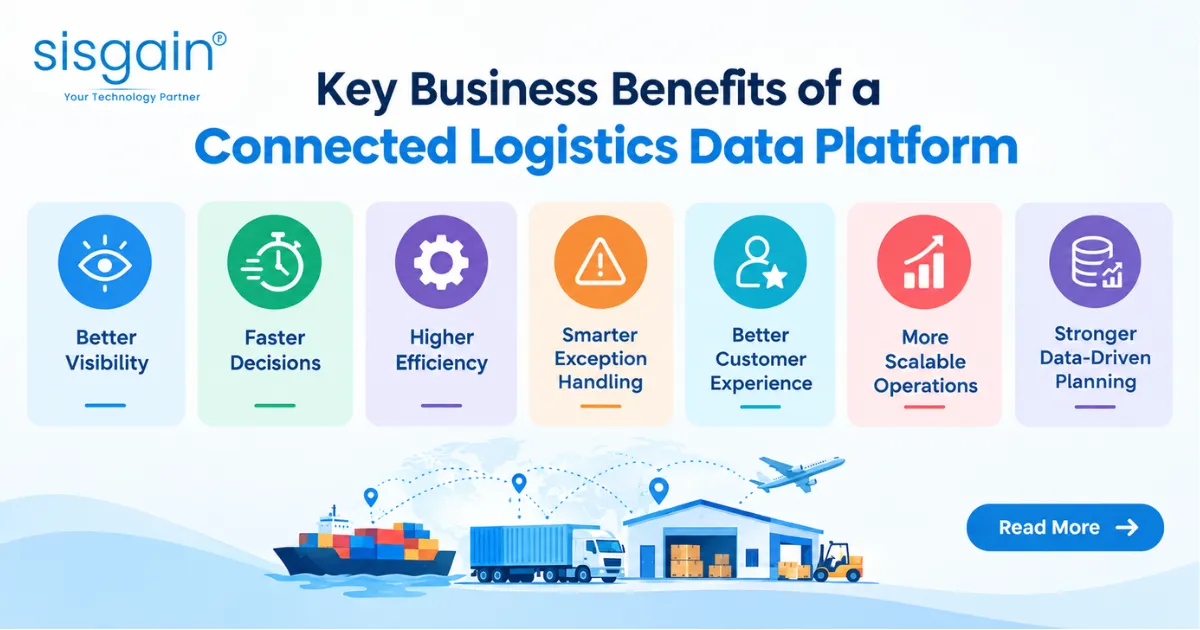
Better supply chain visibility gives teams one consistent view of operational data, rather than reconciling conflicting reports from different systems.
Faster decision-making becomes possible when teams can access timely information directly, instead of waiting on manual reports to be compiled.
Improved operational efficiency follows naturally when repetitive data entry and reconciliation work is reduced or eliminated.
Better exception management allows businesses to identify risks earlier and prioritize the issues that matter most, rather than being overwhelmed by noise.
Improved customer experience results from more accurate shipment information and proactive notifications, rather than reactive updates after something has gone wrong.
More scalable operations become achievable, since a connected architecture makes it easier to add new carriers, systems, locations, and applications without rebuilding integrations from scratch each time.
Stronger data-driven planning emerges as integrated historical and real-time information supports more accurate forecasting and longer-term strategic decisions.
Use Cases for U.S. Logistics and Supply Chain Businesses
Transportation management benefits through carrier data integration, shipment tracking, ETA intelligence, and route visibility — giving dispatchers and planners a clearer operational picture.
Warehouse operations improve through inventory synchronization, order visibility, and warehouse-event monitoring, reducing the gap between physical inventory and system records.
Retail and e-commerce businesses rely on order-to-delivery visibility, real-time inventory availability, and proactive customer notifications to meet rising delivery expectations.
Manufacturing operations gain supplier visibility, production-material tracking, and inventory coordination — reducing the risk of production delays caused by material shortages.
Third-party logistics providers manage multi-client data, carrier connectivity, and centralized reporting across a wide range of customers and operational requirements.
Last-mile delivery operations depend on driver tracking, delivery-status updates, exception management, and proof-of-delivery data — often the most visible and customer-facing part of the entire supply chain.
Security and Governance in Logistics Data Platforms
Greater connectivity inevitably raises the stakes around data security and governance. A professional logistics data platform needs strong access controls, data encryption, and API authentication to protect information as it moves between systems. Role-based permissions ensure that individuals and teams only see the data relevant to their role, while data governance and audit trails create accountability for how information is used and changed over time.
Data quality processes help ensure that the information flowing through the platform remains accurate and trustworthy, and compliance considerations — particularly around customer and financial data — must be addressed from the outset rather than retrofitted later. Secure partner connectivity extends these same principles to suppliers, carriers, and other external parties who need controlled access to shared data. As connectivity expands, controlling who can access which data, and how that data moves, becomes just as important as the integration itself.
How Businesses Can Build a Logistics Data Platform
Identify business problems. Start with visibility gaps and operational pain points rather than leading with technology choices.
Map existing data sources. Catalog TMS, WMS, ERP, CRM, APIs, IoT devices, GPS systems, and any other relevant sources already in use.
Prioritize integrations. Begin with the connections that will create the greatest operational value, rather than attempting to integrate everything simultaneously.
Establish data standards. Normalize naming conventions, formats, identifiers, and data ownership so information is consistent across systems.
Build the integration layer. Use APIs, middleware, event-driven architecture, or other appropriate methods suited to the specific systems involved.
Add analytics and AI. Introduce predictive models and intelligent workflows only after a reliable, well-integrated data foundation is in place.
Monitor and improve. Continuously track data quality, system performance, user adoption, and business outcomes, refining the platform as needs evolve.
The Future of Connected Supply Chains
Looking ahead into 2026 and beyond, several themes are shaping where logistics data platforms are headed: AI-powered logistics intelligence, predictive supply-chain analytics, agentic workflows, real-time event processing, IoT-connected operations, automated exception management, intelligent API ecosystems, digital twins, and increasingly autonomous decision support.
It's worth drawing an important distinction here: connected does not necessarily mean fully autonomous. Businesses can — and generally should — introduce AI capabilities gradually, maintaining appropriate human oversight for decisions that carry significant operational or financial weight. The most successful organizations will likely be those that treat automation as a tool for augmenting human judgment, not replacing it entirely.
Conclusion
Modern supply chains generate enormous volumes of data across transportation, warehousing, inventory, carriers, suppliers, and financial systems — but that data only creates value when it's connected, consistent, and accessible. Fragmentation, left unaddressed, limits visibility and slows decision-making at exactly the moments when speed matters most.
Logistics data platforms offer a practical path forward, creating a connected foundation that brings previously isolated systems into a single, coherent view. APIs and enterprise integration make this connectivity possible, while AI transforms integrated data into predictions, recommendations, and intelligent workflows that support faster, better decisions.
For U.S. businesses evaluating where to start, the most effective approach isn't attempting a complete transformation all at once — it's identifying specific operational problems and building toward a connected, scalable, data-driven supply chain one integration at a time.
Frequently Asked Questions
1.What is a logistics data platform, in simple terms?
It's a centralized layer that connects the different systems a supply chain business already uses — like TMS, WMS, ERP, and CRM — so information can flow between them automatically instead of being manually re-entered or reconciled.
2.How is a logistics data platform different from a TMS or WMS?
A TMS or WMS manages one specific function, such as routing or warehouse operations. A logistics data platform sits above these tools, connecting them so their data works together rather than staying siloed in separate systems.
3.Do we need to replace our existing systems to adopt one?
No. Most logistics data platforms are designed to integrate with the systems a business already has, through APIs and middleware, rather than requiring a full replacement of the existing technology stack.
4.How does AI fit into a logistics data platform?
Once data is integrated and normalized, AI can be layered on top to support predictive analytics, exception detection, and automated recommendations — for example, flagging a likely delivery delay before it happens.
5.Can logistics data platforms support small and mid-sized businesses?
Yes. Businesses can begin with specific use cases, such as shipment visibility, carrier integration, or inventory synchronization, and expand the platform as their operational requirements grow.
6.How can businesses secure logistics data integrations?
Organizations can use authentication, authorization, encryption, access controls, monitoring, audit trails, and appropriate data-governance practices to protect information exchanged between connected systems.
7.Can a logistics data platform support real-time tracking?
Yes. When connected to appropriate GPS, telematics, carrier, IoT, and transportation systems, a platform can collect and process real-time or near-real-time operational information.




























Sign in to leave a comment.