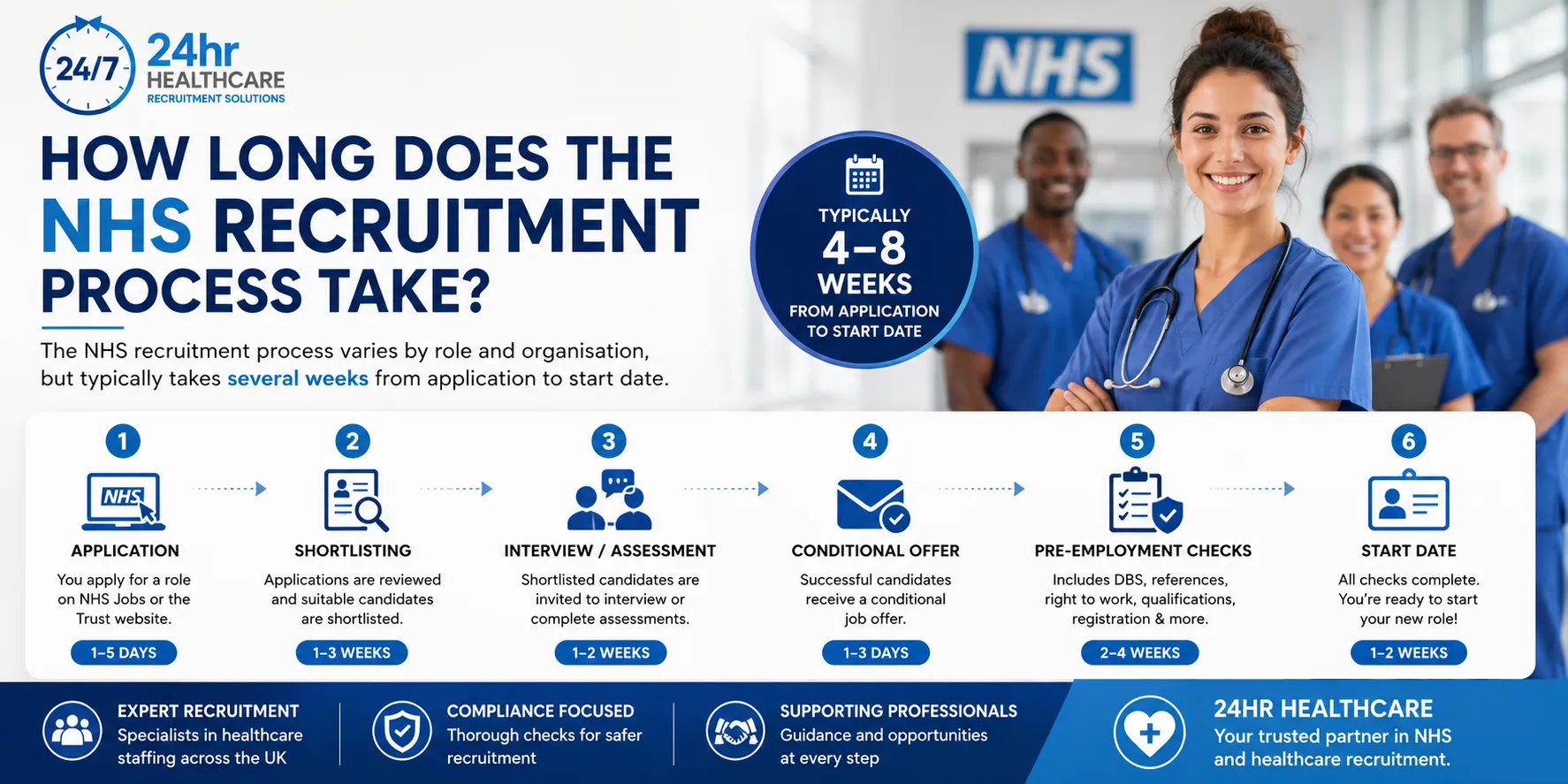

If you have applied for an NHS position, one of the first questions you may ask is: how long does the NHS recruitment process take?
There is no single timeframe for every NHS vacancy. The recruitment timeline can vary depending on the organisation, role, number of applicants, interview arrangements, and how quickly pre-employment checks are completed.
For some candidates, the process can move relatively quickly. For others, it may take several weeks, particularly when references, DBS checks, professional registration, right-to-work verification, or occupational health assessments are required.
For healthcare professionals considering both direct NHS applications and agency opportunities, understanding the recruitment process can make it easier to plan the next step.
How Long Does the NHS Recruitment Process Usually Take?
An NHS recruitment process can take several weeks from application to start date, although the exact timeframe varies considerably between employers and roles.
One NHS recruitment service states that standard pre-employment checks typically take around four weeks after a candidate receives an offer.
NHS Employers has also published examples showing that recruitment times can vary significantly between organisations. One case study reported an average time to hire of nine weeks after process improvements, while another NHS example reduced pre-employment checks from around 30 days to 14 days.
Therefore, candidates should think of NHS recruitment as a multi-stage process rather than a fixed number of days.
What Are the Main Stages of the NHS Recruitment Process?
The NHS recruitment process generally includes several stages.
1. Finding and Applying for a Vacancy
Candidates usually search for suitable positions through NHS Jobs or an individual NHS organisation's recruitment platform.
The application normally requires candidates to demonstrate how their qualifications, experience, skills, and knowledge match the requirements in the job description and person specification.
Applying early can be useful because some NHS vacancies may close before their advertised closing date when there is a high volume of applications.
2. Application Screening and Shortlisting
After the vacancy closes, the recruiting manager reviews applications against the criteria for the position.
Only candidates who meet the required criteria may progress to the next stage.
The time taken at this stage depends on the number of applications and the organisation's recruitment workload.
For example, one NHS organisation states that it aims to contact eligible candidates within a maximum of three weeks after a vacancy closes.
This demonstrates why the shortlisting stage can sometimes be one of the reasons an NHS application takes longer than expected.
3. Interview or Assessment
If shortlisted, candidates are invited to an interview.
Depending on the role, the recruitment process may include:
- Competency-based interviews
- Clinical assessments
- Written tests
- Presentations
- Practical assessments
- Online assessments
NHS Blood and Transplant, for example, states that shortlisted candidates may attend an interview or assessment, with the outcome communicated afterwards.
The time between shortlisting and interview depends on interviewer availability and the requirements of the vacancy.
4. Conditional Job Offer
If the interview is successful, the candidate may receive a conditional offer.
This does not necessarily mean the recruitment process is finished.
The employer still needs to complete the relevant pre-employment checks before confirming the appointment and agreeing a start date.
These checks are designed to confirm that the candidate meets the requirements of the position.
5. Pre-Employment Checks
This is often the stage that can have the biggest impact on the overall recruitment timeline.
NHS organisations may need to complete checks covering:
- Identity
- Right to work
- Professional registration
- Qualifications
- Employment history
- References
- DBS or other criminal record checks where applicable
- Occupational health
- Safeguarding requirements where relevant
NHS England confirms that these checks are completed before agreeing a contract, including professional registration, references, DBS where required, work health assessment, right to work, identity and eligibility checks.
Why Can These Checks Take Time?
Delays can occur when:
- References are slow to respond
- Documents are incomplete
- Additional information is required
- DBS processing takes longer
- Professional registration needs verification
- Occupational health assessments are required
- Right-to-work documentation needs further checking
For registered healthcare professionals, professional registration is particularly important. NHS Employers' current standards include separate requirements for professional registration and qualification checks.
6. Occupational Health Assessment
Some NHS roles require a work health assessment before employment begins.
NHS Employers states that work health assessments take place after an offer but before employment, placement, or training starts.
The assessment helps determine whether the individual is suitable for the working environment and whether reasonable adjustments may be required.
Because this stage can depend on appointment availability and the information required, it may add to the overall recruitment timeline.
What Can Cause Delays in NHS Recruitment?
Several factors can extend the NHS recruitment process.
High Number of Applicants
Popular NHS vacancies may receive a large number of applications, increasing the time needed for shortlisting.
Incomplete Documentation
Missing identity documents, qualifications, references, or other information can delay pre-employment checks.
Reference Delays
References may need to be obtained from previous employers or organisations. NHS Employers' current guidance sets out requirements for verifying employment and training history.
DBS Checks
Where a role requires a criminal record check, the recruitment timeline can depend on the circumstances of the check.
Professional Registration
Registered nurses and other regulated professionals may need their professional registration verified before starting.
NHS Jobs can automatically check certain professional registrations, including NMC registrations, with the relevant professional body.
Right-to-Work Verification
Employers must verify that candidates have the appropriate right to work in the UK. For candidates with time-limited permission, further checks may be required when that permission expires.
Can You Speed Up the NHS Recruitment Process?
You cannot control every part of the recruitment timeline, but you can reduce avoidable delays.
Prepare Your Documents Early
Keep important documents readily available, including:
- Passport or accepted identity documents
- Right-to-work evidence
- Professional registration details
- Qualification certificates
- Employment history
- Reference information
- Relevant training records
Check Your Application Carefully
Make sure your application clearly addresses the essential and desirable criteria in the job description.
Respond Quickly
If the recruitment team asks for additional information, responding promptly can prevent unnecessary delays.
Monitor Your Recruitment Portal
Keep checking your email and recruitment portal for interview invitations, requests for documentation, and updates.
Keep References Informed
Let your referees know that they may be contacted so they can respond promptly.
Does Using a Healthcare Recruitment Agency Make Recruitment Faster?
It depends on the type of role and recruitment arrangement.
Applying directly to an NHS Trust and registering with a healthcare recruitment agency UK are different processes.
An agency can help healthcare professionals identify suitable temporary or permanent opportunities, prepare documentation, complete recruitment steps, and understand available assignments. However, an agency cannot guarantee that an NHS employer's own recruitment and pre-employment checks will be completed within a specific timeframe.
For healthcare organisations, an agency can also help provide temporary staff while permanent recruitment is underway.
This can be particularly useful when an employer is dealing with urgent vacancies or staffing shortages.
How Can 24hr Healthcare Support Healthcare Professionals?
For nurses, Healthcare Assistants, support workers, and other healthcare professionals who are exploring agency work, 24hr Healthcare provides recruitment and staffing support.
This can offer an alternative route to finding healthcare assignments while candidates consider their longer-term career options.
Healthcare professionals can also learn more about agency work through this healthcare agency career guide.
The important distinction is that agency recruitment does not replace the NHS recruitment process for a specific NHS vacancy. Instead, it can provide another route to healthcare employment and temporary staffing opportunities.
NHS Recruitment vs Agency Recruitment
| Factor | Direct NHS Recruitment | Healthcare Agency Recruitment |
|---|---|---|
| Application | Apply for a specific NHS vacancy | Register with an agency |
| Shortlisting | NHS employer reviews applications | Agency screens candidates for suitable opportunities |
| Interview | Usually arranged by NHS employer | Depends on the role and client |
| Compliance | NHS pre-employment checks | Agency and employer checks may apply |
| Staffing type | Mainly permanent NHS roles, plus specific arrangements | Temporary and/or permanent opportunities depending on provider |
| Timeline | Varies by NHS organisation and role | Varies by role, checks, and employer requirements |
| Best suited for | Candidates seeking a specific NHS position | Candidates seeking flexible or varied healthcare opportunities |
How Long Do NHS Pre-Employment Checks Take?
There is no universal NHS-wide number of days for every candidate.
One NHS recruitment service states that pre-employment checks typically take around four weeks, while other NHS examples show shorter or longer periods depending on the organisation and recruitment system.
The fastest way to avoid unnecessary delays is therefore to provide complete and accurate information as soon as it is requested.
What If Your NHS Application Is Taking Too Long?
If you have already completed an interview and received a conditional offer, check your recruitment portal first.
If a check appears to be outstanding, contact the recruitment team responsible for the vacancy.
You can also ask:
- Which checks have been completed?
- Is any documentation missing?
- Are references outstanding?
- Is occupational health required?
- Is the DBS check still being processed?
- Has professional registration been verified?
- When should you expect the next update?
This can help identify whether there is an actual delay or whether the application is progressing normally.
Frequently Asked Questions
How long does an NHS job application take?
There is no fixed timeframe. Shortlisting, interviews, conditional offers, and pre-employment checks can take several weeks depending on the employer and role.
How long do NHS pre-employment checks take?
Some NHS recruitment services report around four weeks for standard pre-employment checks, although actual times vary between organisations and candidates.
Why does NHS recruitment take so long?
The process includes multiple checks, such as identity, right to work, references, qualifications, professional registration, DBS where applicable, and occupational health. Delays in any of these areas can extend the process.
Can I work while waiting for NHS checks?
You should not assume that you can start before the employer confirms that the required checks have been completed. NHS organisations must complete the relevant pre-employment requirements before employment begins.
Is agency recruitment faster than NHS recruitment?
It can be faster in some circumstances, but there is no guaranteed timeframe. Agency recruitment also involves screening and compliance requirements, and the final timeline depends on the role and employer.
Conclusion
So, how long does the NHS recruitment process take?
There is no single answer. The complete process can take several weeks, with the timeline depending on shortlisting, interview scheduling, conditional offers, references, DBS checks, professional registration, right-to-work verification, occupational health, and other pre-employment requirements.
For candidates, preparing documents early and responding quickly to requests can help prevent avoidable delays.
For healthcare professionals who want to explore opportunities outside a direct NHS application, an experienced healthcare recruitment provider such as 24hr Healthcare can offer another route to temporary and permanent healthcare opportunities, depending on the role and requirements.
Understanding both routes can help nurses, Healthcare Assistants, and other healthcare professionals make more informed decisions about their next career move.




























Sign in to leave a comment.