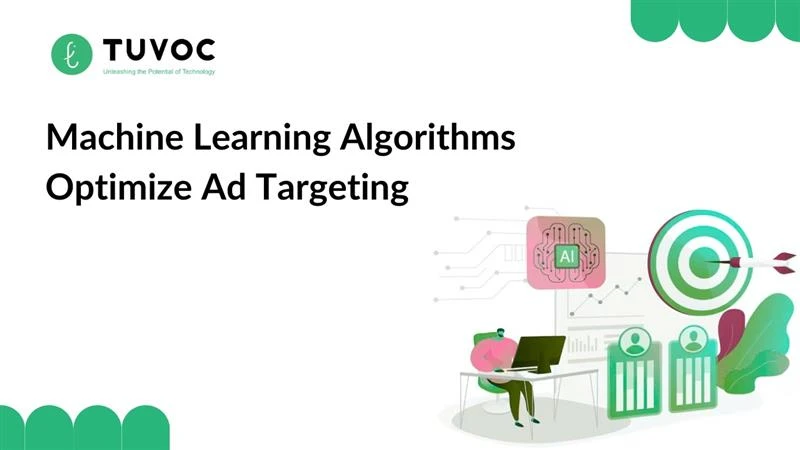

In the current advertisement industry based on data, accuracy is more important than reach. Companies that have invested in developing services related to AdTech are more dependent on machine learning algorithms that can identify behavioral indicators and forecast user intents as well as serve highly relevant advertisements on a large scale. In place of indiscriminate demographic targeting, contemporary systems use contextual, behavioral and transactional data in real-time to make maximum performance and minimum wasted spend.
Machine learning has brought about the shift in digital advertising where automation has rules and rules, to intelligent and self-learning systems. Instead of having audience rules manually applied, algorithms today understand millions of data points: the use of their devices, the way they browse content, how they respond to certain content, and conversion signals, to determine the most relevant ad impression to show to each user.
The Role of Machine Learning in Ad Targeting
In essence, machine learning allows advertising platforms to identify trends in massive amounts of data. The algorithms are trained using historical data of campaigns and can then predict the users most likely to engage, click, or convert. Such predictive capability makes smarter bidding choices and more effective segmentation of the audience.
In developed Custom AdTech Software Development these models are directly implemented in demand-side platforms (DSPs), supply-side platforms (SSP), and data management platforms (DMPs). This system is self-improving because of learning through live campaign performance by continuously refining the targeting parameters, making it more accurate over time and performing this process without human actions.
Machine learning also allows the audience profile to keep evolving unlike traditional targeting models which are based on static segments. When a user has a change in behavior i.e. when he or she starts researching a different product category, then the system will respond immediately to such a change which will allow the relevance of ad to stay high.
Signal Processing and Data Collection
Structured data ingestion is the start of machine learning optimization. Signals gathered by the ad platforms include:
- Website interactions
- App usage behavior
- Purchase history
- Contextual page data
Metadata of device and location
These signals are computed on real time and in milliseconds in programmatic auctions. This data is evaluated by sophisticated algorithms and then it decides whether to bid on an impression.
Leaders using Custom Software Development Services frequently create data pipelines that are proprietary and clean, structured, and privacy-compliant. Clean data will enhance the accuracy of the model considerably whereas low quality data will result in poor targeting and high acquisition costs.
Audience Segmentation and Predictive Modeling
Among the most effective uses of machine learning in targeting advertisements, predictive modeling should be cited. Algorithms do not divide users into segments according to age or location, they form micro-segments, according to behavioral similarity, and intent indicators.
As an illustration, clustering algorithms can identify users with similar engagement patterns and lookalike modeling can recognize new opportunities that are similar to those that convert. These models estimate conversion probability by finding the probability scores.
In scenarios where companies apply scalable AdTech development services, companies typically apply ensemble models, composed of a number of machine learning approaches that include logistic regression, gradient boosting, and neural networks, to enhance the accuracy of predictions. The multi-layered strategy minimizes bias and improves the accuracy of the targeting to different groups of the audience.
Optimization of Real-Time Bidding
Milliseconds have to be used to make decisions in programmatic advertising. Machine learning algorithms make use of impression-level data to calculate the best bid values. This process includes:
- Getting the probability of conversion
- Computing the expected revenue
Adjusting bids dynamically
Instead of bidding in a consistent manner, algorithms can use strategic allocation of budget by prioritizing impressions with greater estimated ROI.
Using developed custom AdTech software, the advertisers have the chance to incorporate reinforcement learning models, which constantly update the bidding strategies according to real-time feedback. These models use experiences of success and failure in auctions; they maximize expenditure allocation over time and enhance campaign efficiency.
Intelligence about context and privacy conformity
Contextual targeting is becoming relevant again with the more stringent privacy policies and the degradation of third-party cookies. Machine learning boosts contextual intelligence based on the information about the pages, sentiment, and the semantic meaning.
The models of natural language processing (NLP) are used to categorize web pages in terms of topics and purpose and not by mere matching of keywords. This will keep the ads related to the environment of relevant content, enhancing their engagement without violating privacy.
Modern custom software development services help companies to create privacy-focused architectures, which do not depend on tracking data and processes but on first-party data collections and contextual analysis. Machine learning is used to center on actionable insights of these compliant data sources.
Constant Learning and Performance Continuous improvement
Continuous improvement is one of the most effective elements of machine learning. Some metrics that are tracked by the use of algorithms include click-through rates, conversion rates, and cost per acquisition. On the basis of such metrics, models automatically optimize targeting parameters.
When one of the segments of the audience starts performing poorly, the system slows down the bids frequency. On the other hand, segments that are performing highly are allocated more budgets. This responsive change will be the most efficient campaign without being manually supervised.
With effective AdTech development services, companies will be able to adopt automated A/B testing models with machine learning assessing creative variations and combinations of audiences in parallel. The platform finds better winning configurations quicker than conventional testing approaches, speeding up performance wins.
Detecting Fraud and Quality Assurance
The problem of ad fraud is also a major issue in programmatic ecosystems. Machine learning algorithms identify abnormal traffic behavior, anomaly in a click, and bot activities. Platforms can prevent fraudulent impressions by detecting suspicious signals in advance before spending money and time on it.
State-of-the-art models of fraud detection examine past behavior to differentiate between users with legitimate and automated or artificial traffic. Not only does this protect advertising spend, but also enhances better data integrity, which leads to a better targeted decision.
Companies that have invested in safe Custom AdTech Software Development tend to include anomaly detection software applications that run with the targeting algorithms, making sure that there is efficiency as well as exposure.
The Strategic Effect on the ROI of Advertising
Machine learning shifts the ad targeting approach to the predictive approach. Advertisers are able to foresee performance and make amends instantly rather than examining performance once the campaigns have finished.
The improved accuracy in targeting results in:
- Higher conversion rates
- Reduced acquisition costs
- Better user experience
Increased lifetime value
Machine learning should be used as a competitive advantage but done effectively by deploying scalable custom software development services, it will not be a technical characteristic but an advantage. It helps brands to convey pertinent messages at the appropriate time and also stay efficient and compliant.
Conclusion
The methods of digital advertising have been transformed to the core by machine learning algorithms. The current AdTech platforms can be characterized by the precision at the scale of predictive modeling, real-time bidding optimization, contextual intelligence, and fraud detection. Companies that embrace these features by organizing strategic development programs receive improved targeting performance, as well as long-term flexibility in an increasingly changing advertising environment.





















Sign in to leave a comment.