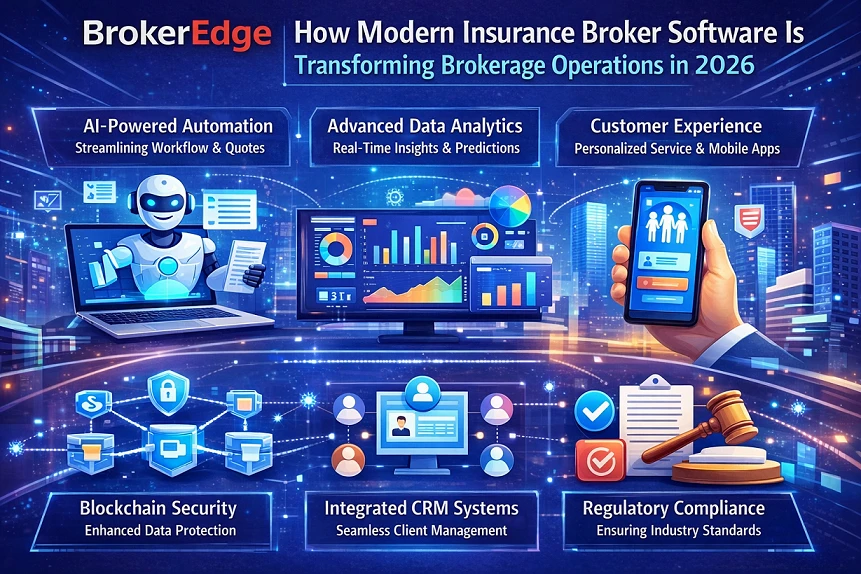

Today's insurance brokerage firms are seeking ways to modernize operations from client onboarding to policy renewals. Brokers that work with legacy systems experience major operational inefficiencies. The legacy brokerage systems force agents to devote hours on manual data entry, document management, and policy tracking, impacting client relationship development. That's why implementing modern insurance software for brokers has become an operational necessity more than a competitive advantage.
This content highlights what determines modern broker software solutions, which brokerage operations are modernized by the software, and how to validate the right broker software systems. The implementation of modern broker software simplifies the transformation from paper workflows to digital operations that minimize administrative workload while improving customer satisfaction.
Insurance Broker Software: Overcoming Traditional Brokerage Challenges
Insurance brokerage software offers a range of professional solutions built to automate various brokerage processes across. The broker software manages insurance product development, underwriting, claims management, policy administration, document handling, reporting, analytics, and customer support from a single interface. These systems function as a digital brokerage infrastructure that ensures smooth alignment between various broker processes, rather than forcing agents to adapt to rigid technological limitations.
Legacy brokerage operations lead to persistent operational inefficiencies due to fragmented workflows. Brokers depending on legacy systems experience various challenges:
- Disparate data management across spreadsheets, email threads, and databases makes consistent client record management highly impossible.
- Manual policy processing necessitates consistent data entry efforts for quotes, renewals, and endorsements, leading to higher time consumption.
- Limited scalability prevents brokerages from expanding into new markets since legacy systems can't handle increased workload without proportional staff increases.
- Data silos fragment client information across separate tools, blocking unified views of customer interactions and policy histories.
- The reporting module in legacy brokerage systems doesn't offer dashboards or analytics to monitor renewals, sales performance, or assess customer behavior patterns.
- Compliance inefficiencies arise when manual processes fail to manage audit trails, native compliance checks, or secure data encryption.
The challenges of legacy brokerage systems escalate over time. Manual renewal processes simply don't function when processing thousands of policies annually. Insurance brokers devote huge time switching between quoting tools, carrier portals, and shared drives rather than closing business. The traditional broker platforms lack API integration, analytics, and automation capabilities that modern brokerages firms require.
The implementation of modern insurance software for brokers eliminates these inefficiencies through diverse technological capabilities. A broker software with automated workflow management module manages repetitive tasks like policyholder onboarding, claims processing, policy renewals, and commission valuations with minimal human intervention. The cloud data repositories in broker platforms eliminate silos by establishing a single information source for all policies and policyholders. The omnichannel collaboration tools enable smooth interaction for brokers and customers.
What are the Brokerage Operations Modernized by Insurance Broker Systems Software
The insurance brokerage software manages operational domains where manual processes historically created hindrances. Each operational area receives tailored automation and intelligence support that transforms broker workflows from reactive management to rapid service delivery.
1. Client and Policy Management
The native data repositories in insurance broker software systems function as a data maintenance source for all policy documents, guaranteeing robust version control and retrieval. The software capture policy-header information along with essential data, such as limits, coverages, deductibles, and benefits in purpose-built data models. NLP-based smart search capabilities help users find relevant policy information matching their intent without navigating complex folder structures.
Consolidated views display policy updates, approval workflows, reviews, and communication across the complete policy lifecycle. Real-time access to policy information at each lifecycle stage allows brokers to provide quick, accurate service responses. Systems track every client interaction, policy change, and communication touchpoint, syncing data autonomously, so teams maintain current client details without manual updates.
2. Quote Generation and Comparison
Automated quoting workflows eliminate repetitive data entry across multiple insurer websites. Insurance software for brokers prefills pre-existing customer and prospect data into quoting applications, creating single points of data entry with built-in validation. Data enrichment services populate application forms more accurately and efficiently, reducing manual typing.
AI-powered tools automatically identify and compare key elements across carrier quotes while maintaining complete accuracy. Systems process multiple carrier quotes, extract coverage details, analyze premiums, and compare terms and conditions, including manuscript forms. Side-by-side comparison displays show quotes together, highlighting key differences in coverage, pricing, and terms instantly. Brokers receive polished comparisons that enhance market presence through clear coverage breakdowns and premium analysis.
3. Policy Issuance and Endorsement Handling
Automated policy issuance functionality in insurance brokerage software reduces processing time from hours to minutes through predefined templates and instant document generation. Platforms support multi-currency and multi-language policy issuance with automated pricing based on customer data and coverage type. Policy distribution occurs automatically to customers via email, portals, or established communication channels.
Endorsement management uses configurable templates for common types such as coverage changes, beneficiary updates, and policy term modifications. Systems handle automated approval and validation of endorsements alongside manual override procedures for complex cases. Recalculations of policy coverage pricing, additional premiums, or fees associated with endorsements occur automatically, ensuring accuracy.
4. Renewals and Retention Workflows
Automated renewal processes trigger based on predefined conditions or manual approval settings. Platforms flag policies nearing renewal, assign tasks automatically, and send communications so nothing falls through the gaps. Scheduled notifications alert policyholders and agents about approaching renewals to ensure complete coverage.
AI-driven retention tools forecast potential broker-of-record losses and proactively notify account teams with client details. Systems empower staff with the next best actions and automated outreach capabilities. Grace period configurations handle late renewals with automatic penalty calculations based on established rules.
5. Document Management
Centralized document repositories capture files from any source, including scanned paper, email attachments, and system outputs. Automatic indexing and categorization organize issued policies and related metadata without manual filing. OCR capabilities convert scanned documents into searchable text, enabling metadata tag searches by policy number, customer name, document type, and date. Platforms maintain complete audit trails logging every action performed, supporting compliance requirements and operational transparency.
How to Evaluate the Insurance Broker Software Systems for Your Business
The implementation of an ideal insurance broker systems software necessitates extensive evaluation across various aspects. Brokerage firms should validate fundamental aspects like software architecture, feature requirements, integration requirements, and regulatory adherence before purchasing the software platforms that will determine operational effectiveness.
I. Determining Pre-Built vs. Custom Software
Brokerage solutions that are pre-built and supported by vendors ensure faster implementation timelines than custom solutions. These platforms offer lower upfront expenses and vendor support, making them optimal for brokerage firms testing new policy models before scaling.
Whereas custom insurance software for brokers ensures greater flexibility and adaptability as business requirements differ. Custom solutions integrate with legacy systems, adapt to proprietary workflows, and fulfill regional compliance demands that standard platforms can't manage. Insurance carriers now adopt hybrid models, using pre-built platforms for foundational operations while implementing custom platforms for complex functions like proprietary risk assessment.
II. Analyzing Essential Features
Native rating capabilities should seamlessly connect quoting and policy management workflows with embedded commercial and personal rating. The sales pipeline tools in broker software support specific sales motion with automated workflows that process opportunities through strategic phases. Extensive financial management simplifies resource movement, enabling online payment collection and commission automation. Agency intelligence functionalities deliver analytical insights for workflows, enabling brokers to make strategic decisions. The broker software with cloud and API-friendly interfaces helps agencies remain agile and scalable.
III. Integration Support
The broker software API architecture supports smooth connections with CRM platforms, quoting portals, accounting software, and carrier systems. This architecture enables different tools to interact, eliminating manual data entry, and maintaining operational effectiveness.
IV. Data Privacy and Compliance Considerations
Insurance broker software systems must incorporate data encryption mechanisms for storage and transmission. The software should comprise smart access controls, and extensive audit trails. Platforms support data compliance and regulation standards through automated compliance checks and robust data governance frameworks.
Final Words
Modern insurance broker systems software delivers exactly what brokerages need: relief from administrative burden and capacity for strategic growth. As a result, brokers can redirect energy from manual data entry toward building meaningful client relationships and expanding market presence. Before selecting a platform, thoroughly evaluate your operational requirements, integration needs, and compliance obligations. When you choose the right insurance software for brokers, you're making a strategic investment that positions your brokerage for sustained success in an increasingly competitive marketplace.



Sign in to leave a comment.