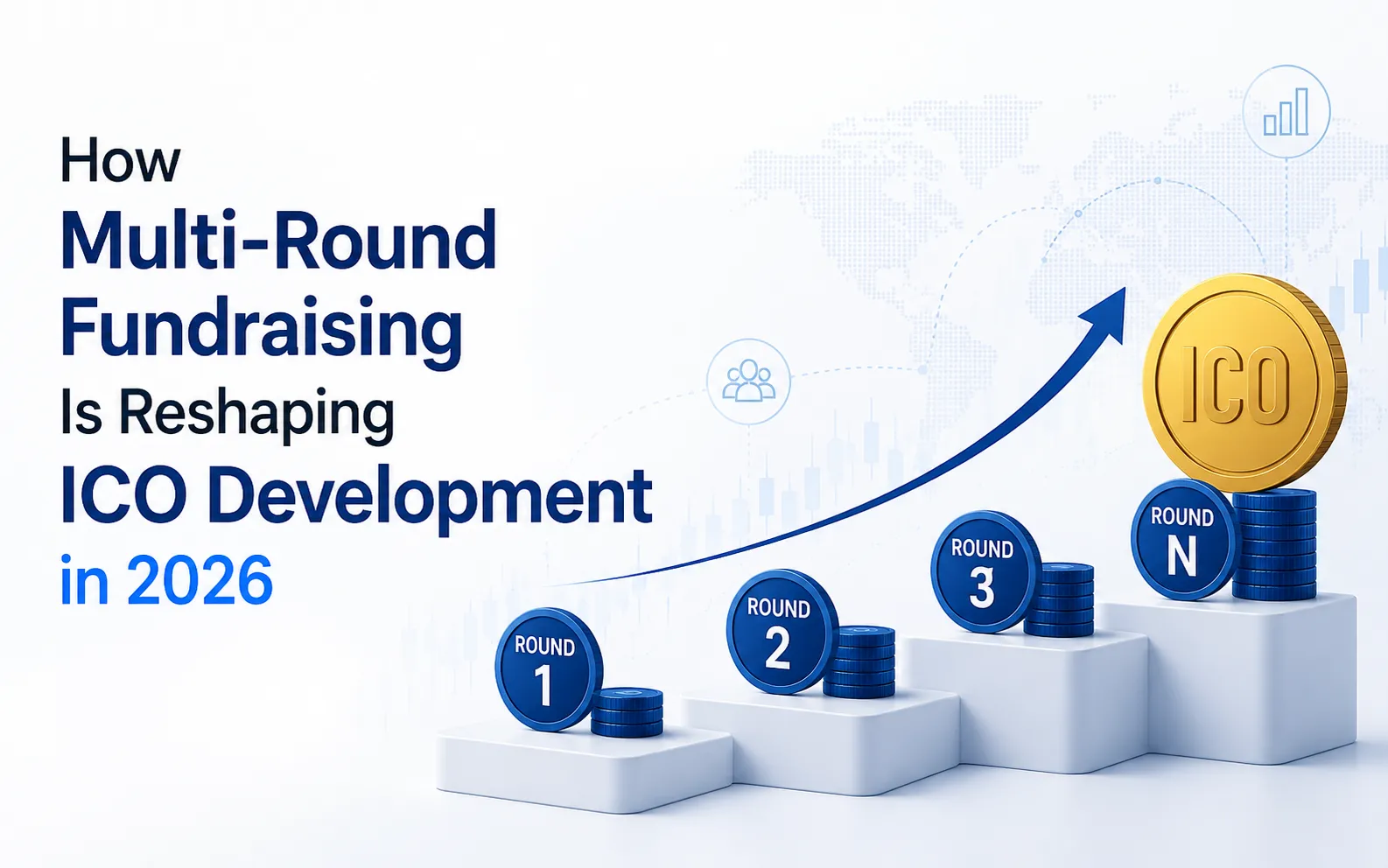

Initial Coin Offerings have changed considerably from the single-event token sales that defined the earlier crypto market. In 2026, projects are increasingly treating fundraising as a staged process rather than one public sale. Private allocations, strategic rounds, community rounds, public sales, and post-launch funding can each serve different purposes within the same capital strategy.
This shift is changing how ICOs are designed. Tokenomics, smart contracts, investor allocation, vesting, compliance, community access, and launch timing now need to work together across several fundraising stages.
The reason is straightforward. Raising capital is no longer the only objective. Projects also need to build credible networks, manage dilution, demonstrate product progress, create sustainable token demand, and maintain investor confidence after the token generation event.
Multi-round fundraising provides a framework for doing that. When structured carefully, it allows projects to match capital requirements with development milestones instead of placing the entire fundraising burden on a single token sale.
From One Token Sale to a Fundraising Lifecycle
Traditional ICO structures often concentrated fundraising into one major public event. A project announced its token, established a sale price, promoted the opportunity, and opened participation to the market.
That approach created several weaknesses. Projects had limited opportunities to demonstrate progress before asking the market for substantial capital. Investors also had little visibility into how earlier allocations would affect future circulating supply.
Multi-round fundraising takes a different approach.
A project can raise an initial amount from strategic participants, use that capital to develop its product, demonstrate traction, and then approach broader investor groups with stronger evidence of progress.
A typical structure can include:
- Strategic or seed round: Early capital from selected investors.
- Private round: Larger allocation for investors supporting development and growth.
- Community or early-access round: Broader participation with controlled allocation.
- Public ICO: Wider market access and token distribution.
- Post-TGE financing: Additional capital through ecosystem, treasury, or strategic initiatives.
The exact structure varies by project. The important change is that fundraising becomes an ongoing capital strategy rather than a single launch date.
Why Projects Are Moving Toward Multiple Rounds
The crypto fundraising environment has become more demanding. Investors increasingly evaluate product traction, token utility, market positioning, supply schedules, team credibility, and unlock structures before committing capital.
A staged model gives projects more opportunities to answer those questions.
Early capital can fund product development and infrastructure. Later rounds can be priced against measurable progress. This creates a stronger connection between fundraising and execution.
There is also a practical reason for staging capital. A project rarely needs all of its planned funding on day one.
A protocol developing an application, for example, may initially need funding for engineering and security. Once its product reaches a working stage, additional funding can support liquidity, partnerships, user acquisition, and market expansion.
Multi-round fundraising allows capital requirements to follow those milestones.
Tokenomics Becomes More Complex
The biggest technical consequence of multi-round fundraising is the increased complexity of tokenomics.
Every round can have different pricing, allocation percentages, lockups, vesting periods, and investor rights. If these elements are poorly coordinated, later rounds can create dilution or selling pressure that damages earlier participants.
Consider a simplified example.
A project allocates 15% of its total supply to an early strategic round at $0.05 per token. A private round receives 10% at $0.10, while a public sale receives 5% at $0.20.
The pricing structure reflects different levels of risk. Early investors contribute capital before the project has demonstrated significant progress, so they receive a lower entry price.
The problem appears when these allocations unlock.
If strategic investors receive transferable tokens before the public market has developed sufficient liquidity, they can hold substantial unrealized gains. That creates potential selling pressure.
As a result, modern ICO development requires tokenomics models to evaluate allocation and timing together.
Vesting Is Becoming a Core Fundraising Tool
Vesting schedules have moved from being a technical detail to a central part of fundraising strategy.
Multi-round ICOs often use different vesting structures for different investor groups. Early investors may have longer cliffs and extended vesting periods, while community participants may receive smaller allocations with shorter lockups.
This helps align investor incentives with project development.
For example, an early investor who receives tokens over 24 months has a stronger economic connection to the project's longer-term performance than someone receiving the entire allocation at TGE.
Projects also need to monitor unlock concentration. A large release from several rounds on the same date can create a sudden increase in circulating supply.
This is why token schedules increasingly need scenario modeling. Teams must examine what happens to circulating supply at TGE, three months later, six months later, and after major investor cliffs.
Each Round Serves a Different Purpose
A strong multi-round structure does not simply divide one token sale into several smaller sales.
Each round should have a defined strategic purpose.
The earliest round typically provides high-risk capital. Investors at this stage often contribute more than money. They can provide industry relationships, technical guidance, market access, or credibility.
Private rounds then support expansion as the project moves closer to launch.
Community rounds serve another function. They broaden participation and begin establishing a distributed user base around the token.
The public ICO ultimately connects fundraising with broader market participation.
This distinction matters because a project should not judge every round solely by the amount of capital raised. Strategic value can differ significantly between investor groups.
Fundraising Is Becoming More Milestone-Driven
Multi-round fundraising also encourages projects to connect capital deployment with measurable milestones.
Instead of announcing a fundraising target without context, teams can explain how each round supports specific development objectives.
For example:
Round 1 → Product development → Testnet → Security audit → Round 2 → Mainnet → Community expansion → TGE
This creates a more understandable relationship between investment and execution.
It also gives investors more information when evaluating later rounds.
If a project promised to deliver a testnet before the next fundraising stage and actually delivers it, the second round begins with stronger evidence than the first.
This creates an important feedback mechanism between fundraising and product development.
Investor Allocation Requires More Sophisticated Infrastructure
Managing multiple investor groups manually becomes difficult as a project grows.
ICO development platforms increasingly need systems that can track investor eligibility, allocation limits, payment status, wallet addresses, KYC results, vesting schedules, and token claims across different rounds.
Smart contracts can automate several of these functions.
An allocation contract can enforce maximum purchase limits. Vesting contracts can release tokens according to predetermined schedules. Claim contracts can allow eligible participants to receive tokens after TGE.
This automation reduces operational errors and creates a verifiable record of token distribution.
For projects targeting international investors, compliance systems become equally important. Different jurisdictions can apply different rules to token offerings, investor eligibility, marketing, and financial instruments. A multi-round structure therefore needs legal and compliance planning alongside technical development.
Pricing Between Rounds Creates New Risks
One of the most delicate decisions in multi-round fundraising is pricing.
If the price gap between rounds is too large, early investors can receive an unusually strong economic advantage. If later investors pay substantially more but receive similar token rights and faster liquidity, dissatisfaction can follow.
Projects need a pricing framework that reflects changing risk.
Early capital should compensate for development uncertainty. Later rounds should reflect progress without creating unrealistic valuation expectations.
The goal is not simply to increase the token price in every round. A healthy fundraising structure should produce credible valuation progression based on product development, market traction, user growth, and ecosystem expansion.
Artificial price increases can create problems at TGE if public-market valuation becomes disconnected from actual demand.
Multi-Round Fundraising Changes ICO Marketing
Marketing also changes when fundraising happens in stages.
A single ICO campaign can focus heavily on launch awareness. A multi-round strategy requires a continuous narrative.
Early messaging can focus on the problem, technology, team, and investment thesis. Later campaigns can highlight product milestones, ecosystem growth, partnerships, user metrics, and token utility.
Community communication becomes especially important.
Investors need clear information about:
- Round allocation
- Token price
- Vesting period
- Unlock dates
- Eligibility
- Token utility
- Treasury allocation
- TGE timing
Transparent communication reduces uncertainty and gives investors a clearer understanding of how the token economy is expected to develop.
The Model Works Best When Fundraising Follows Demand
Multi-round fundraising is not automatically better than a single-round ICO.
Too many rounds can create excessive complexity. Frequent private allocations can dilute public participants. Aggressive fundraising can also create valuation pressure that the product cannot justify.
The strongest models are demand-driven.
If a project demonstrates increasing users, transaction activity, revenue, developer adoption, or ecosystem participation, subsequent fundraising can reflect measurable growth.
This creates a healthier relationship between capital and product-market development.
The key question is no longer:
"How much can the project raise?"
It is:
"How much capital does the project need at each stage, and what evidence should exist before moving to the next stage?"
What ICO Development Looks Like in 2026
The modern ICO is becoming less of a fundraising website and more of a coordinated financial and technical system.
Development teams need to connect smart contracts with investor management, KYC workflows, allocation logic, vesting, token distribution, treasury management, analytics, and post-TGE operations.
This creates a more sophisticated development lifecycle:
Token strategy → Fundraising design → Tokenomics → Smart contracts → Investor onboarding → Round execution → Vesting → TGE → Post-launch management
Every stage influences the next.
A technically secure token cannot compensate for poor allocation design. Strong marketing cannot fix unsustainable unlocks. A successful private round does not guarantee public-market demand.
The entire system needs to function together.
Conclusion
Multi-round fundraising is reshaping ICO development by turning token sales into structured capital journeys. Instead of relying entirely on TGE hype, projects can raise capital according to development stages, build stronger investor relationships, and align token distribution with measurable progress.
The model also raises the standard for ICO infrastructure. Tokenomics, pricing, vesting, investor eligibility, compliance, smart contracts, and post-TGE liquidity now need to be designed as interconnected components.
For projects planning a staged token launch, Blockchain App Factory provides ICO development solutions that bring fundraising infrastructure, token creation, smart contracts, investor management, and launch requirements into a coordinated development strategy.
In 2026, a successful ICO is not defined only by how much it raises at launch. It is defined by how intelligently each fundraising round supports the project's next stage of growth.



























Sign in to leave a comment.