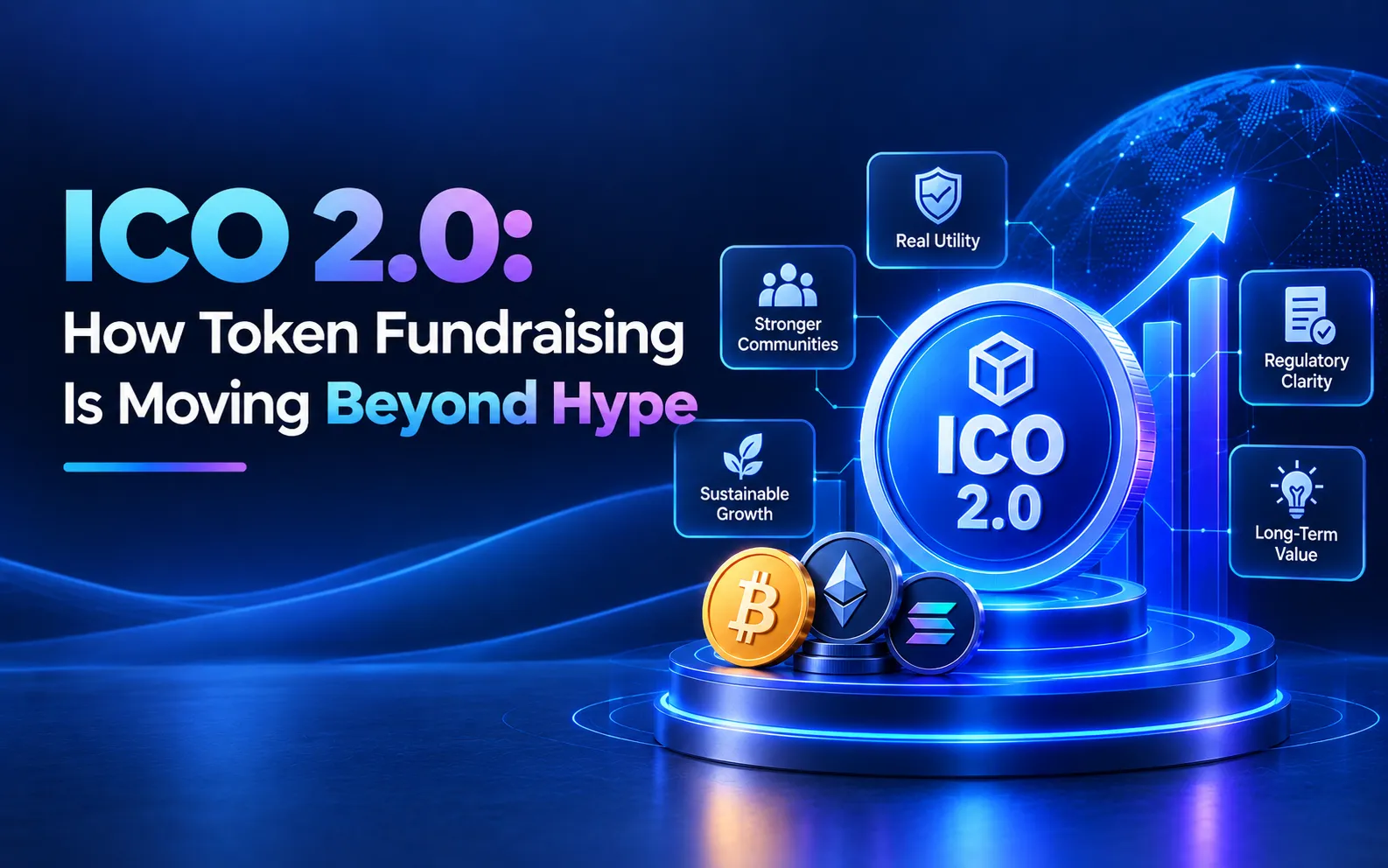

The first ICO boom showed how blockchain could change startup fundraising. Projects could reach global investors, issue tokens, and raise capital without depending entirely on traditional venture capital. But the model also exposed major weaknesses. Speculation, unrealistic promises, weak tokenomics, and limited investor protection caused confidence in ICOs to decline.
In 2026, token fundraising is becoming more structured. ICO 2.0 focuses on real utility, sustainable token economics, regulatory planning, stronger investor protections, and measurable business value. The token is increasingly treated as part of a broader financial and technology ecosystem rather than the entire investment proposition.
From Token Hype to Real Utility
Early ICOs often attracted investors through future growth expectations. A token could gain attention even when the underlying product was still years away from completion. This created a gap between token valuation and actual business activity.
ICO 2.0 takes a different approach. Founders need to demonstrate why the token is necessary and what will generate demand after launch. A token may support payments, governance, staking, platform access, asset ownership, or settlement, but those functions need to connect to real user activity.
This makes product development and tokenomics closely connected. A token with no meaningful use case can struggle to maintain demand once the initial fundraising excitement disappears.
Regulation Is Becoming Part of ICO Development
Regulatory planning is one of the biggest changes in modern token fundraising.
In March 2026, the U.S. Securities and Exchange Commission issued an interpretation explaining how federal securities laws apply to different types of crypto assets, including digital securities. The SEC also clarified that a crypto asset can become subject to securities laws when offered as part of an investment contract.
This means founders need to consider legal structure before finalizing their token sale model. Investor eligibility, disclosures, geographic restrictions, transfer rules, marketing language, and token-holder rights can all influence how an ICO is designed.
For development companies, this creates a more integrated process where legal requirements, tokenomics, smart contracts, and fundraising infrastructure need to work together.
RWA Tokenization Is Expanding the Fundraising Model
Real-world asset tokenization is one of the strongest developments influencing ICO 2.0.
Tokenized assets can represent exposure to Treasuries, commodities, real estate, funds, equities, and private credit. CoinGecko reported that tokenized RWAs excluding stablecoins increased from $5.42 billion at the beginning of 2025 to $19.32 billion by March 2026, representing 256.7% growth.
This creates new possibilities for blockchain fundraising. Instead of building a token economy around a purely digital concept, projects can connect tokens to identifiable economic assets or financial products.
For example, a tokenized real estate project could use blockchain to manage ownership records, investor access, transfers, and potentially income distributions. The token then becomes part of a broader asset-management structure.
However, tokenization does not automatically establish investor rights. The legal relationship between the token and the underlying asset must be clearly defined.
Tokenomics Is Becoming More Disciplined
Tokenomics is also moving beyond simple supply and allocation charts.
Modern projects need to examine circulating supply, vesting, unlock schedules, investor allocations, emissions, treasury reserves, staking rewards, and long-term demand.
A project may raise substantial funds but still face problems if large quantities of tokens enter circulation shortly after listing. Similarly, excessive token emissions can create inflation and selling pressure.
Strong tokenomics therefore connects token supply with actual ecosystem activity.
The key question is no longer simply "How many tokens will exist?" It is "What will create sustainable demand for those tokens?"
Investors Are Doing More Due Diligence
Investors are also becoming more selective.
Social-media followers and large communities can generate awareness, but they do not prove that a project has a sustainable business model. Investors increasingly examine the team, product, technology, token allocation, treasury, partnerships, smart-contract audits, legal structure, and roadmap.
RWA projects require even deeper evaluation. Investors may need to consider asset ownership, custody, valuation, redemption mechanisms, reporting, and the rights attached to each token.
This makes transparency an important competitive advantage for ICO projects. Clear documentation and realistic communication can help establish credibility in a market where investors have become more cautious.
Smart Contracts Are Becoming Financial Infrastructure
Smart contracts are no longer limited to creating and distributing tokens.
Modern ICO platforms can include:
- Investor registration and KYC
- Whitelisted wallets
- Purchase limits
- Token allocation
- Vesting schedules
- Automated distribution
- Transfer restrictions
- Refund mechanisms
- Treasury controls
RWA and regulated token offerings can require even more sophisticated controls. For example, only eligible wallets may be permitted to receive certain tokens.
Because smart contracts can directly control investor funds and token ownership, security audits and testing have become essential parts of professional ICO development.
Liquidity Must Be Planned Before Launch
Another major shift is the treatment of liquidity.
Earlier token projects often viewed exchange listings as a post-launch objective. ICO 2.0 treats liquidity as part of the initial strategy.
Founders need to consider circulating supply, vesting, market access, liquidity provision, exchange infrastructure, and the potential impact of token unlocks.
The growth of tokenized assets shows why this matters. CoinGecko reported $15.1 billion in spot trading volume for tokenized stocks during Q1 2026, while tokenized gold recorded $90.7 billion in spot trading volume.
Token issuance and market infrastructure are increasingly becoming connected.
Institutional Participation Is Raising Expectations
Institutional involvement is also influencing token fundraising.
Financial institutions are exploring blockchain for tokenized securities, settlement, custody, and asset management. Their participation brings higher expectations around security, compliance, governance, reporting, and operational controls.
This can push ICO development closer to traditional financial-market standards while preserving blockchain's advantages in programmability and digital settlement.
For founders, this means a token project targeting serious capital needs stronger infrastructure than a typical community-driven launch.
The New ICO Launch Model
The modern ICO lifecycle is becoming more connected:
Business validation → Token utility → Legal structure → Tokenomics → Technology → Compliance → Smart-contract audit → Fundraising → Liquidity → Post-launch growth
Each stage influences the next. Tokenomics depends on the business model. The fundraising strategy depends on regulation. Smart contracts depend on token allocation and transfer requirements. Liquidity depends on circulating supply and vesting.
This integrated approach is what separates ICO 2.0 from simply bringing back the old ICO model.
What Makes an ICO 2.0 Successful?
A strong token fundraising strategy should answer several fundamental questions:
- Why does the token need to exist?
- What creates ongoing demand?
- What rights or utility does it provide?
- How is token supply controlled?
- Who can participate in the offering?
- How are investors protected?
- What happens after the token sale?
- How will liquidity be developed?
Projects that can answer these questions clearly are better positioned to build credibility beyond the initial fundraising campaign.
Conclusion
ICO 2.0 is moving token fundraising from hype-driven launches toward stronger business fundamentals. Regulation, RWA tokenization, institutional participation, improved tokenomics, investor due diligence, and better technical infrastructure are reshaping how projects approach capital formation.
For founders, launching a token now requires more than creating a smart contract and building a community. It requires a useful product, sustainable token economics, secure technology, appropriate compliance, transparent communication, and a clear post-launch strategy.
Blockchain App Factory supports businesses with end-to-end ICO development, including token creation, smart contracts, tokenomics, fundraising infrastructure, and launch strategy. As the market matures, successful ICOs will be those that turn token issuance into sustainable economic value rather than short-term market hype.






























Sign in to leave a comment.