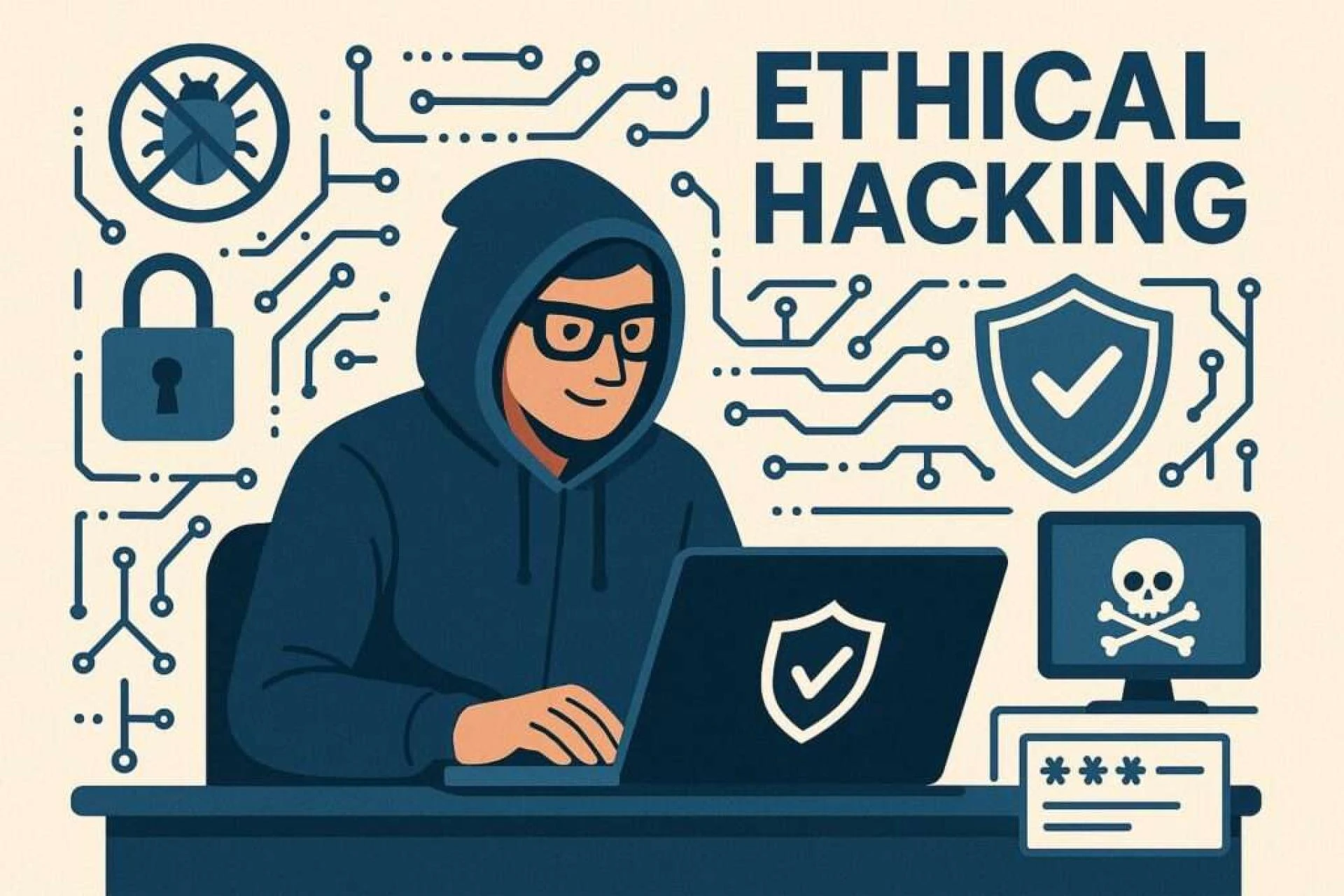

Let’s start with what most people won’t say out loud.
You have an interest in ethical hacking. You are curious. You are motivated. You are working hard.
And lurking in the back of your mind will be this nagging thought: “I didn’t major in computer science. Maybe this is not really my field.”
This is a thought that, on its own, has foiled more prospective ethical hackers than any computer problem that might arise.
The truth is uncomfortable to some, and liberating to others: ethical hacking is not the exclusive domain of the computer science student. It never was. But just as the landscape of cybersecurity changes everyday, so does the disadvantage that a student from a background that is not computer science used to represent. It is now an edge.
The problem is not the degree. The problem is the explanation given by the industry. Most advice is intended for computer science majors in the first place. Most roadmaps presume that you already have the language in mind. Most career advice paths slightly overlook those whose path was elsewhere. It can be very easy to feel like you are constantly behind when you did not have the “expected” background to begin with.
However, in ethical hacking, timing is not everything. As a matter of fact, being "first to hack" has no room in moral hacking. Ultimately, in moral hacking, what gets rewarded is what makes sense at.
And something which non-CS students can absolutely master.
Ethical hacking is not about memorizing syntax or proving any sort of academic purity. It’s about learning how systems break when pushed to the limit. It’s about understanding not just the havoc you can wreak, but also the innocent people you inadvertently harm if you don’t consider user boundaries, not just network boundaries.
Ironically, people who did not have a traditional computer science education often succeed here more than those who took the direct route.
As a whole, non-CS students ask different questions. They don’t assume how a system should work. They ask questions about how a system works. They ask questions like, “What are these default settings? Is that smart? What about these strange, complicated interfaces? These risky, complicated workflow sequences? The myriad ways that users can get things wrong?” These are things that engineers might overlook.
Cybersecurity failures don't happen because of failures in advanced algorithms; they occur because somebody trusted the wrong input, exposed the wrong endpoint, reused a password, misunderstood a configuration, or assumed no one would look there.
That’s not a problem in computer science. That’s a problem in thinking.
And first and foremost, ethical hacking is about thinking.
The biggest mistake non-CS students make is trying to be "fake computer science graduates." Competing by trying to cram theory that they don't need, chasing each and every programming language, and measuring themselves against those who have been coding since their teens.
That strategy burns people out fast.
It's not about matching someone else's background; it's about creating functional credibility. Hiring managers don't ask, "What degree did you study?" They ask, “Can you identify risk, explain impact, and think like an attacker without causing damage?”
If you can do that, your background becomes immaterial.
To compete, finally, the non-CS student must focus on the foundational elements that matter-not academic prestige. You don't have to be a master in computer science; you need to understand how networks communicate, how Web applications handle data, how authentication fails, how permissions escalate, and how systems misconfigure.
It is a skill that can be learned! Step-by-step! Without the need for a degree in computer science.
the average student from a Non-Cs program thinks they must "know everything." They are stuck in an infinite loop of learning. Also, most successful white-hat hackers started knowing far less than they now believe you know.
One of the most effective ways to convert this mindset into real career credibility is through the right certification. A good ethical hacking certification doesn’t just teach tools; it provides structure, validates your skills, and gives employers a shared benchmark of your knowledge. More importantly, it helps non-CS learners bridge the confidence gap by turning self-learning into recognized proof.
This is where programs like 3.0 University’s Certified Ethical Hacker stand out. Their approach focuses on practical thinking, real-world attack scenarios, and ethical judgment—not just theory. If you’re serious about entering ethical hacking without a CS degree, it’s worth exploring:
👉 https://www.3university.io/certified-ethical-hacker-v13/
The next shift is psychological, and it's critical.
What separated them wasn't knowledge; it was evidence.
Ethical hacking jobs depend upon evidence rather than promises. Exams done in solitude aren’t of any use unless related to practical evidence. Random practice may not be impressive to employers unless related to attack paths and risks.
This is where non-CS students can compete aggressively.
For example, rather than mentioning tools used, talk about the thought processes. Instead of talking about the certifications you have, talk about the way you solved something. Instead of showing you're technical, try to simplify the vulnerabilities described.
When you are able to present an explanation for the imperfection and an explanation of how it could be misused in the field of life, it displays maturity.
That matters more than perfection in syntax.
Another positive contribution that comes from non-CS students is verbal communication.
The majority of ethical hackers suck at explaining their findings. They know how to break things, not how to talk about them. This causes friction among security teams, developers, and leadership.
People with their background in business, psychology, design, law, or non-technical sciences already know how to describe complex ideas to a non-technical audience. It is relatively a unique skill within cybersecurity and very valuable.
An ethical hacker who is able to find vulnerabilities and communicate impact is infinitely more useful than one who only knows tools.
It is not about showcasing intelligence. It is all about mitigating risk, and risk mitigation has to be very clear.
There's also the unspoken truth that nobody really bothers to mention: a lot of ethical hacking doesn't need or require deep programming. It requires curiosity, methodical testing, pattern recognition, documentation, and ethical judgment.
Yes, coding helps. But it’s a tool, not a gatekeeper.
You can learn enough scripting to automate tasks without becoming a software engineer. You can also read code well enough to understand logic flaws without writing enterprise applications.
You can grow technically while already working in security roles.
The career never begins after perfection. It begins after commitment.
Non-CS students are also more careful, and that is a plus for ethics hacking. Reckless curiosity can destroy your professional career. Ethical hackers are appreciated and trusted sooner as they are law abiding.
Knowing boundaries, contracts, consequences is just as important as the technical aspects of the task. Many new programmers struggle here not in spite of their knowledge but in spite of their lack of restraint.
You’re already a thinker and consider what you do before you actually do it—if you
The path forward is not about catching up. It’s about positioning.
Position yourself as someone who understands the system, understands people, and understands the risk. Position yourself as someone who learns, not randomly, but with intention. Position yourself as someone who understands ethics just as well as exploit.
Such a combination of qualities is rare.
Therefore, rarity is what gets hired.
The place for the discipline of ethical hacking is not more people who use tools. It’s people who can think clearly under conditions of uncertainty, describe risk in complicated ways, and adapt to the evolving environment.
If you come from a non-computer science background, you’re actually not behind. You’re actually ahead by a wide measure.
You don't have to erase where you've come from to advance.
The primary reason for this is the fact that in ethical hacking, the strongest competitions are not those with the right degree, but those who know what goes wrong and why.
That, too, is something you can absolutely master.











Sign in to leave a comment.