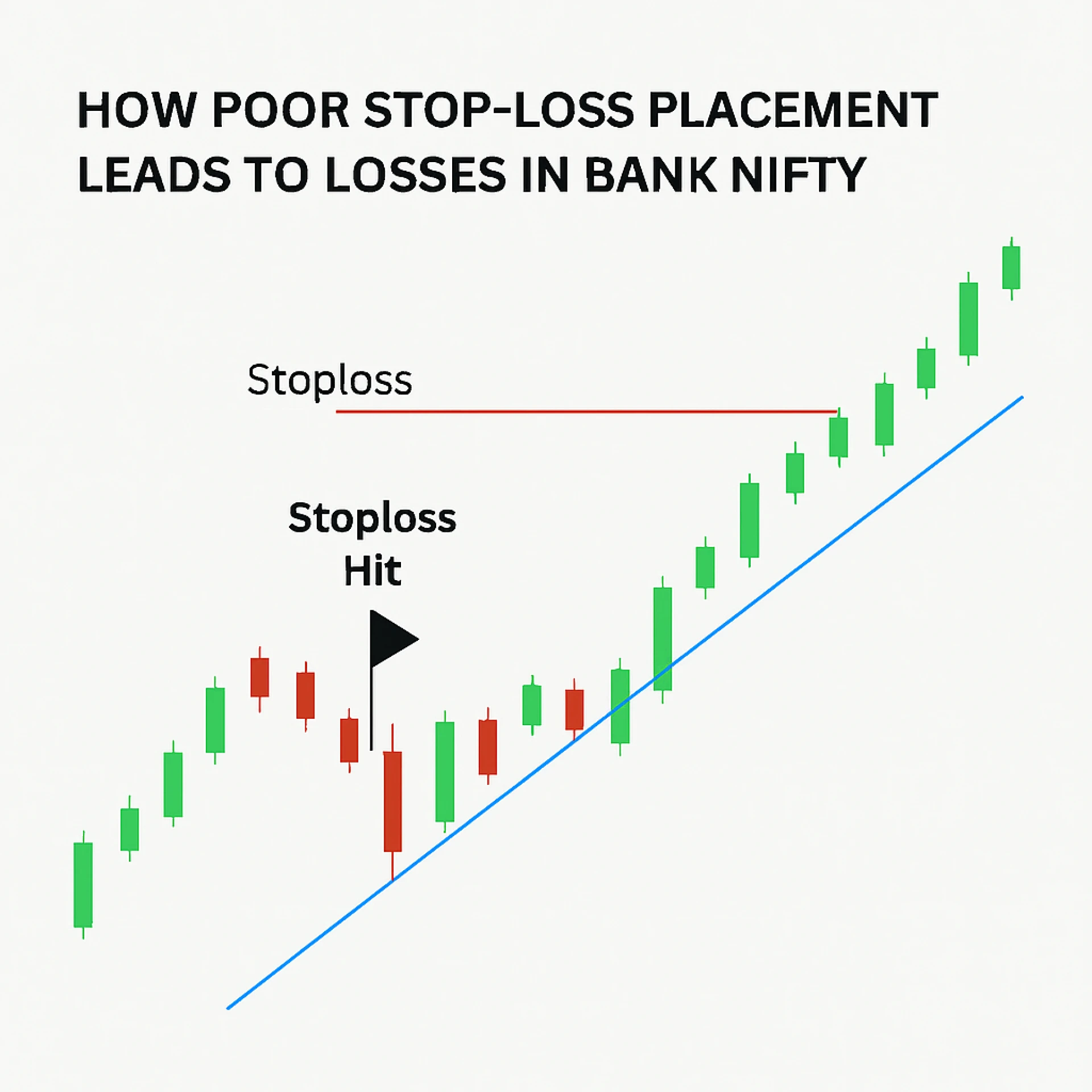

Poor stop-loss placement is one of the most common reasons traders face losses in Bank Nifty. This index moves quickly, and even a small mistake in stop-loss planning can turn a manageable trade into an unexpected exit. Understanding how stop-loss works, how Bank Nifty behaves, and where traders usually go wrong helps bring more clarity to intraday decision-making.
1. Why Stop-Loss Matters More in Bank Nifty
Bank Nifty is highly volatile and reacts sharply to news, opening gaps, and intraday momentum bursts. This is why stop-loss planning becomes a key part of risk control. Many beginners try to follow aggressive entries without placing stop-loss levels based on structure. Before learning advanced concepts, traders often go through basic frameworks shared in Bank Nifty tips, which highlight the importance of protecting capital before focusing on entries.
2. Placing Stop-Loss Too Close to the Entry
One of the biggest reasons traders experience repeated whipsaws is placing the stop-loss extremely close to their entry. Bank Nifty naturally pulls back 20–40 points during normal price action. A tight stop-loss ignores this noise and leads to unnecessary exits.
Why does this mistake happen:
Traders fear losing more points, so they keep a very small cushion. They want quick results, but Bank Nifty rarely moves in a straight line.
How to avoid it:
Use structure-based stops, such as below a swing low in an uptrend or above a swing high in a downtrend. This basic habit is also explained in Avoiding Common Intraday Trading Mistakes in Bank Nifty, where traders learn how to align stop-loss placement with actual market behaviour.
3. Using a Fixed Stop-Loss Instead of a Structure-Based Stop-Loss
Some traders use the same stop-loss for every trade—like 20, 30, or 40 points—without considering volatility or trend strength. Bank Nifty does not maintain a fixed range, especially during events or index rebalancing.
Why does this mistake lead to losses:
Fixed numbers do not match the dynamic movement of the index. When volatility expands, the stop-loss becomes too small. When volatility contracts, the stop-loss becomes unnecessarily large.
Better approach:
Observe ATR (Average True Range) or the size of recent candles. Place stop-loss beyond the natural fluctuation zone.
4. Placing Stop-Loss on Round Numbers
Many traders place stop-loss on levels like 48,000, 48,100, or 48,200. Algorithms and big players often target these round numbers because many retail traders cluster orders there.
What usually happens:
Price hits the round number, triggers stop-loss, and immediately reverses.
How to improve:
Shift your stop-loss slightly above or below round levels. Even a 10–15 point adjustment helps avoid unnecessary triggers.
5. Not Adjusting Stop-Loss When Trend Strength Changes
Bank Nifty often shifts between trending and ranging phases within 15–20 minutes. Traders who fail to adjust stop-loss according to trend strength end up holding losing trades longer than necessary.
Why traders get trapped:
They focus only on entry signals but ignore the structure change. When consolidation forms, stop-loss must be re-evaluated.
How to handle it:
Follow the price behaviour candle by candle. If the breakout weakens or momentum drops, adjust your stop-loss to reflect the new structure.
6. Moving Stop-Loss Emotionally Instead of Logically
A common pattern among new traders is shifting the stop-loss away from the price because they hope the trade will turn in their favour. Emotional stop-loss management increases risk without any structural support.
Smarter method:
Trail the stop-loss only when price forms fresh swing highs or lows—not based on hope or fear.
Conclusion
Poor stop-loss placement leads to losses in Bank Nifty mainly because traders overlook structure, volatility, and natural price behaviour. When the stop-loss is based on emotions instead of market context, it gets triggered easily and repeatedly. Learning to place stop-loss properly, adjusting it with trend strength, and avoiding round numbers can help traders navigate Bank Nifty more confidently.








Sign in to leave a comment.