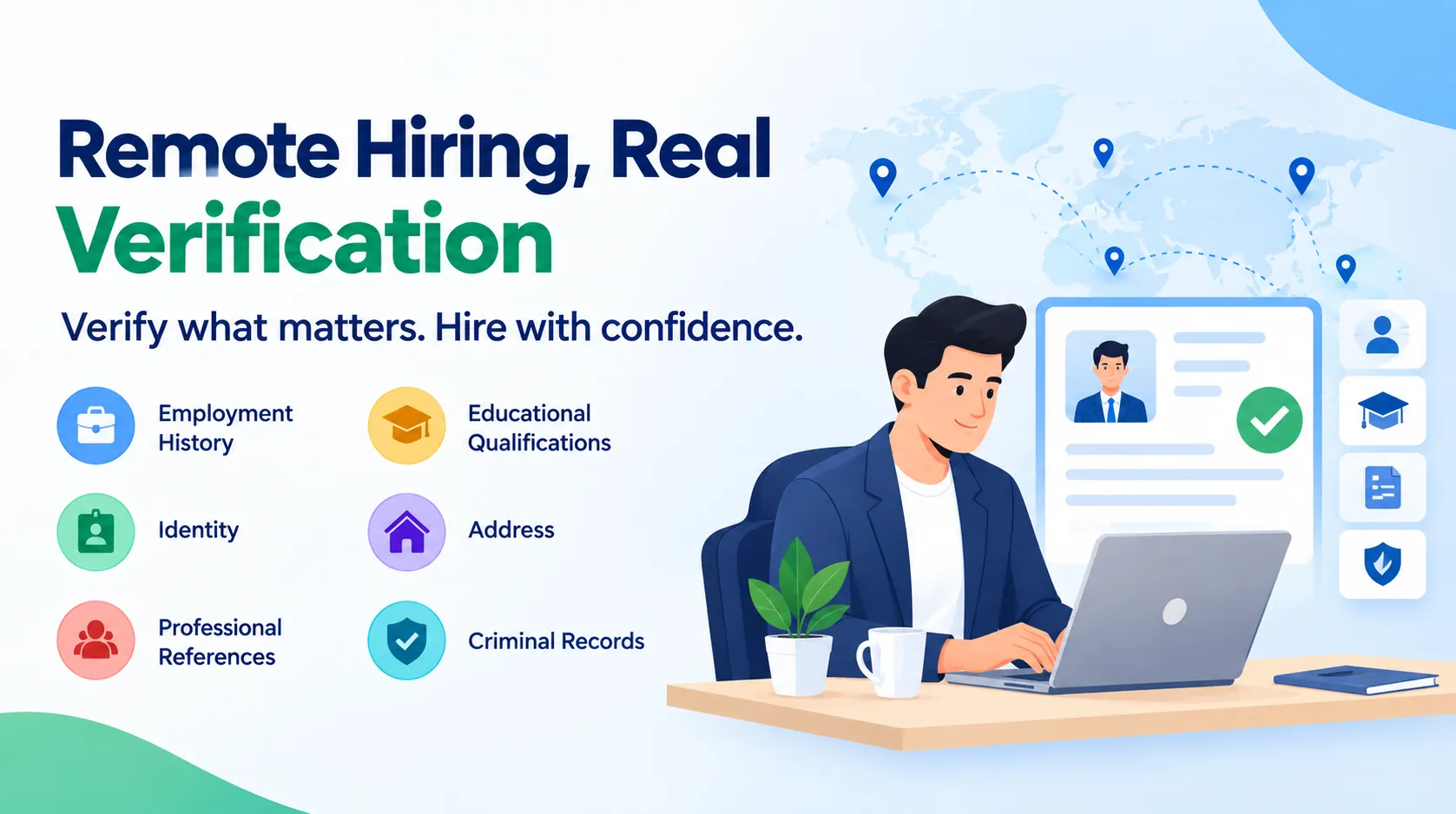

Remote and hybrid hiring have changed how organizations identify, interview, and onboard employees. A candidate can now apply for a position from another city or country, complete interviews online, submit documents digitally, and begin working without ever visiting the employer's office. While this has made recruitment more flexible, it has also created new challenges around establishing candidate identity and validating information.
For HR teams, the question is no longer simply whether a candidate has the right experience. It is also how that information can be independently verified when much of the recruitment process happens online. This is making employee background verification an increasingly important part of modern recruitment.
Why Remote Hiring Requires a Different Approach
Traditional recruitment provided HR teams with several opportunities for in-person interaction. Documents could be reviewed physically, candidates could visit an office, and local references or records could sometimes be checked through established channels.
Remote recruitment changes this model. A candidate may be located hundreds or thousands of kilometres away, while their previous employers and educational institutions may be in completely different locations.
This creates a need for verification processes that are capable of working across locations without making recruitment unnecessarily slow.
A structured background verification service can help organizations coordinate these checks through digital workflows while allowing HR teams to monitor the status of individual verification requests.
What Information Should Employers Verify?
Not every candidate requires the same level of screening. The appropriate checks depend on the role, industry, organizational policy, location, and legitimate business requirements.
Some of the commonly verified areas include:
Employment History
Professional experience is often one of the most important factors in recruitment. Employment verification can help establish whether the candidate worked for the organizations mentioned in their application and whether relevant details such as employment dates and designation can be confirmed.
This can be particularly useful for senior or specialized positions where previous experience is directly connected to the responsibilities of the new role.
Educational Qualifications
A candidate's academic background may be an essential requirement for certain positions. Education verification can help confirm degrees, qualifications, institutions, and other credentials provided during recruitment.
Independent verification can provide employers with additional confidence in the information presented by candidates.
Identity
Remote recruitment makes identity verification especially important because the employer and candidate may never meet physically before onboarding.
Identity verification helps establish that the person participating in the recruitment process corresponds with the identity information submitted to the organization.
Address
Address verification can help validate residential information supplied during recruitment. Depending on the organization's requirements and applicable procedures, this may involve document-based or other permissible verification methods.
Professional References
Reference verification can provide additional information about a candidate's previous professional associations and experience. It can complement employment verification by providing another perspective on the candidate's professional history.
Criminal Records
For roles where it is legally permissible and relevant, criminal record checks may form part of the screening process. Organizations should ensure that such checks are conducted according to applicable laws and established procedures.
The Challenge of Digital Documents
Digital recruitment has made it easier for candidates to submit documents quickly. However, the convenience of digital documentation also means that employers should avoid treating a submitted document as the only evidence of a qualification or claim.
A verification process can involve checking information against appropriate independent sources rather than relying solely on documents uploaded by a candidate.
This distinction is particularly important when organizations recruit at scale. HR teams may receive hundreds or thousands of applications, making manual examination of every document difficult and time-consuming.
Technology-enabled verification can help automate repetitive stages while allowing exceptions and discrepancies to be reviewed separately.
Can Automation Make Verification Faster?
Automation is increasingly being used to streamline background verification. Instead of managing every request through individual emails and spreadsheets, organizations can use centralized platforms to initiate checks, track progress, manage documents, and generate reports.
API integrations can take this further by connecting verification platforms with applicant tracking systems and HRMS platforms. Candidate information can move between systems with less manual intervention, helping HR teams reduce administrative work.
A modern background verification service may therefore combine digital workflows, automation, API integration, and verification expertise.
However, automation should not be confused with completely removing human involvement. A system may identify a discrepancy, but understanding the reason behind that discrepancy can require additional verification or human review.
What Happens When a Verification Fails?
A discrepancy does not automatically mean that a candidate has intentionally provided false information.
There can be legitimate reasons for differences between candidate-provided information and verification results. Employment dates, company names, designations, academic records, or addresses may have changed or been recorded differently by different sources.
For this reason, organizations should establish a clear process for handling discrepancies.
The process can include reviewing the information, seeking clarification where appropriate, conducting additional verification, and documenting the outcome. Decisions should be based on relevant evidence and the organization's established policies.
How HR Teams Can Improve the Verification Experience
Background checks can sometimes create friction for candidates, particularly when they involve repeated requests for documents or information that has already been provided.
Organizations can improve the experience by explaining the verification process clearly, collecting necessary information systematically, providing visibility into the status of checks, and minimizing unnecessary requests.
Technology can support this by giving candidates digital interfaces for submitting information and HR teams centralized dashboards for monitoring verification.
A streamlined process benefits both sides. HR teams spend less time following up on administrative tasks, while candidates have greater clarity about what is expected from them.
What to Consider When Selecting a Verification Provider
Organizations evaluating providers should consider several factors rather than choosing solely on the basis of price.
The provider's verification coverage should match the organization's hiring requirements. Businesses should also evaluate data security, technology infrastructure, reporting capabilities, turnaround processes, geographic coverage, and integration options.
Scalability is another important factor. A provider that can support both regular recruitment and high-volume hiring can help organizations maintain consistency as their workforce expands.
For companies hiring internationally, it is also important to understand whether the provider has appropriate processes and coverage for the locations where candidates have studied, worked, or lived.
IISERVZ and Employee Background Verification
IISERVZ provides employee verification and risk mitigation solutions for organizations across different industries and geographies. Its services include employment, education, identity, address, and other verification requirements, supported by technology-driven workflows. IISERVZ also offers API-based integrations and automation capabilities that can help organizations connect verification processes with their HR and recruitment systems.
The company has more than 17 years of industry experience, works with 300+ enterprise clients, and supports verification requirements across 100+ countries. Its combination of verification services and technology can support organizations managing both conventional and geographically distributed recruitment processes.
The Future of Verification in a Remote-First Recruitment Environment
Remote hiring is likely to remain an important part of modern workforce strategies. As recruitment becomes increasingly digital, organizations will need ways to establish candidate trust without depending entirely on face-to-face interactions.
This does not mean every employee needs the same set of checks. Instead, businesses can develop role-specific verification frameworks based on legitimate requirements, risk exposure, location, and organizational policies.
A reliable background verification agency can help employers manage these processes through structured workflows, technology, and appropriate verification methods.
Ultimately, employee background verification is becoming less of a standalone HR task and more of an integrated component of digital recruitment. Organizations that build verification into their hiring workflows can create a process that is more consistent, transparent, and manageable while adapting to the realities of remote and distributed hiring.






















Sign in to leave a comment.