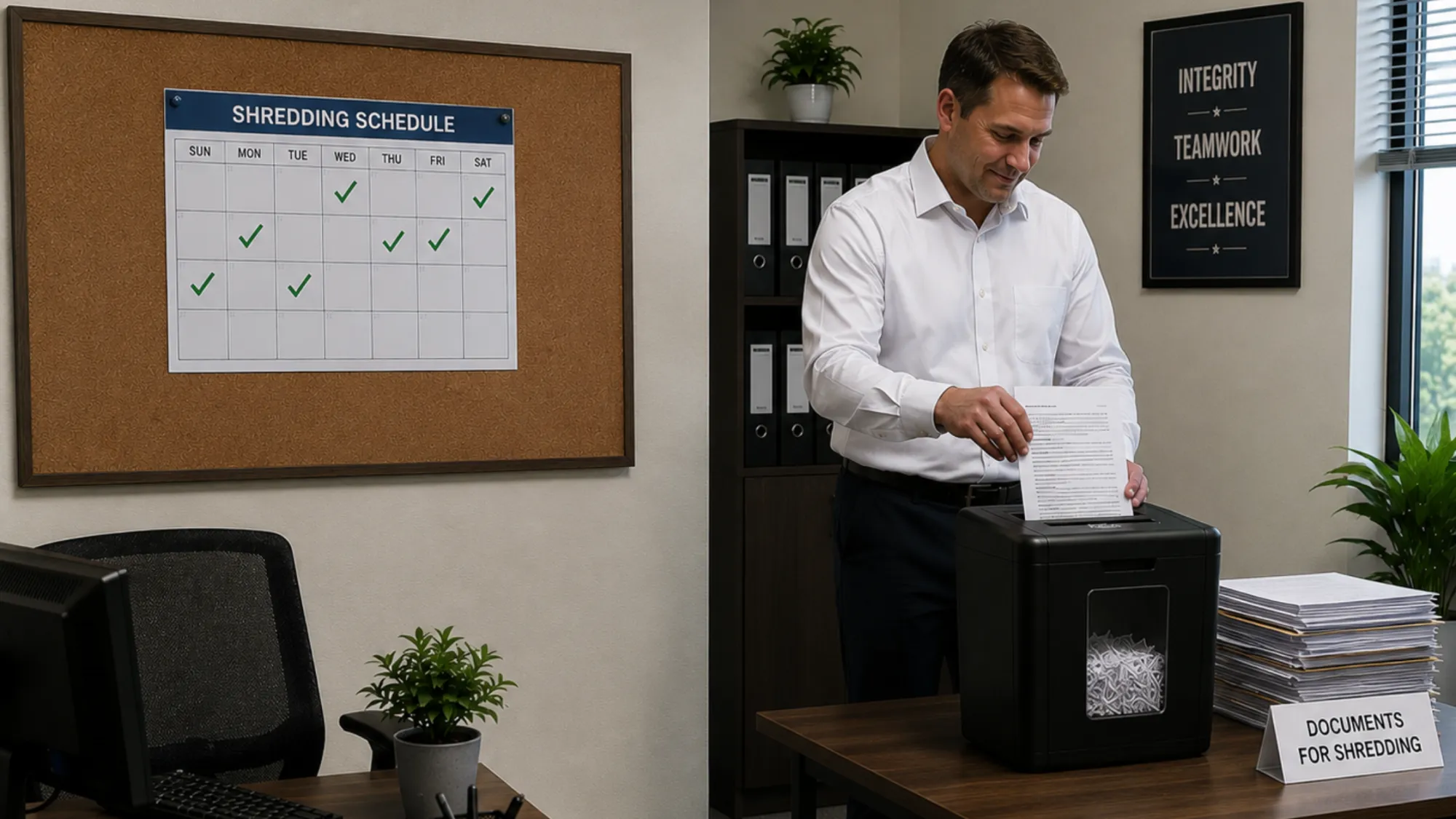

Most conversations about data security center on firewalls, encrypted networks, and phishing awareness. We visualize hackers in dark rooms wearing hoodies, typing frantically to bypass a mainframe.
Yet, according to the 2023 Verizon Data Breach Investigations Report, 74% of all breaches involve the human element. Surprisingly, a significant portion of those leaks don't start on a screen, they start at desks, in filing cabinets, and at the bottom of waste bins.
Physical paperwork remains one of the most underestimated risks in the modern workplace. We live in a "paper-lite" world, not a "paperless" one.
For many organizations, especially those navigating the specific compliance needs of document shredding St. Louis, the shift to scheduled shredding for data protection isn’t just a "nice to have", it’s a way to stop relying on employee memory and start relying on a foolproof system.
What Is The Real Cost of "I Forgot"
Human error in document handling isn't usually malicious. It’s rarely a disgruntled employee selling secrets. Instead, it’s the "micro-errors": the payroll report left sitting on a shared printer, the customer invoice tossed into a recycling bin because the personal shredder was jammed, or the sticky note with a password stuck to a monitor.
These moments feel minor in the frantic pace of a Tuesday afternoon. However, the downstream consequences are massive. The Ponemon Institute estimates the average cost of a data breach in the United States is now over $9.4 million.
While a large portion of that cost is attributed to digital forensics, a significant chunk stems from legal liabilities and "lost trust" that begins when a physical document falls into the wrong hands.
The real problem is structural. We expect employees to be security experts, amateur archivists, and compliance officers while they're trying to do their actual jobs. That’s not a sustainable model. When we rely on individual memory, we are essentially gambling with the company’s reputation.
Why Routine Shredding Outperforms Individual Effort
When you implement scheduled document shredding, you’re doing more than just cleaning up paper; you’re performing a psychological "reset" for your office. You are removing the "decision fatigue" that leads to catastrophic errors.
Eliminating the Guesswork
Every time an employee handles a document, they have to perform a mental audit: Is this sensitive? Does it contain PII (Personally Identifiable Information)? How long do I keep it according to the 2024 tax code? Where does it go?
Routine shredding services simplify this into one move: if the paper is no longer needed, it goes into the secure, locked bin.
You don't need to teach every intern the nuances of the Sarbanes-Oxley Act if you have a system that defaults to security. By shortening the decision tree, you narrow the margin for error to nearly zero.
Controlling the Paper "Pile-Up"
Cluttered offices are high-risk offices. When files accumulate on desks or in "to-be-filed" boxes, confidential records inevitably get mixed with general scrap paper. Under pressure, an employee cleaning their desk for a meeting might accidentally scoop a sensitive client contract into the bin along with a lunch menu.
By using secure shredding services, you keep the volume at a manageable baseline. Lower accumulation leads to better spatial organization, which directly prevents the careless handling that exposes data.
Removing the "Trash Can" Temptation
Let’s be honest: if a shredder is across the hall, making a loud grinding noise, and requires the staples to be removed first, a busy employee might just use the trash can under their desk. It’s the path of least resistance.
Professional document destruction services place secure, aesthetically pleasing consoles in high-traffic, convenient locations. These bins don't require staple removal or hand-feeding paper three sheets at a time.
This makes the "secure way" the "easy way," ensuring sensitive materials never enter the regular waste stream where "dumpster diving" becomes a legitimate threat to your business.
The Psychology of Habit vs. Training
We often think that more training sessions will solve security leaks. But human nature suggests otherwise. Training wears off; systems endure.
When an office adopts a recurring schedule, it creates a "security culture." Employees begin to associate the sight of the secure bin with the importance of data privacy. It becomes a subconscious habit.
Much like how we instinctively look for a recycling bin for a plastic bottle, a scheduled shredding for data protection program trains the brain to handle information with a higher level of care.
Managing Risk: The Financial Perspective
It is helpful to stop viewing paper management as an administrative chore and start seeing it as an investment in risk mitigation. When you evaluate the worth of shredding services, the math is remarkably simple.
Consider the "Post-Breach" checklist:
- Legal fees and settlement costs.
- Regulatory fines (which can reach into the millions for HIPAA or GDPR violations).
- Mandatory identity theft monitoring for affected customers.
- The loss of future business due to a tarnished brand.
The cost of a recurring, professional service is a predictable, modest operating expense. It’s insurance against a "black swan" event that could potentially bankrupt a mid-sized firm.
For companies in healthcare, finance, or law, business shredding solutions provide something manual shredding never can: a Certificate of Destruction.
This document is your shield during an audit, proving that your organization didn't just try to be compliant, it followed a verified, professional protocol.
Vulnerabilities Of Not Shredding Paper Industrywise
Different sectors face different "human error" triggers.
- Healthcare: With the rise of telehealth and physical charts, PII is everywhere. A "shred-all" policy simplifies the incredibly complex HIPAA requirements.
- Legal: Client confidentiality is the bedrock of the profession. Leaving a "draft" of a motion in a communal bin is a potential malpractice suit waiting to happen.
- Finance: Tax records and account numbers are the "gold" that identity thieves look for in office dumpsters.
The Reality of the Hybrid Office
The shift to hybrid work has created a "security vacuum." Documents printed at home, often on unencrypted home printers, don't always make it back to the office for disposal. Does the employee have a shredder at home? Usually not.
Those documents end up in residential recycling, which is even less secure than a commercial dumpster.
Forward-thinking companies are now extending their scheduled shredding for data protection to their remote workforce.
This includes providing small secure consoles for home offices or organizing "shred days" where remote staff can bring their accumulated sensitive paperwork to a central location for professional destruction.
How often should the "shred truck" come?
- Weekly: Ideal for high-traffic environments like clinics or large HR departments.
- Bi-Weekly: The "sweet spot" for most mid-sized professional services firms.
- Monthly: Sufficient for smaller offices with lower paper output but a high need for compliance.
The goal is to ensure the bins never overflow. An overflowing secure bin is just as dangerous as an open trash can, as it encourages people to leave stacks of paper on top of the console.
Partner with a Certified Shredding Company Today
Human error isn’t something you can "train away" entirely. People get tired, busy, and distracted, it is simply part of the human condition.
Scheduled shredding for data protection works because it doesn't ask your team to be perfect; it provides a reliable, mechanical system that works in the background while they focus on their core responsibilities.
By taking the burden of disposal off the individual and placing it on a professional shredding company, you effectively close the gap between security "intent" and actual "action."
You don’t need a complex, high-tech strategy to protect your physical data, you just need a consistent, visible, and professional one.
Take control of your workplace security today by establishing a routine that removes the opportunity for error. Contact a certified professional to audit your document flow and implement a destruction plan that keeps your sensitive information where it belongs.























Sign in to leave a comment.