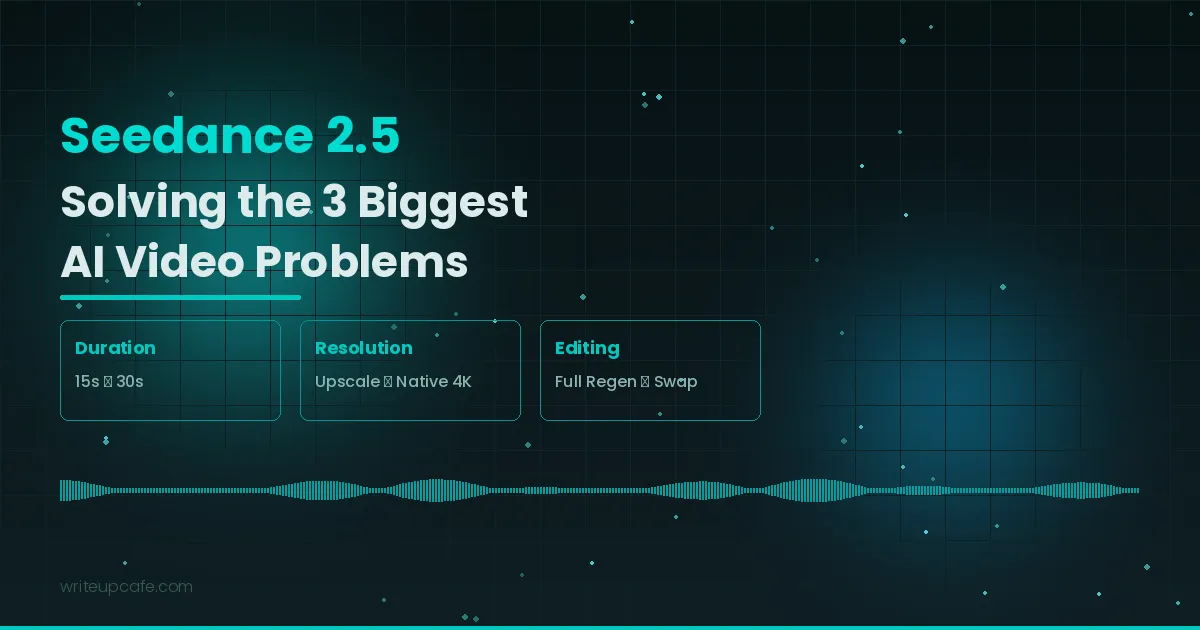

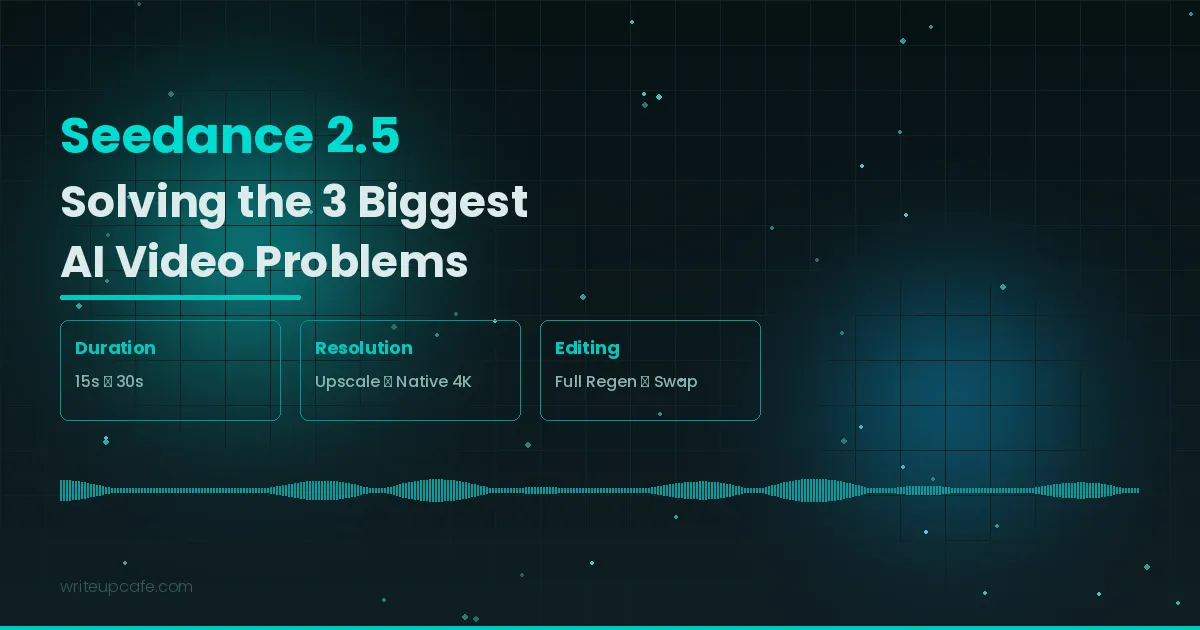
AI video generation has reached a point where the output quality is genuinely impressive. Characters maintain their appearance across frames, camera movements feel deliberate, and the overall visual fidelity rivals what you might expect from a mid-range production setup. But despite these advances in raw quality, three persistent structural problems have kept the technology from becoming a reliable part of professional workflows.
The first is duration. Most models generate 15 to 20 seconds of video per request, which means any project longer than a social media clip requires generating multiple segments and stitching them together manually. The second is resolution quality — many tools claim 4K output but actually generate at lower resolutions and upscale afterward, losing fine detail in the process. The third is the editing problem: changing a single element in a generated video typically requires regenerating the entire clip from scratch, with no guarantee that the parts you liked will survive the regeneration.
ByteDance's Seedance 2.5, announced at the Volcano Engine FORCE conference in June 2026, tackles all three problems in a single release.
Problem One: Duration
The 15 to 20 second generation limit is not merely an inconvenience. It imposes a workflow overhead that scales with every project. For a 30-second advertisement — the standard format for digital and broadcast advertising — you need two or three separate generation calls. Each call produces an independent clip with no temporal context from the previous one.
When you stitch these clips together, the boundaries introduce systematic quality risks. Character identity drifts between clips — facial features shift subtly, body proportions change, clothing details vary. Lighting conditions differ between segments, creating visible discontinuities at cut points. Physical behaviours may not carry consistently across independently generated clips. A ball that bounces naturally in clip one may float unnaturally in clip two.
Professional editors working with stitched AI video report spending 40 to 60 percent of their post-production time on consistency correction — work that produces no creative value and exists solely to compensate for a model limitation.
Seedance 2.5 generates up to 30 seconds of continuous video from a single prompt — the first AI video model to reach this length. Character identity, scene lighting, and physical behaviour remain consistent throughout, eliminating the visual discontinuities that plague multi-clip assembly workflows. The stitching step disappears entirely, and with it, all the time, cost, and quality risk it carried.
Problem Two: Resolution
The model generates at native 4K resolution from the diffusion stage rather than upscaling from a lower base resolution. This preserves high-frequency detail in textures, fabrics, hair, and product surfaces — detail that upscaling algorithms cannot reconstruct because it was never generated in the first place.
The distinction between native and upscaled 4K is immediately visible in any content where fine detail matters. Embroidery shows individual thread patterns rather than smooth approximations. Hair separates into individual strands rather than merging into soft masses. Product surfaces display specific material textures rather than generic smoothness. For commercial video — fashion, food, beauty, luxury goods, interiors — these details are not aesthetic preferences. They are the visual information that drives viewer engagement and purchase intent.
The 10-bit colour depth support compounds the quality advantage. With over one billion colour values compared to 16.7 million at 8-bit, gradients are smoother, skin tones are more accurate, and post-production colour grading has significantly more headroom before visible artefacts appear. For professional workflows that include colour correction as a standard step, the difference between 8-bit and 10-bit source material is the difference between footage that tolerates adjustment and footage that degrades under it.
Problem Three: Editing
Seedance 2.5 introduces localised editing, allowing users to swap specific elements — products, backgrounds, characters — without regenerating the surrounding frame. A conference demonstration showed lipstick shade variants being substituted in real time within an advertisement, with all other visual elements remaining unchanged.
This solves the destructive regeneration problem that has been one of the most wasteful aspects of AI video workflows. Under previous models, fixing a single wrong element — a product colour, a background, a character's outfit — required regenerating the entire clip. The regeneration rerolled everything, often producing output where the fixed element is correct but other previously-correct elements have changed. The result is an iteration loop where each fix introduces new problems.
With localised editing, the fix stays targeted. Change the product. The model stays the same. Change the background. The lighting stays the same. The economics of variant production improve by an order of magnitude: ten product variants no longer require ten full regeneration cycles but one generation plus ten targeted swaps.
The Fourth Improvement: Multi-Reference Input
The model also accepts up to 50 multimodal reference assets per generation, including images, video clips, audio files, and 3D models. This addresses the fundamental imprecision of text-only prompting by allowing users to provide visual direction through actual materials rather than verbal descriptions.
For brand-conscious production, this is transformative. Instead of spending iterations trying to prompt your way toward brand consistency — the right colour temperature, the right lighting mood, the right compositional style — you provide the brand assets directly. The model works from the visual materials rather than from your linguistic approximation of them.
The conference demonstration showed over ten character references being processed simultaneously, with the model handling casting and scene composition autonomously — a capability that text prompting alone cannot replicate.
When Can You Try It
Seedance 2.5 is in final internal testing with public availability expected in early July 2026. For anyone working with AI video — whether in content creation, marketing, or production — the combination of longer generation, true 4K quality, multi-reference input, and non-destructive editing makes this a release worth watching closely. The three biggest problems in AI video have been duration, resolution, and editing. This is the first model that addresses all three simultaneously.





























Sign in to leave a comment.