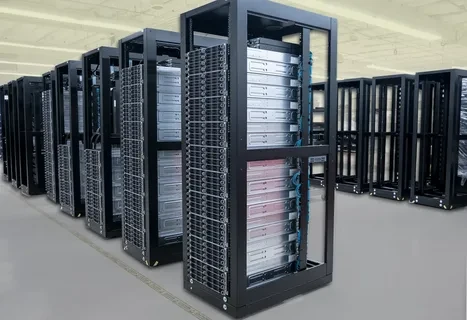

The digital world we inhabit relies on vast networks of computers and servers, all working diligently behind the scenes to power the internet and keep our connected devices functioning. But what does it look like in the real world? Where do all those servers live? For many businesses and organisations, the answer is server racks.
Server racks form the backbone of IT infrastructure, providing sturdy frames to securely house rows of stacked servers. On the surface, they may seem like simple metal structures, but server racks in fact bring immense order and clarity to complex technology environments. They transform a jumble of boxes into a neatly organised system, making maintenance and expansion a breeze.
So let's take a closer look at why server racks have become so indispensable.
Facilitates Cooling and Power Distribution
As you pack more equipment into tighter spaces, cooling and power become critical considerations that server racks address effectively. Without proper airflow management and power distribution, your densely packed gear risks overheating or experiencing unreliable power, leading to downtime and hardware failures. Racks are designed from the ground up with these utility needs in mind.
Most racks include integrated fans for active cooling. You'll find them either built into the rack itself or as detachable fan trays that slide into slots. These work to pull cool air from the floor and push warm exhaust out the top. Larger data centre racks may even support liquid cooling systems with water-filled pipes. Beyond simple fans, some racks feature temperature sensors and remote monitoring of airflow performance, so you can proactively catch issues before equipment overheats.In addition to active cooling, server rack designs promote passive thermal management through openings for front-to-back or side-to-side crossflows.Vertical cable channels and adjustable horizontal cable managers help separate airflow from congested cable areas. You can further fine-tune airflow by using blanking panels and airflow containment kits. All of this airflow engineering ensures your densely packed gear runs at optimal temperatures without hot and cold spots developing.When it comes to power distribution, racks centralise this as well. Instead of individual power supplies, racks feature integrated power distribution units (PDUs) that consolidate electricity from the building into neatly organised power strips. Having all power delivered through centralised PDUs rather than direct wall outlets reduces cable clutter for improved cooling and easier capacity planning.Many PDUs also offer outlet-level metering, so you can monitor each device's power draw. Some even provide remote outlet control that allows power cycling of non-responsive equipment without a physical visit. For mission-critical applications, dual-circuit PDUs add redundancy by drawing power from separate electrical panels. You also get high-amperage PDUs for equipment with power-hungry needs, like blade servers.
Contains Everything in One Place
One of the biggest benefits of server racks is that they allow you to consolidate all of your IT equipment into a single, centralised location. No more searching all over the office when you need to access a particular server or make changes to your network setup. With a rack, everything has a designated spot that is easy to find. This saves you time that would otherwise be wasted tracking devices down.
Maximise Limited Space
Data centres and server rooms have strict space limitations. Server racks help you utilise vertical space efficiently to hold the maximum amount of equipment without taking up a large footprint. Standard rack sizes are designed so equipment can be stacked from floor to ceiling in an organised column. This density allows you to accommodate more devices in the same physical space.
Improve Accessibility
Not only does a rack corral your gear, but it also positions everything at a convenient height. Rack-mounted servers and other devices sit at waist level or above, so you don't have to bend down or crawl under desks to access them. Front and rear rack doors further improve accessibility by keeping cables organised and not in the way. This streamlines maintenance and troubleshooting tasks.
Enforce Standardisation
A rack has a standard size and configuration for all equipment installed in it. This promotes consistency across your infrastructure. All servers are the same height and width, network switches fit in the same slots, and so on. Standardisation simplifies device replacements and expansion plans down the road. It also prevents compatibility issues between gear from different vendors.
Simplified Cable Management
Without a centralised location, cable spaghetti inevitably develops. Racks include multiple cable management arms, channels, ties, and hooks to corral thick bundles of wires and cords. This keeps cables organised and out of the way for improved airflow and easy tracing of connections. Good cable management also makes future cabling jobs cleaner and less frustrating.
Speedy Deployment of New Devices
Adding or upgrading servers is a breeze with server rack infrastructure already in place. New devices simply slide into open slots. Network and power connections are also simplified through centralised patching. This accelerates the deployment of capacity increases versus a distributed, non-rack environment.
Facilitates Scalability
As technology advances, your infrastructure needs will grow. Racks provide a framework built for horizontal and vertical expansion. You can install additional racks or expand existing ones by adding height extensions. This scalability ensures your environment flexes with changing requirements over time.
























Sign in to leave a comment.