
Anyone who has walked through a newly renovated hotel corridor or a senior living common area has likely stood on flooring produced by one of today's leading SPC flooring manufacturers, even if they never noticed the material beneath their feet. Stone plastic composite flooring has become one of the most requested commercial flooring categories in hospitality renovations, largely because it holds up to daily foot traffic in a way that traditional laminate simply can't match. Owners and procurement teams keep specifying it because it solves a problem that has frustrated hospitality buyers for years, since it delivers the appearance of hardwood or stone while resisting moisture, denting and daily wear far better than softer flooring categories.
After years of working alongside procurement teams on hotel and senior living renovations, I have seen firsthand how much the raw material selection behind a flooring product determines whether it performs well for a decade or starts failing within eighteen months. This article walks through exactly how experienced manufacturers choose their core materials, what separates a reliable supplier from a risky one and what procurement teams should confirm before committing to a bulk order.
Understanding SPC Flooring and What SPC Flooring Manufacturers Actually Do
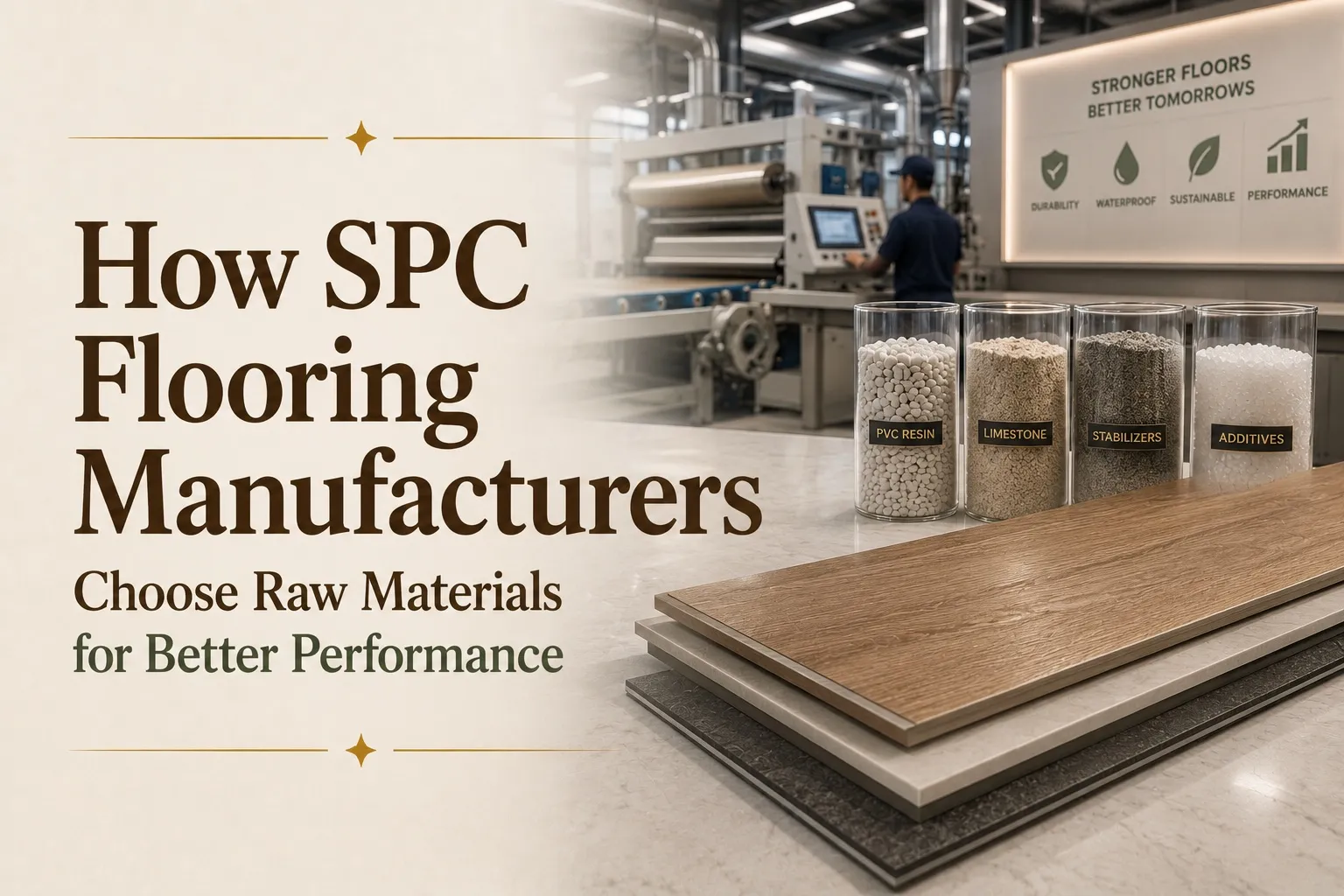
Stone plastic composite flooring gets built from a rigid core made primarily of limestone powder combined with polyvinyl chloride resin, along with stabilizers and plasticizers that give the finished plank its strength and flexibility. Reputable SPC flooring manufacturers control the exact ratio of these raw materials carefully, since even small shifts in composition change how the finished plank performs under heavy commercial traffic.
This rigid core sits beneath a printed design layer and a protective wear layer, which together create the realistic wood or stone appearance that hospitality buyers request most often. Understanding this layered construction matters considerably when evaluating suppliers, since the quality of each layer, not just the surface appearance, determines how the flooring performs once thousands of guests start walking across it every month.
The Core Raw Materials That Determine Long Term Performance
Manufacturers rely on a fairly consistent set of core materials, though the exact ratios and sourcing quality vary considerably between suppliers competing in the same market.
| Material Component | Function in the Finished Plank | Why Quality Matters |
| Limestone powder | Provides rigidity and dimensional stability | Impure or inconsistent limestone weakens the core over time |
| PVC resin | Binds the core together and adds flexibility | Lower grade resin leads to premature cracking under load |
| Stabilizers | Prevent degradation from heat and UV exposure | Poor stabilization causes discoloration and brittleness |
| Plasticizers | Control flexibility without sacrificing rigidity | Excess plasticizer softens the plank and shortens its lifespan |
| Wear layer coating | Resists scratching, staining and foot traffic damage | A thin wear layer wears through quickly in high traffic zones |
I have walked hotel corridors where a budget supplier used a thin wear layer to cut costs and within two years, foot traffic had worn visible paths through the printed design layer near the elevators. That kind of failure rarely shows up in a sample board review, which is exactly why procurement teams need to ask pointed questions about wear layer thickness before signing off on a large order.
How Raw Material Ratios Affect Real World Performance
The ratio between limestone powder and PVC resin directly affects how the finished plank handles impact, temperature changes and moisture exposure across a busy hospitality property. A core with too much limestone and too little resin becomes brittle and prone to cracking under heavy rolling loads, which matters considerably in areas where housekeeping carts or luggage trolleys cross the floor repeatedly throughout the day.
Manufacturers who understand hospitality environments specifically formulate their SPC vinyl flooring to withstand these repeated stress points, rather than relying on a generic residential formulation. This distinction explains why hotel spc vinyl flooring products marketed specifically for commercial use often perform noticeably better in high traffic corridors and lobbies than flooring pulled from a general residential product line.
Manufacturing Process and Quality Control Worth Understanding
Reputable manufacturers extrude the rigid core under carefully controlled temperature and pressure conditions, since inconsistent extrusion creates weak points that surface months after installation. The design layer then gets printed and bonded beneath the wear layer using heat and pressure lamination and any inconsistency during this step causes bubbling or delamination that becomes visible within the first year of heavy use.
Quality manufacturers test finished planks for impact resistance, dimensional stability under temperature swings and wear layer durability before those planks ever reach a hospitality procurement team. Suppliers who skip or shortcut this testing tend to produce flooring that looks acceptable on a sample board yet fails prematurely once installed across an entire hotel floor.
Why Hotels and Senior Living Properties Choose SPC Vinyl Flooring
Hospitality properties gravitate toward SPC flooring because it solves several problems at once that older flooring categories could never fully address. It resists moisture far better than traditional laminate, which matters considerably in bathrooms, entryways and any area exposed to spills or cleaning solutions throughout a busy operating day.
The rigid core also resists denting under furniture legs and rolling luggage, while the realistic surface printing gives properties the appearance of hardwood or natural stone without the maintenance burden either material typically requires. For assisted living and memory care communities specifically, the slip resistant surface options and consistent, even coloring support both safety requirements and a warm, residential appearance that residents and families notice immediately.
Comparing SPC Flooring to Other Commercial Flooring Options
Procurement teams evaluating flooring categories for a renovation often want a direct comparison before committing budget to one material over another.
| Flooring Type | Moisture Resistance | Durability Under Heavy Traffic | Typical Installation Speed |
| SPC vinyl flooring | Excellent, fully waterproof core | Very high, resists denting and cracking | Fast, click lock installation |
| Traditional laminate | Poor, prone to swelling | Moderate, scratches and dents easily | Moderate |
| Solid hardwood | Poor, requires careful moisture control | High, though refinishing is required over time | Slow, labor intensive |
| Standard LVT | Good, though seams can allow moisture in | Moderate to high depending on wear layer | Fast |
This comparison explains why so many hospitality renovation projects have shifted toward SPC flooring over the past several years, particularly in areas with heavy foot traffic and unavoidable moisture exposure.
How to Choose SPC Flooring Suppliers for Hospitality Projects
Selecting the right partner among competing spc flooring suppliers requires more scrutiny than simply comparing price per square foot across a few quotes. Many procurement teams make the mistake of treating this as a commodity purchase, when raw material quality and manufacturing consistency vary enormously between suppliers claiming similar specifications.
Consider confirming each of these points before committing to a hotel spc flooring supplier for a renovation project.
- Request documented wear layer thickness rather than relying on marketing language alone
- Ask for third party testing results covering impact resistance and dimensional stability
- Confirm the supplier has completed hospitality specific projects, not only residential installations
- Verify lead times for bulk orders, since large renovations often need thousands of square feet on a tight schedule
- Ask whether the manufacturer offers batch consistency guarantees across a large multi property order
Working with established hotel spc flooring manufacturers who understand commercial specification requirements tends to prevent the batch inconsistency and premature wear that budget suppliers often produce once a project moves from sample to full scale installation.
ADA, Fire Safety and Commercial Compliance Considerations
Commercial flooring in hospitality and senior living properties must meet specific slip resistance and fire rating requirements that residential flooring products often don't address. ADA guidance also covers transition thresholds between flooring types, which matters considerably when SPC flooring meets carpet or tile at doorways and hallway transitions throughout a property.
Reputable manufacturers publish documented fire ratings and slip resistance coefficients for their commercial product lines, which procurement teams should request and compare directly rather than assuming every SPC product meets the same baseline standard.
Cost Considerations Procurement Teams Should Plan Around
SPC flooring typically costs more than basic laminate but considerably less than solid hardwood, which places it in a practical middle position for most hospitality renovation budgets. Industry reports suggest that bulk hotel renovation orders, where thousands of square feet get purchased together, often receive meaningfully better per unit pricing than smaller, piecemeal purchases made across multiple phases.
It's also worth budgeting for underlayment and transition materials separately, since these often get overlooked during initial cost estimates yet add up considerably across a full property renovation.
Installation Timeline and Renovation Planning
Click lock SPC installation moves considerably faster than traditional hardwood refinishing, which allows hotels to renovate common areas with shorter closures and less disruption to daily operations. Many properties schedule installation in phases, working floor by floor or wing by wing, so guest occupancy and revenue continue largely uninterrupted throughout the renovation timeline.
Maintenance and Cleaning Requirements Worth Communicating Early
SPC flooring requires considerably less maintenance than hardwood, though housekeeping teams should still avoid harsh solvents that can degrade the wear layer over repeated use. A neutral pH cleaner paired with regular dust mopping keeps the surface looking new for years longer than aggressive commercial cleaning products used improperly on a daily basis.
Common Mistakes to Avoid When Sourcing SPC Flooring
Several recurring mistakes tend to cost hospitality properties the most once installation is already complete and guests are actively using the space.
- Choosing a supplier based on price alone without confirming wear layer thickness in writing
- Skipping a physical sample review under actual lighting conditions before committing to a full order
- Assuming every SPC product carries the same fire rating and slip resistance certification
- Underestimating lead times for large, multi property renovation orders
- Allowing housekeeping teams to use cleaning products that void manufacturer warranties over time
Best Practices and Future Trends Shaping the Category
More manufacturers are now offering SPC flooring produced with recycled limestone content and lower emission manufacturing processes, which aligns closely with hospitality sustainability goals without sacrificing durability. Expect a growing number of properties to request documented environmental certifications going forward, as sustainability increasingly becomes part of formal procurement scorecards used during vendor selection.
Final Thoughts on Choosing SPC Flooring Manufacturers
The manufacturers who consistently produce reliable SPC flooring are the ones who treat raw material selection as a performance decision rather than a cost cutting opportunity and that discipline shows up clearly once a property has been in daily operation for a few years. Procurement teams who request documented testing, confirm wear layer thickness and vet a supplier's hospitality specific experience tend to avoid the premature wear and batch inconsistency that plague properties working with budget focused suppliers.
If you're planning a renovation, treat your flooring supplier selection with the same scrutiny you would bring to any other major furniture, fixtures and equipment investment, since the raw material quality behind the product will determine whether it performs quietly for a decade or becomes a maintenance problem within just a few years.





























Sign in to leave a comment.