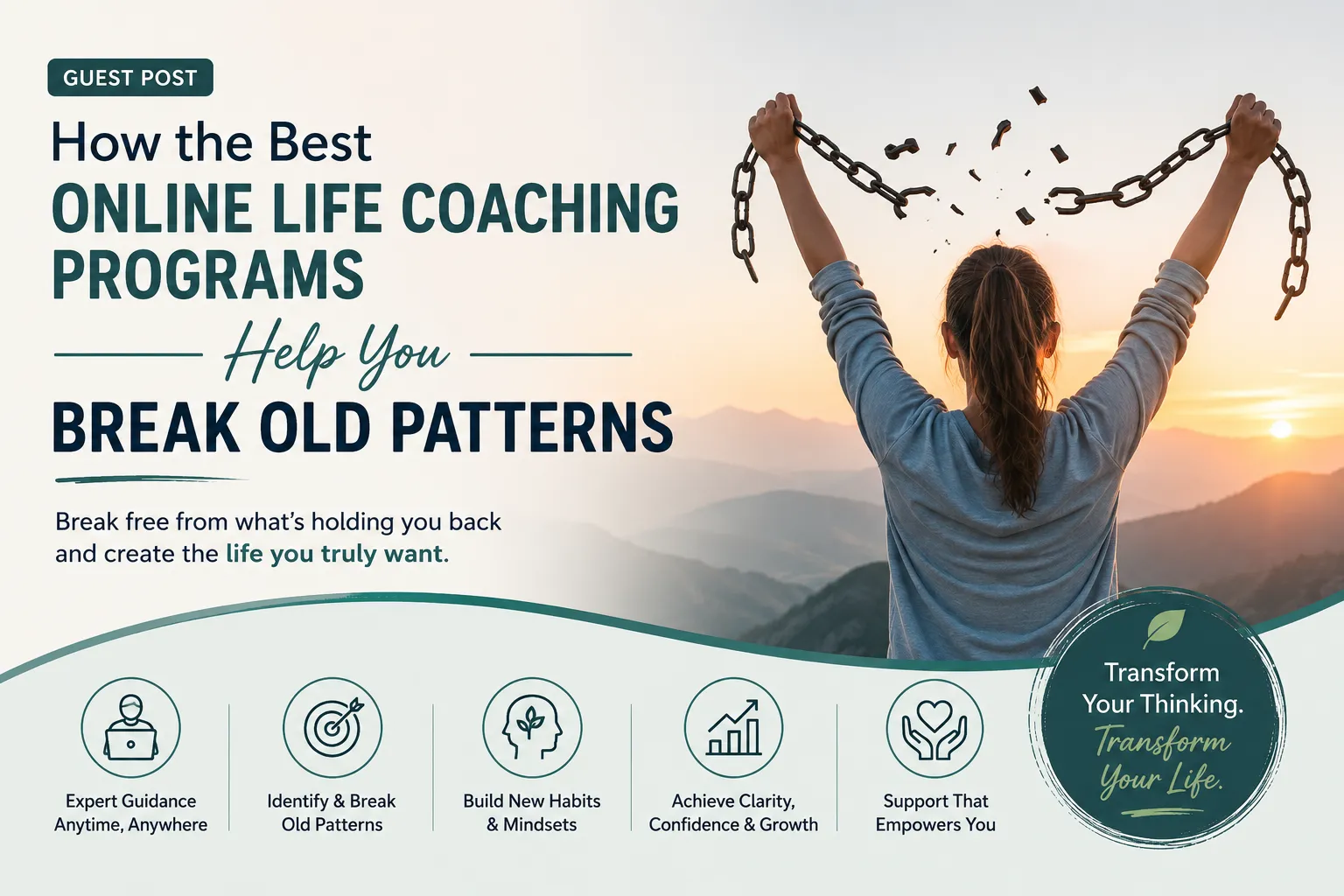

Most people don't wake up one day and decide to change their life. They wake up tired of the same argument, the same procrastination loop, the same 2 a.m. anxiety spiral and they finally admit that willpower alone hasn't fixed it. That's usually the moment someone starts searching for Online Life Coaching Programs.
Old patterns are stubborn because they're not really habits in the surface sense. They're wired-in responses the way you shut down during conflict, the way you self-sabotage right before a win, the way you say "I'm fine" when you're not. Reading about these patterns rarely changes them. Working through them with someone trained to spot what you can't see yourself, consistently, over weeks and months that's what actually shifts them. That's the real value behind the best online life coaching programs, and it's why demand for structured, remote coaching has grown so quickly over the past few years.
Why Old Patterns Are So Hard to Break Alone
Behavioral patterns form for a reason. At some point, avoiding conflict protected you. Overworking earned you approval. Staying quiet kept the peace. The pattern made sense once the problem is it never got updated, so you're still running an old survival strategy in a life that doesn't need it anymore.
Trying to break this alone usually looks like a cycle: motivation spikes, you make a change, life gets stressful, you revert, you feel like a failure, motivation drops. Not because you're weak-willed, but because insight and behavior change are two different skills. You can know you overthink everything and still overthink everything tomorrow morning. This gap between knowing and doing is exactly where coaching earns its value.
What Makes Online Life Coaching Programs Different From Self-Help
Self-help gives you information. Coaching gives you a mirror, a structure, and accountability three things a book can't provide.
A good program built around Online Life Coaching Programs typically includes:
- Regular 1:1 sessions where a coach tracks your patterns across time, not just in a single conversation
- Structured goal-setting that breaks vague intentions ("I want to be less anxious") into specific, trackable actions
- Between-session accountability — check-ins, journaling prompts, or small weekly commitments
- A feedback loop where your coach reflects back behaviors you've normalized and stopped noticing
This last point matters more than people expect. Most patterns survive because they're invisible to the person living them. A coach who sees you consistently over time will notice, for instance, that you always deflect with humor right when a conversation gets emotionally honest something a friend might miss and you'd never catch yourself.
The Mental Health Connection Coaching Programs Often Miss
It's worth being clear about something the industry sometimes blurs: a life coach is not a therapist, and a good program won't pretend to be one. But that doesn't mean mental health is irrelevant to coaching it's often central to it.
Many people who seek out a mental health wellness coach aren't in crisis. They're functioning, holding down jobs and relationships, but they're stuck anxious, burned out, disconnected from what they actually want. A mental health wellness coach works alongside that reality, focusing on present-day patterns, coping strategies, and forward movement, while knowing when to refer someone to clinical support if deeper issues surface. The best online programs are upfront about this boundary, and it's one of the clearest signs you're looking at a credible provider rather than someone overselling their scope.
Why Whole-Person Coaching Outperforms Single-Issue Fixes
One of the biggest shifts in the coaching industry has been away from narrow, single-topic coaching and toward integrated models. It's a mistake to treat your mindset, your body, and your habits as separate problems, because they rarely are. Someone caught in a pattern of emotional eating isn't just dealing with food they're often dealing with stress regulation, self-worth, and routine. This is where a Nutrition Life Coach adds a dimension that pure "mindset" coaching misses entirely.
A Nutrition Life Coach doesn't just hand out meal plans. Done well, this kind of coaching looks at how your relationship with food reflects and reinforces deeper patterns: using food to numb stress, restricting as a form of control, or skipping meals as a byproduct of chronic overwork. Pairing nutrition coaching with emotional and behavioral coaching tends to produce more durable change than either approach alone, because the pattern gets addressed on more than one level at once.
What to Look For in the Best Online Life Coaching Programs
Not all programs are built with the same rigor. Before committing, it helps to check for:
- Qualified, experienced coaches — certifications matter, but so does real-world client experience
- A structured framework, not just open-ended chats you should know roughly what the first 8–12 weeks look like
- Clear boundaries around mental health support — a program that's honest about when to refer out is more trustworthy than one that claims to fix everything
- Integrated services where relevant — access to a Nutrition Life Coach, stress management support, or wellness resources alongside core coaching
- Flexibility — since it's online, sessions should genuinely fit around your schedule, not just claim to
Pro tip: Ask any program directly how they measure progress. Vague answers are a warning sign. A strong coaching relationship should produce visible, trackable shifts in your habits, your self-talk, or your relationships within the first couple of months.
Common Mistakes People Make When Starting Coaching
- Expecting instant results. Patterns that took years to form don't dissolve in three sessions.
- Choosing a coach based on price alone. Fit and expertise matter more than finding the cheapest option.
- Skipping the goal-setting phase. Coaching without a clear direction tends to drift into venting sessions rather than real change.
- Ignoring the physical side of wellbeing. Sleep, movement, and nutrition all influence emotional patterns — a coach who ignores this is only working with half the picture.
Did You Know?
Research on habit formation consistently shows that behavior change sticks far better with external accountability than with self-monitoring alone one of the core reasons structured coaching outperforms solo effort, even when the person already knows exactly what they "should" be doing.
Final Thoughts
Breaking an old pattern isn't about trying harder. It's about seeing clearly, having support that holds you accountable when motivation dips, and addressing the pattern from more than one angle mental, emotional, and physical. That's the real strength of well-designed Online Life Coaching Programs: they don't just tell you what to change, they walk with you while you actually change it.
If you're ready to work with a team that combines mental health informed coaching with practical, whole-person support including nutrition and emotional wellbeing you can learn more at physicalwellbeing.co.uk.




























Sign in to leave a comment.