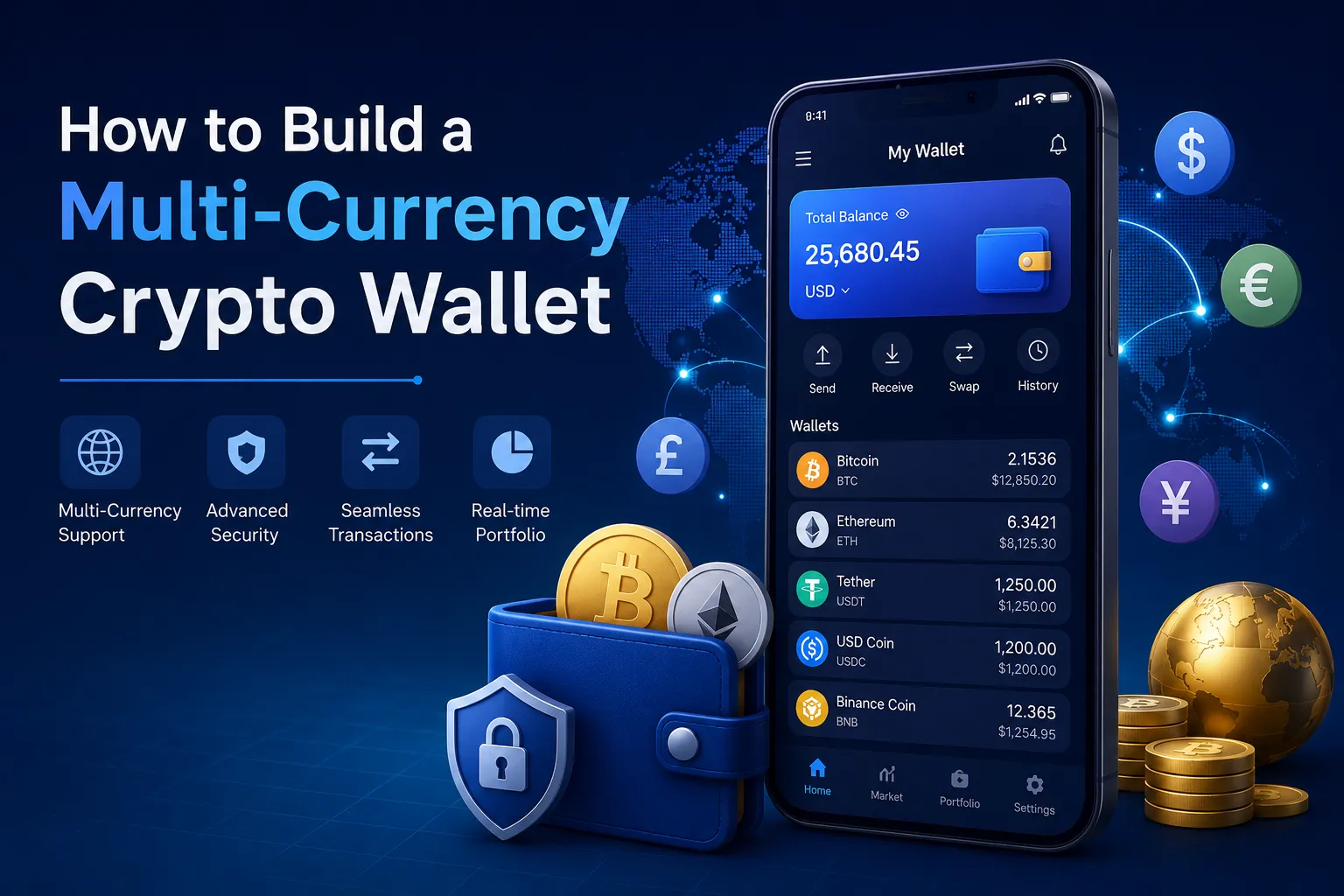

Crypto users today rarely hold just one digital currency. Someone may have Bitcoin for long-term investment, Ethereum for DeFi, stablecoins for payments, and other tokens for trading or daily use. Managing all these assets through different wallets can be confusing and time-consuming.
This is why multi-currency crypto wallets have become popular. They allow users to store, send, receive, and manage different cryptocurrencies from one application.
For businesses, building this type of wallet can open new opportunities in digital payments, trading, and financial services. However, a successful wallet needs more than a simple interface. Security, blockchain integration, transaction handling, and a smooth user experience all need careful planning.
This guide explains how to build a multi-currency crypto wallet, what features it should have, the technology involved, and the main development steps.
What is a Multi-Currency Crypto Wallet?
A multi-currency crypto wallet is a digital wallet that allows users to manage several cryptocurrencies from one place.
Instead of creating separate wallets for Bitcoin, Ethereum, USDT, or other assets, users can access them through a single application. Depending on the wallet type, users may also be able to swap assets, connect with decentralized applications, track prices, and make crypto payments.
A multi-currency wallet can be available as:
- Mobile applications
- Web wallets
- Desktop wallets
- Browser extensions
- Hardware wallets
The right option depends on the target users and business model.
Why Build a Multi-Currency Crypto Wallet?
The main benefit is convenience. Users do not have to move between different platforms to manage their digital assets.
A well-built wallet can also help businesses:
- Reach users who hold multiple cryptocurrencies
- Support crypto payments
- Add token swapping services
- Generate revenue through transaction fees
- Offer access to DeFi services
- Build a broader digital finance product
Multi-currency wallets can also become part of larger financial platforms. For example, businesses working on fintech app development can add crypto wallet functionality to support digital asset payments and transfers.
Key Features of a Multi-Currency Crypto Wallet
Before starting development, decide which features your wallet will offer. A basic wallet can start with core functions and add advanced features later.
1. Multi-Currency Support
This is the most important feature. The wallet should support the cryptocurrencies that your target audience actually uses.
Bitcoin, Ethereum, USDT, USDC, and other popular tokens can be included based on market demand. Supporting multiple blockchain networks may require separate integrations because different networks use different technologies.
2. Send and Receive Crypto
Users should be able to send and receive assets without unnecessary steps.
The wallet should clearly show:
- Wallet address
- Network
- Amount
- Transaction fee
- Transaction status
A QR code can also make receiving payments faster.
3. Secure Login
Security should be considered from the beginning rather than added later.
Common security options include:
- PIN protection
- Biometric authentication
- Two-factor authentication
- Seed phrase backup
- Device verification
- Session management
For non-custodial wallets, users should remain in control of their private keys.
4. Transaction History
Users need a clear record of their wallet activity. The transaction section should show deposits, withdrawals, transfers, fees, and transaction status.
Providing blockchain transaction IDs can also help users verify transactions on the relevant network explorer.
5. Real-Time Asset Prices
Showing current crypto prices and portfolio values makes the wallet more useful.
Users can see how much their complete portfolio is worth without checking another application.
6. Token Swap
A built-in swap feature can allow users to exchange one supported asset for another.
This can be connected to decentralized exchanges or liquidity providers. Before adding this feature, businesses need to consider network fees, liquidity, slippage, and regulatory requirements.
7. Push Notifications
Notifications can keep users informed about important wallet activity.
For example:
- Payment received
- Transaction completed
- Transaction failed
- Security alert
- Login from a new device
These alerts can improve both security and user experience.
How to Build a Multi-Currency Crypto Wallet
Building a wallet becomes easier when the development process is divided into clear stages.
Step 1: Define Your Wallet Type
First, decide whether you want to build a custodial or non-custodial wallet.
In a custodial wallet, the platform manages users' private keys. In a non-custodial wallet, users control their own private keys and recovery phrases.
This decision affects the architecture, security model, compliance requirements, and user experience.
Step 2: Choose the Supported Blockchains
Next, decide which blockchain networks you want to support.
For example, you may start with Bitcoin and Ethereum and later add networks such as BNB Chain, Polygon, Solana, or others.
Do not add networks simply to increase the feature list. Choose networks based on your users, supported assets, transaction costs, and business goals.
Step 3: Design the Wallet Interface
The interface should make crypto management easy, even for beginners.
The home screen can show the total portfolio value, supported assets, recent transactions, and quick actions such as Send, Receive, and Swap.
Keep the navigation simple. Users should not need technical blockchain knowledge to perform basic transactions.
Step 4: Develop the Wallet Core
This is where the main wallet functions are built.
The development team works on wallet creation, key management, address generation, transaction signing, balance tracking, and blockchain communication.
For a non-custodial wallet, private keys should be protected carefully and should never be exposed unnecessarily.
Step 5: Integrate Blockchain Networks
Each blockchain needs proper integration for reading balances and sending transactions.
Depending on the network, developers may use blockchain nodes, RPC providers, APIs, or SDKs.
The wallet should also handle network fees and transaction confirmations correctly.
Step 6: Add Security Measures
Security testing should happen throughout development.
A reliable wallet should protect sensitive information using encryption and secure storage. Developers should also test authentication, private-key handling, API security, transaction signing, and session management.
A security audit before launch can help identify weaknesses that may not be visible during normal testing.
Step 7: Test the Wallet
Test the application across different devices, networks, and transaction situations.
Important tests include:
- Sending and receiving crypto
- Incorrect wallet addresses
- Failed transactions
- Network congestion
- Low gas balance
- Backup and recovery
- Login security
- Transaction history
- App performance
It is better to identify these problems before real users start storing funds in the wallet.
Technology Stack for a Multi-Currency Wallet
The technology stack depends on the wallet type and supported blockchains.
A typical stack may include:
| Area | Possible Technology |
|---|---|
| Mobile App | Flutter, React Native, Swift, Kotlin |
| Backend | Node.js, Python, Java |
| Database | PostgreSQL, MongoDB |
| Blockchain | Bitcoin, Ethereum, Solana, BNB Chain |
| APIs | Blockchain RPCs and third-party APIs |
| Security | Encryption, biometrics, 2FA |
| Cloud | AWS, Google Cloud, Azure |
The final technology choices should be based on performance, security, scalability, and development requirements.
How Much Does It Cost to Build a Multi-Currency Crypto Wallet?
The cost depends on the wallet's features and technical complexity.
A basic wallet with a few supported cryptocurrencies will cost less than a full platform with token swaps, staking, DeFi connections, payment features, advanced security, and multiple blockchain networks.
The main cost factors include:
- Number of supported blockchains
- Wallet type
- Mobile or web platforms
- UI/UX design
- Security requirements
- Third-party integrations
- Admin panel
- Testing and auditing
- Post-launch maintenance
A simple MVP can be launched first and expanded as the user base grows.
Common Challenges to Consider
Crypto wallet development comes with several challenges.
Security: A wallet handles valuable digital assets, so even a small security weakness can create serious problems.
Blockchain differences: Every network has its own technical rules, transaction models, and fee structures.
Regulatory requirements: Depending on the country and wallet model, businesses may need to address KYC, AML, licensing, data protection, and other requirements.
User education: Crypto transactions can be confusing for beginners. The application should explain important actions clearly and warn users before irreversible transactions.
Final Thoughts
A multi-currency crypto wallet can become a valuable product for businesses entering the digital asset market. But the goal should not be to support as many coins as possible. The focus should be on security, useful features, reliable blockchain connections, and an easy user experience.
Businesses can work with a reliable crypto wallet development company to handle the technical side, from blockchain integration and wallet architecture to security testing and deployment.
Nimble AppGenie can help businesses plan and develop crypto wallet solutions based on their target market and required features. Starting with a focused MVP and adding advanced capabilities over time can make the development process more manageable.
The right approach is to first understand your users, select the required blockchain networks, build the core wallet functions, and then add features such as swaps, payments, and DeFi integrations. With proper planning and strong security, a multi-currency wallet can grow into a broader digital finance product.
Nimble AppGenie also works on financial technology solutions where crypto capabilities can be combined with wider digital payment and financial services.


























Sign in to leave a comment.