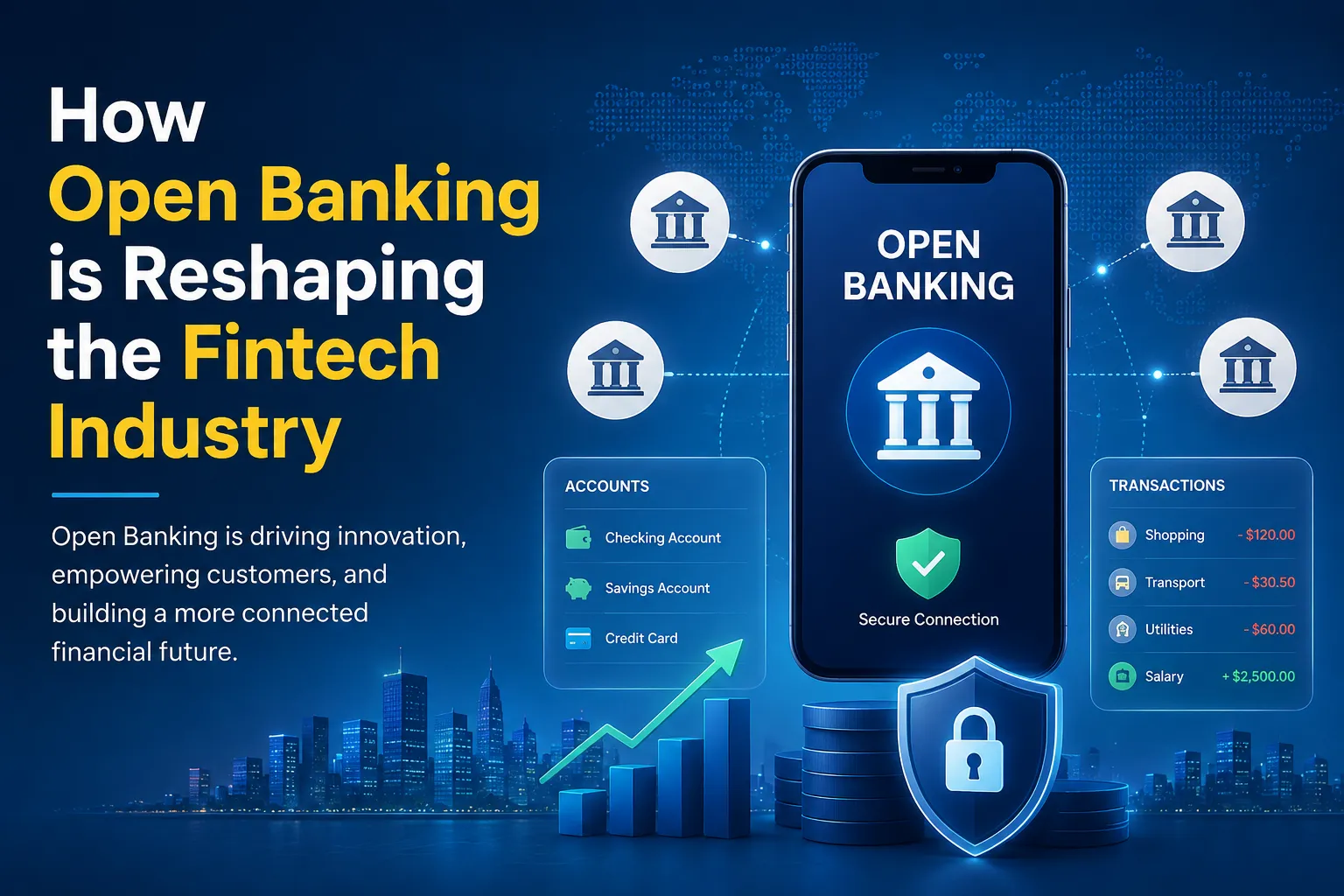

The way people manage money is changing quickly. Customers no longer want to visit a bank branch for every small financial task. They expect to check their accounts, make payments, compare financial products, and manage their money from their phones.
This shift has created a strong need for better digital financial services. One technology playing an important role in this change is open banking.
Open banking allows banks to securely share customer financial data with approved third-party companies, usually with the customer's permission. This gives fintech companies access to useful financial information and helps them create more convenient and personalized services.
As more banks and financial businesses adopt open banking, it is changing how financial products are built, delivered, and used.
What is Open Banking?
Open banking is a system that allows customers to give authorized third-party financial services access to their banking information through secure APIs.
For example, imagine that a customer has accounts with three different banks. Instead of checking each banking app separately, an open banking-powered app can bring important financial information into one place, with the customer's permission.
This can include:
- Account information
- Transaction history
- Account balances
- Payment information
- Income details
- Spending patterns
The customer remains in control of the information and decides which service can access it.
The main idea behind open banking is simple: customers should have more control over their financial data and how it is used.
How Open Banking is Changing Fintech
Open banking has created new opportunities for fintech businesses. Companies can now build services around real financial data instead of depending only on information entered manually by customers.
Here are some of the biggest ways it is changing the fintech industry.
1. Better Personal Financial Management
Managing money becomes easier when customers can see their financial information in one place.
Fintech apps can connect different bank accounts and provide users with a clearer view of their income, expenses, savings, and spending habits.
For example, an app can automatically categorize transactions and show how much a person spends on food, shopping, transport, bills, or entertainment.
This helps users understand where their money is going without having to calculate everything themselves.
2. More Personalized Financial Services
Every customer has different financial needs. Open banking gives fintech companies access to data that can help them understand those needs better.
For example, a financial app may look at a customer's income and spending history to provide more relevant budgeting suggestions.
Lenders can also use financial information, where legally permitted, to better understand a customer's financial situation.
This can lead to financial products that are more closely matched to individual users.
3. Faster and Easier Payments
Open banking is also changing the payment experience.
Instead of depending entirely on traditional card payment methods, businesses can use open banking-based payment solutions that allow customers to make payments directly from their bank accounts.
This can reduce unnecessary steps during checkout and create a smoother payment experience.
For businesses, direct account-to-account payments can also provide another way to manage transactions and reduce dependence on certain traditional payment methods.
4. New Opportunities for Fintech Companies
Open banking has lowered some of the barriers for businesses that want to build new financial products.
A fintech app development company can use open banking APIs to create applications for budgeting, lending, payments, wealth management, financial planning, and other use cases.
Instead of building every banking-related function from scratch, developers can connect their applications with existing financial institutions through APIs.
This allows businesses to focus more on the customer experience and the specific problem they want to solve.
Open Banking and Financial Inclusion
Another important benefit of open banking is its potential to make financial services more accessible.
Traditional financial services can sometimes be difficult to access for people who do not have a strong credit history or enough financial knowledge.
With access to authorized financial data, fintech platforms can develop alternative ways to understand a customer's financial situation.
For example, a financial service may consider regular income and transaction behavior when assessing an application instead of relying only on traditional information.
However, these systems must be designed carefully. Financial data is highly sensitive, so businesses need to follow applicable regulations and use responsible data practices.
The Role of APIs in Open Banking
APIs are one of the main technologies behind open banking.
An API allows two different systems to communicate with each other. In open banking, APIs can help banks securely provide approved financial information or payment functionality to third-party applications.
For example, a fintech app could use an API to connect with a customer's bank account after the customer gives permission.
This makes it possible to create services that would be much harder to build without direct digital connections between financial platforms.
A fintech app development company can use these APIs to connect banking services with features such as account aggregation, payments, financial tracking, lending, and money management.
Security and Privacy Are Still Major Concerns
While open banking offers many benefits, it also creates serious responsibilities.
Financial information cannot be treated like ordinary user data. Businesses must protect it from unauthorized access, fraud, and misuse.
Strong security measures may include:
- Secure API connections
- Data encryption
- Multi-factor authentication
- Access controls
- Regular security testing
- Fraud detection
- Consent management
- Secure data storage
Customer permission is also extremely important. Users should clearly understand what information they are sharing, why it is needed, and which company will use it.
Building trust is just as important as building new features.
How Businesses Can Benefit From Open Banking
Businesses can use open banking to create financial products that are faster, more connected, and easier to use.
For example, a company could build a money management app that connects multiple bank accounts. Another business could create a lending platform that uses permitted financial information to simplify the application process.
Payment companies can also use open banking to offer new payment options.
For businesses entering this space, working with an experienced fintech app development company can help with API integration, application design, security, compliance requirements, and overall product development.
The right technical approach can make it easier to connect different financial systems while keeping the user experience simple.
How Nimble AppGenie Can Help?
Building an open banking product requires more than just connecting an API. The application needs a strong technical foundation, a simple user experience, secure data handling, and reliable integration with financial systems.
Nimble AppGenie works on fintech application development and can help businesses turn financial technology ideas into working digital products.
From planning the application to developing core features and integrating financial technologies, the development process should be based on the business model and the needs of the target customers.
What is the Future of Open Banking?
Open banking is likely to become an even bigger part of the fintech ecosystem as customers become more comfortable managing their finances digitally.
We can expect to see more connected financial applications, smarter payment experiences, personalized financial tools, and services built around customer-controlled financial data.
The next stage may also involve more advanced data analysis and automation. However, the focus should remain on giving customers useful services while keeping their information secure.
As financial institutions and fintech companies work more closely together, the line between traditional banking and digital financial services will continue to become less clear.
Final Thoughts
Open banking is changing fintech by making financial data more accessible, connected, and useful. It gives customers more control over their information and gives businesses new ways to build financial products.
From personal finance apps and digital payments to lending and financial management, open banking is opening the door to many new possibilities.
For fintech businesses, the opportunity is significant, but security, privacy, customer consent, and regulatory requirements cannot be ignored.
Companies such as Nimble AppGenie can help businesses build fintech solutions that make use of modern financial technologies while keeping the customer experience simple.
As open banking continues to grow, it will not simply change how people use financial services. It will also influence how the next generation of fintech products is created.





























Sign in to leave a comment.