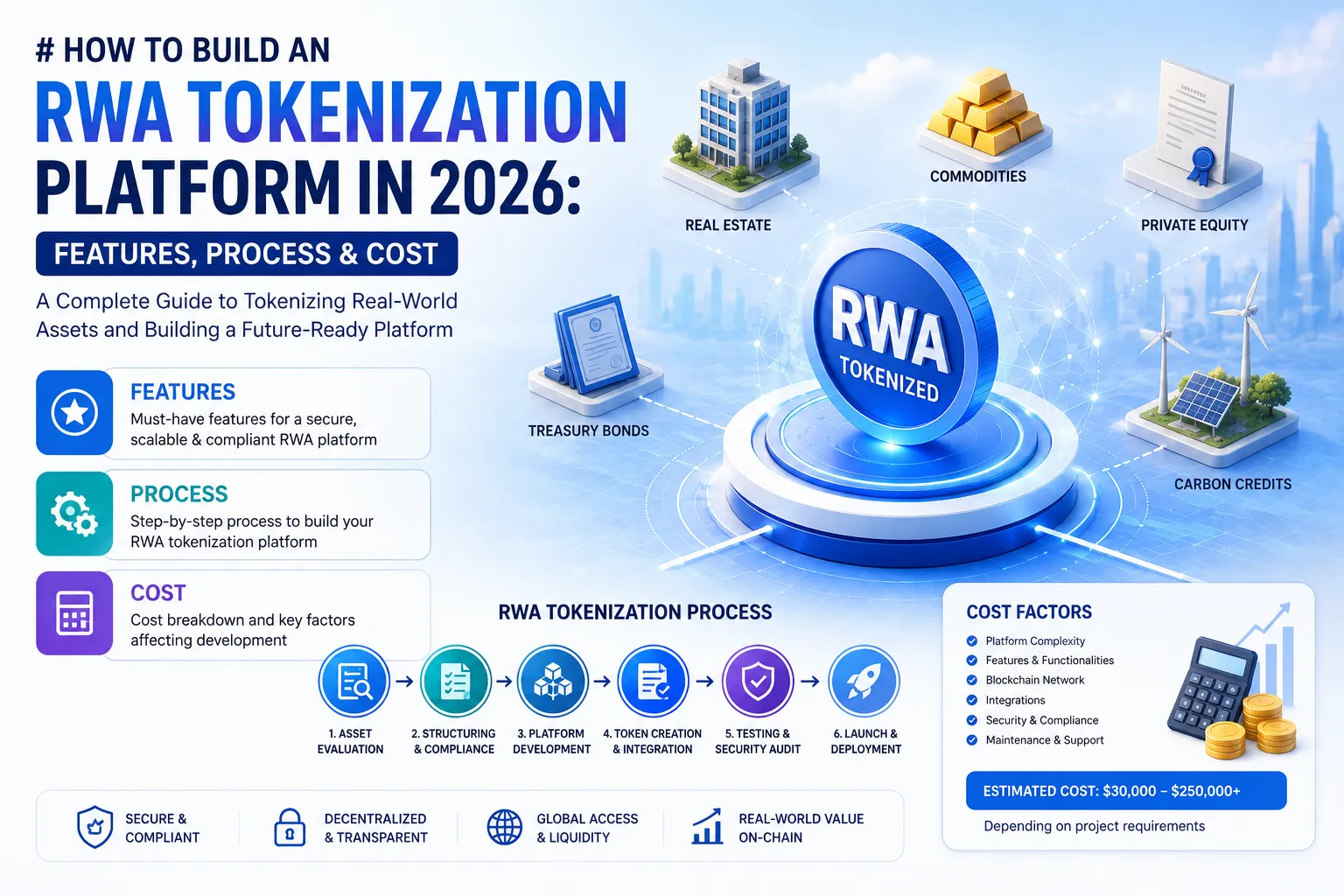
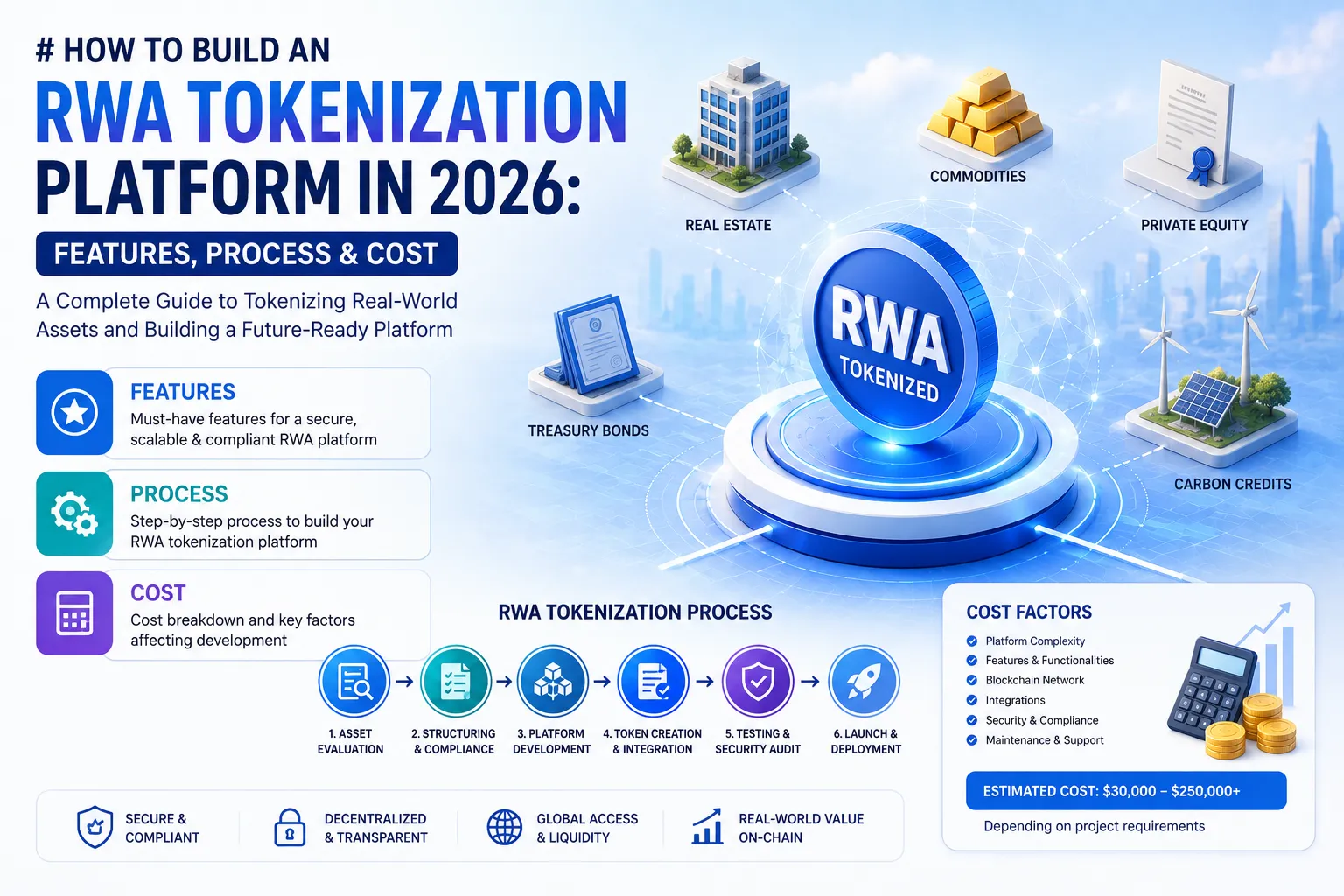
Real-world asset tokenization is changing the way businesses think about ownership, investment, and asset management. Real estate, private equity, commodities, funds, debt instruments, and other traditional assets can now be represented digitally on blockchain networks.
But creating an RWA token is only one part of the process.
Businesses planning to enter this market need a complete RWA tokenization platform that can handle asset onboarding, token issuance, investor verification, compliance, wallets, transactions, and ongoing asset management.
So, how do you actually build one?
This guide explains the major features, development stages, technology choices, and cost factors involved in building an RWA tokenization platform in 2026.
What Is an RWA Tokenization Platform?
An RWA tokenization platform development is a blockchain-based application that allows businesses to convert ownership or economic rights associated with real-world assets into digital tokens.
For example, a company could structure a commercial property investment and issue digital tokens representing eligible ownership or economic interests in that asset.
The platform then manages the digital side of the process, including token issuance, investor onboarding, transfers, compliance, and reporting.
The exact legal meaning of a token depends on the asset, jurisdiction, and underlying legal structure. Tokenization technology itself does not automatically create legal ownership of an asset.
Why Are Businesses Building RWA Tokenization Platforms?
There are several reasons businesses are exploring this model.
Fractionalization
Some assets require significant capital to access. Tokenization can allow an eligible asset or interest to be divided into smaller units, subject to the applicable legal structure.
Faster Settlement
Blockchain infrastructure can automate parts of asset transfers and settlement, potentially reducing manual processes.
Greater Transparency
Blockchain transactions provide a persistent record of token movements, which can make transaction histories easier to audit.
Programmable Assets
Smart contracts can automate rules for transfers, distributions, permissions, and other business processes.
Digital Asset Management
Instead of managing tokenized assets through disconnected systems, businesses can provide issuers and investors with a unified digital platform.
What Assets Can Be Tokenized?
RWA tokenization isn't limited to real estate.
Depending on the legal and regulatory framework, businesses can explore tokenization across several categories.
Real Estate
Commercial buildings, residential properties, rental portfolios, and other real-estate interests are frequently discussed as RWA use cases.
Commodities
Gold and other commodities can potentially be represented through digital tokens when appropriate custody and legal structures are established.
Private Credit
Loans, receivables, and other credit-related instruments can be represented using tokenized structures.
Investment Funds
Fund interests can be represented digitally, potentially simplifying parts of the subscription and ownership process.
Carbon Credits
Carbon credits can be brought onto blockchain infrastructure to improve digital tracking and transferability.
Securities
Stocks, bonds, and other financial instruments can potentially be tokenized within applicable securities regulations.
Essential Features of an RWA Tokenization Platform
A successful platform needs more than a token generator.
1. Asset Onboarding
The issuer should be able to add an asset and provide relevant information such as:
- Asset description
- Valuation
- Ownership details
- Supporting documentation
- Asset location
- Legal structure
- Token allocation
This information forms the foundation of the tokenization process.
2. Token Issuance
The platform should support the creation and management of tokens based on the project's requirements.
The appropriate token standard depends on the asset and compliance model. Common blockchain token standards include ERC-20, ERC-721, ERC-1155, and compliance-oriented standards such as ERC-3643.
3. KYC and AML
If the platform involves regulated investments, investor verification becomes a critical component.
Users may need to provide identity information and pass appropriate KYC/AML checks before purchasing or receiving tokens.
4. Investor Dashboard
Investors need a simple interface where they can view:
- Token holdings
- Asset details
- Transaction history
- Investment information
- Distributions
- Verification status
A complicated interface can become a barrier to adoption, even when the underlying blockchain infrastructure is strong.
5. Smart Contract Management
Smart contracts can automate token issuance, transfers, permissions, distributions, and other platform functions.
Because smart contracts control valuable digital assets, security testing and auditing should be treated as essential rather than optional.
6. Wallet Integration
Users need secure wallets for holding and transferring their tokenized assets.
The platform can support custodial or non-custodial models depending on the business and regulatory requirements.
7. Compliance Management
Compliance functionality can include:
- Investor eligibility
- Transfer restrictions
- Jurisdiction rules
- Holding limits
- Whitelisting
- Identity verification
- Transaction monitoring
The exact controls depend on the project's legal structure.
8. Asset Verification
Investors need confidence that the digital representation is connected to a genuine underlying asset.
Depending on the asset class, the platform may integrate documentation systems, third-party verification, custodians, valuation providers, or oracle infrastructure.
9. Marketplace
Some businesses may want to provide a marketplace where eligible users can buy, sell, or transfer tokenized assets.
Secondary-market functionality must be designed around the applicable regulations and asset structure.
10. Analytics and Reporting
Administrators may need dashboards showing:
- Total assets
- Token supply
- Investor numbers
- Transactions
- Asset performance
- Distributions
- Compliance information
How to Build an RWA Tokenization Platform
The development process normally begins with the business model rather than the blockchain.
Step 1: Define the Business Model
First, determine what asset you want to tokenize and what the token represents.
Ask questions such as:
- What asset is being tokenized?
- Who owns the underlying asset?
- What rights does the token provide?
- Who can purchase it?
- How will investors receive returns?
- Will there be secondary trading?
These decisions influence almost every later stage.
Step 2: Establish the Legal and Compliance Structure
This is one of the most important stages.
The business should work with qualified legal and compliance professionals to determine the applicable regulatory framework.
The technology should then be designed to support those requirements.
Step 3: Choose the Blockchain
The blockchain should be selected based on factors such as:
- Transaction costs
- Scalability
- Security
- Ecosystem
- Smart-contract capabilities
- Institutional support
- Interoperability
There isn't one blockchain that is automatically best for every RWA project.
Step 4: Select the Token Standard
The token standard should match the asset and business model.
For example, a simple fungible structure may have different requirements from a regulated security token with transfer restrictions.
Step 5: Design the Platform
At this stage, the development team creates the platform architecture.
This usually includes:
Frontend → Backend → Smart Contracts → Blockchain → Database → Compliance → External Integrations
The architecture should be designed to keep sensitive off-chain information separate from public blockchain data where appropriate.
Step 6: Develop Smart Contracts
Smart contracts are created for the required token and business functions.
Typical functions can include:
- Minting
- Burning
- Transfers
- Whitelisting
- Permission management
- Distribution logic
- Supply management
Step 7: Integrate KYC/AML
The platform can connect with appropriate identity verification and compliance providers.
Only verified and eligible users should be allowed to perform restricted activities when required by the project's legal structure.
Step 8: Build the Investor and Admin Interfaces
The next stage involves building the actual user experience.
There may be separate interfaces for:
- Investors
- Asset issuers
- Administrators
- Compliance teams
- Asset managers
Step 9: Test and Audit
Before launch, the platform should undergo:
- Functional testing
- Smart-contract testing
- Security testing
- API testing
- Performance testing
- User acceptance testing
Smart contracts should also undergo appropriate independent security review or auditing.
Step 10: Launch and Maintain
After deployment, the platform requires ongoing monitoring and maintenance.
This can include security updates, blockchain upgrades, new integrations, compliance changes, and performance improvements.
Technology Stack for RWA Tokenization
The exact technology stack depends on the platform requirements.
A typical architecture may include:
| Layer | Possible Technologies |
| Frontend | React, Next.js |
| Backend | Node.js, Python, Java |
| Blockchain | Ethereum, Polygon, Arbitrum, other suitable networks |
| Smart Contracts | Solidity |
| Database | PostgreSQL, MongoDB |
| Wallet | MetaMask, WalletConnect, institutional custody solutions |
| Identity | KYC/AML provider APIs |
| Storage | IPFS or secure cloud infrastructure |
| Oracles | Chainlink or suitable oracle infrastructure |
| Cloud | AWS, Azure, Google Cloud |
These are examples rather than mandatory choices. The right stack should be selected after evaluating the asset, regulatory requirements, expected transaction volume, and business model.
How Much Does It Cost to Build an RWA Tokenization Platform?
There is no fixed price for RWA tokenization platform development.
A small proof-of-concept may require a relatively limited feature set, while an institutional-grade platform can require considerably more development and integration work.
The major cost factors include:
- Platform complexity
- Number of asset classes
- Blockchain network
- Smart-contract complexity
- KYC/AML integration
- Custody integration
- Wallet functionality
- Marketplace development
- Compliance requirements
- Oracle integration
- Security auditing
- UI/UX design
- Multi-chain support
- Third-party integrations
The best way to estimate the cost is to define the platform requirements first and then prepare a detailed development scope.
Challenges in RWA Tokenization Development
RWA tokenization development company has significant potential, but it also comes with challenges.
Regulatory Complexity
Different asset classes and jurisdictions can have very different regulatory requirements.
Connecting Digital Tokens With Physical Assets
The platform needs a reliable process for establishing the relationship between the on-chain token and the underlying asset.
Liquidity
Creating a token doesn't automatically create a liquid market. Businesses need appropriate distribution and trading strategies.
Security
Tokenization platforms manage valuable assets, making smart-contract and infrastructure security extremely important.
Investor Trust
Users need confidence that the underlying asset exists, is properly managed, and is represented accurately by the digital token.
Interoperability
As multiple blockchain networks and tokenization platforms develop, interoperability can become increasingly important.
RWA Tokenization Platform Development: What's Next?
The future of RWA tokenization is likely to involve more than simply putting traditional assets on a blockchain.
Platforms will increasingly need to connect assets, investors, compliance systems, custodians, financial institutions, and blockchain networks within a single ecosystem.
We can also expect greater attention toward programmable compliance, institutional custody, cross-chain interoperability, automated settlement, and better investor experiences.
For businesses, the opportunity isn't simply to create a token. The bigger opportunity is to build infrastructure that makes tokenized assets practical and usable.
Final Thoughts
Building an RWA tokenization platform requires a combination of blockchain expertise, financial understanding, compliance planning, and strong product development.
From asset onboarding and token issuance to KYC, smart contracts, investor management, and secondary-market functionality, every component needs to work together.
If you're planning to launch your own RWA platform, starting with a clear asset model and compliance structure can save significant time and development costs later.
Clarisco Solutions provides customized RWA tokenization platform development services for businesses exploring real-world asset tokenization.























Sign in to leave a comment.